Last updated on August 10th, 2026 at 05:00 pm
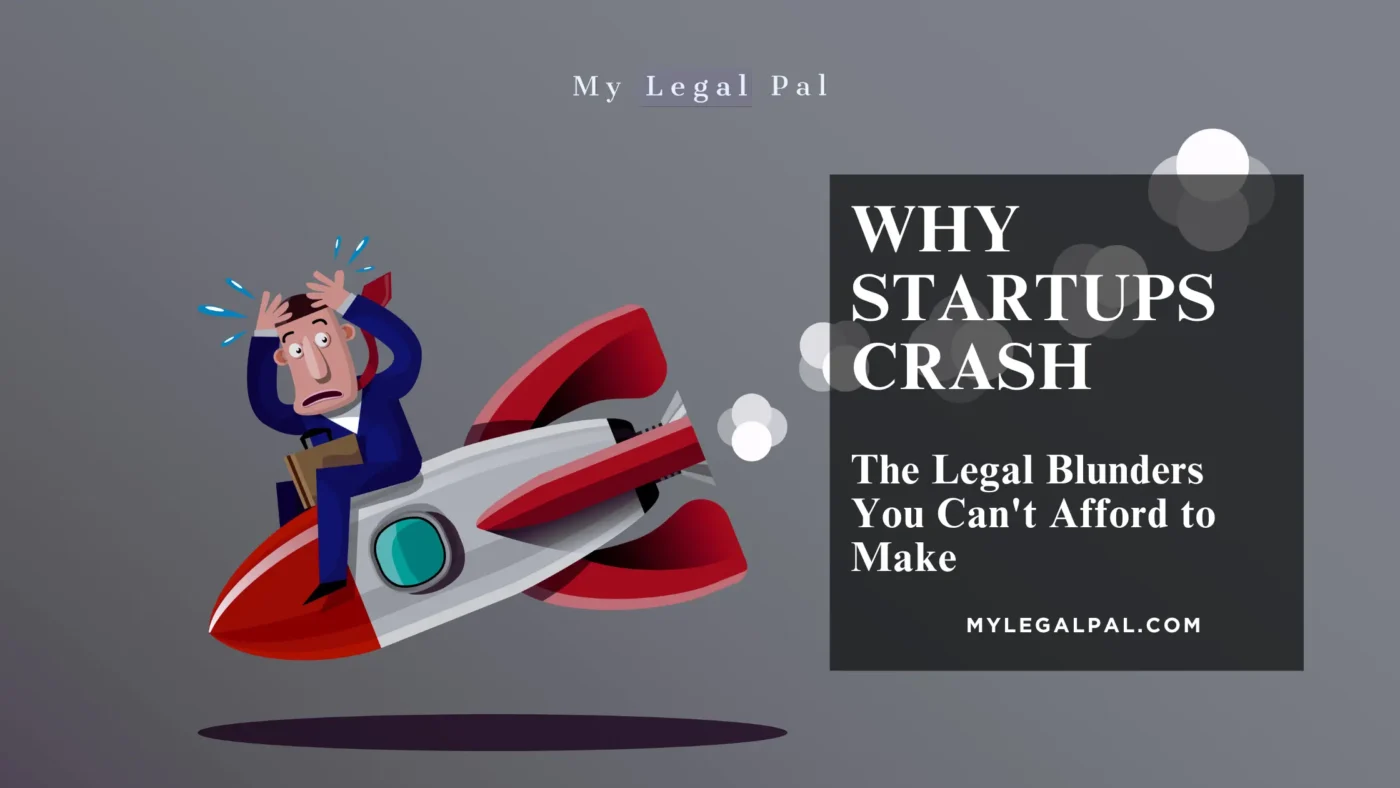
Starting a business is exhilarating: the rush of validation, the energy of a dedicated team, the potential for real disruption. But most startups don’t make it, and the commonly cited culprits, funding dry-ups, market fit failure, founder burnout, aren’t the whole story. There is a quieter killer running underneath many premature shutdowns: legal mistakes made early and discovered late.
For an ambitious founder, legal groundwork often feels like a hurdle to postpone until “after launch.” That mindset is itself one of the biggest risks a young company carries. Skipping the unglamorous work, the contracts, the fine print, the paperwork, doesn’t save time; it loads a delayed-action problem that tends to go off at the worst possible moment: during a fundraising round, in the middle of an acquisition, or the day a dispute lands on your desk.
Quick overview: This guide covers the six legal blunders that most reliably damage or kill promising startups, and for each one, a full, dedicated guide on our site goes deeper than this overview can. Use this page as the map; use the linked guides to actually fix each risk.
1. The “friendship deal” that wasn’t: poorly defined founder agreements
Every startup begins with a shared vision, and when you start with a close friend or trusted colleague, formal paperwork can feel almost insulting to bring up. This is exactly the moment most startups sign their own death warrant.
The problem. Without a clear, legally binding founders’ agreement, often structured as a shareholders’ agreement, you are building on sand. Founders frequently grant themselves a 50/50 split on day one with no vesting attached; if one leaves after six months, they walk away with half the company while the remaining founder is left demotivated, diluted, and stuck with a co-owner contributing nothing. Beyond equity, an agreement silent on decision-making creates deadlock the moment founders disagree on something consequential, undefined roles breed resentment as the company scales, and IP created by founders before or during the company’s life needs to be explicitly assigned to the company, not assumed.
Your safeguard. A founders’ agreement, engaged before incorporation and before major work begins, needs standard vesting (four years, one-year cliff), a clear IP assignment clause, defined exit and buy-sell provisions for when a founder leaves, quits, or is removed, and a mandated dispute resolution process rather than leaving deadlock to fester. Our guides on what every co-founder must legally settle, why every startup needs a comprehensive founders’ agreement, and what should be included in a founder agreement cover this in full, and if a founder is already on their way out, our guide on what happens to equity when a co-founder leaves covers that process directly. Our founders’ agreement drafting service can build this before you need it.
2. “Whoops, is that my idea?”: intellectual property neglect
Your product, your brand, your algorithm are the intangible assets that actually carry your startup’s value. Failing to legally protect them invites competitors to take your edge for free, and exposes you to accidentally infringing someone else’s.
The problem. Launching with an unregistered brand name risks a costly forced rebrand if a larger company already holds the mark. Hiring contractors, designers, developers, without a specific IP assignment clause means they legally own what they built, and you merely hold a licence to use it, a gap investors will specifically probe for during due diligence. Trade secrets, customer lists, unique processes, unpatented algorithms, are only protected if you can show you took real steps to keep them secret.
Your safeguard. Run a professional clearance search before finalising a brand name, then register the trademark. Every person who touches your core product, founder, employee, or contractor, needs a signed IP assignment covering everything they create in connection with their work. If a genuinely novel invention is involved, a patent strategy, even a provisional filing, secures a priority date while you finalise funding. Our guides on why startups lose ownership of their own product and what investors actually check during IP due diligence cover exactly how this gap gets discovered, usually at the worst possible time.
3. The employer vs contractor nightmare: misclassification
To save on payroll costs and administrative burden, startups often default to classifying workers as independent contractors. Done carelessly, this is a legal risk that can bankrupt a cash-strapped company overnight.
The problem. Tax and labour authorities apply tests focused heavily on control: if you set a worker’s hours, provide their equipment, direct exactly how the work gets done, or prevent them from working for others, they look like an employee regardless of what the contract calls them. A relationship intended to be ongoing rather than project-based also points toward employee status, and misclassifying someone whose role is core to your business, a lead developer at a software company, for instance, carries the highest risk of all. Getting this wrong means exposure to years of unpaid payroll obligations, penalties, interest, and claims for denied benefits.
Your safeguard. Draft contractor agreements that genuinely reflect an independent relationship: the contractor runs their own business, sets their own hours, uses their own tools, and is engaged by deliverable, not by hours worked. Audit your contractor pool periodically with counsel to confirm the relationship hasn’t drifted toward an employment one in practice. Our guide on work for hire versus independent contractor agreements and our 1099 contract guide cover the classification tests and the documentation that actually protects you.
4. Regulatory roulette: ignoring industry-specific compliance
Some sectors carry regulatory weight that has nothing to do with how innovative the underlying technology is, and assuming otherwise is a common, expensive mistake.
The problem. A HealthTech company handling protected health information without the required security protocols and signed business associate agreements risks serious fines. A FinTech company handling payments without proper know-your-customer and anti-money-laundering compliance risks licence revocation and frozen funds. Any company processing personal data faces data protection obligations wherever its users are, the EU’s GDPR, the DPDP Act in India, and equivalent regimes elsewhere, with penalties that scale with global revenue in some jurisdictions.
Your safeguard. Identify every regulator that governs your data, product, and geography from day one, and build compliance into the product itself rather than bolting it on after launch, designing consent and data-minimisation into your architecture from the start rather than retrofitting it. Our guides on essential legal documents for fintech startups, essential contracts every AI startup must have, and our complete guides to the DPDP Act and data protection laws around the world cover the specific compliance obligations that apply to your sector and markets.
5. The fine print nobody reads: neglecting Terms of Service and Privacy Policies
In the digital world, your website and app are legally defined by two documents most users never read, and treating them as generic boilerplate is an open invitation for disputes and regulatory action.
The problem. Without properly drafted Terms of Service, your business has no defined rules for user conduct, no disclaimer for service interruptions, and no contractual limit on its own liability. Without a compliant Privacy Policy, you have no legal basis for collecting, processing, or sharing user data, and no defence if you promised protection you didn’t deliver.
Your safeguard. A properly tailored Terms of Service should include a dispute resolution clause, a genuine limitation of liability, and clear rules on acceptable use specific to your platform. Your Privacy Policy needs to accurately reflect what you actually do with data, including third-party tools and any data sharing, disclosed clearly rather than buried. Our guides on what terms and conditions must cover, what a privacy policy must cover, and why not having a limitation of liability clause can seriously damage a business cover this in depth, and our guide on arbitration versus litigation covers the dispute-resolution clause specifically.
6. The funding fumble: messy investment rounds and cap table chaos
Successful fundraising is often treated as the milestone that proves a startup has arrived. Poorly managed rounds can just as easily create legal knots that make the company un-investable or un-acquirable later.
The problem. A cap table that is inaccurate, full of expired instruments, or unclear about vested versus unvested equity signals real risk to later-round investors, who will often halt a deal until it is cleaned up, an expensive and time-consuming process at exactly the wrong moment. Founders eager for cash sometimes sign terms they don’t fully understand: excessive liquidation preferences that pay investors back multiple times before founders see anything, anti-dilution terms that punish founders unfairly in later rounds, or board control provisions that quietly strip founder decision-making power. Certain contract clauses specifically depress valuation during diligence if left unaddressed.
Your safeguard. Never negotiate or sign investment documents without a lawyer experienced in venture deals; the cost is a small fraction of the equity or control that a bad term can cost you. Understand the liquidation waterfall and how it actually affects your payout in an exit. Keep the cap table updated after every single transaction, not reconstructed under pressure before a round. Our founder’s guide to cap tables and fully diluted ownership, our guide on the startup agreements investors actually read before funding you, and our guide on the specific contract clauses that slash a startup’s valuation during due diligence cover exactly what investors look for and what to fix before they find it.
The bottom line: legal diligence is business survival
Behind every startup that survives its first real test is a foundation of unglamorous legal work done early, not scrambled together under pressure. None of the six blunders above are exotic; they are common, well-documented, and entirely preventable with the right groundwork before the investors call, the regulator audits, or a dispute arises. Our legal compliance checklist for startups in India is a useful, practical starting point covering the fuller range of obligations a growing company needs to track, and our free startup legal health check is a fast way to see where your own gaps actually are.
Frequently asked questions
What is equity vesting and why is it non-negotiable for founders?
Equity vesting is the process by which founders earn their shares over time, typically four years with a one-year cliff. It protects the company because if a co-founder leaves prematurely, before the cliff, they forfeit their shares entirely, preventing them from holding a significant, unearned stake in a business they no longer contribute to. Without vesting, a 50/50 split with no time-based earning creates exactly this exposure.
What is the “one-year cliff” in a vesting schedule?
The one-year cliff means a founder or employee who leaves before their first anniversary forfeits all unvested shares entirely. Reaching the one-year mark typically vests 25% of the total grant immediately, with the remainder usually vesting monthly over the following three years. This structure rewards genuine commitment rather than a brief stint.
How should founders handle pre-existing intellectual property?
Any IP, code, designs, or concepts, that a founder created before the company’s formation and that the startup will use must be formally and explicitly assigned to the company upon incorporation. Skipping this means the company doesn’t legally own its own foundational technology, which is an immediate red flag for investors during due diligence.
What is the most common IP mistake startups make with contractors?
Failing to include a clear IP assignment clause in the independent contractor agreement. Without it, the contractor legally retains ownership of the code, designs, or content they create, and the startup merely holds a licence to use it. Investors specifically look for proof that a company owns, not just licenses, its core IP before funding it.
What is the single biggest factor in determining worker classification?
The degree of control the company exercises over the worker. If the company sets specific hours, provides the equipment, dictates the manner and method of the work, and integrates the worker into core management functions, the worker is likely an employee under most tests, regardless of what the signed contract calls them.
What are the financial consequences of misclassifying an employee as a contractor?
The consequences can be severe: liability for years of unpaid payroll obligations, both the employer and employee portions, plus interest, penalties, and potential claims for denied benefits such as health insurance and retirement contributions. For a cash-strapped startup, a misclassification finding can be genuinely existential.
Should I trademark my brand name before or after incorporating?
Run a trademark clearance search before incorporating to confirm your proposed name doesn’t infringe an existing mark, then file the trademark application immediately after or alongside incorporation. Waiting until the business has grown significantly risks a forced, costly rebrand if a prior rights holder challenges your name later.
Authored and reviewed by Prakhar Rai, Advocate, founder of My Legal Pal. Prakhar is enrolled with the Bar Council of India and has over ten years of experience advising startups and founders on the legal foundations that determine whether a company survives its early years. He is an alumnus of the National Law School of India University, Bangalore, where he completed his Master of Business Laws, and of La Martiniere. Connect on LinkedIn.
This article is general information, not legal advice. The specific legal requirements for your startup depend on your sector, structure, and jurisdiction. For advice on your own business, speak to a qualified lawyer.
If you want to fix these gaps before they cost you a funding round or a dispute, our team can help. Our startup legal retainer service and shareholders’ agreement drafting cover the foundational work, and you can speak to our contract lawyers in India or the USA.