Last updated on August 11th, 2026 at 12:19 pm
TL;DR: An IP assignment agreement transfers ownership of intellectual property, code, designs, content, inventions, from the person or entity who created it to another party, permanently and completely. Without one, the creator, not the business paying for the work, may legally own it. This is one of the most consistently damaging gaps discovered during investor due diligence and one of the cheapest to prevent: a signed agreement before work begins, rather than a costly retroactive fix once a deal is already on the table.
Quick overview: This guide covers what an IP assignment agreement actually does, the essential clauses it needs, how it differs from an IP licence, the requirements across the US, UK, EU, Australia, and Singapore, and a dedicated section on India. For the specific due diligence lens, what investors and acquirers actually check for, our guides on what investors check during IP due diligence and why startups lose ownership of their own product go deeper on that risk specifically.
What is an IP assignment agreement?
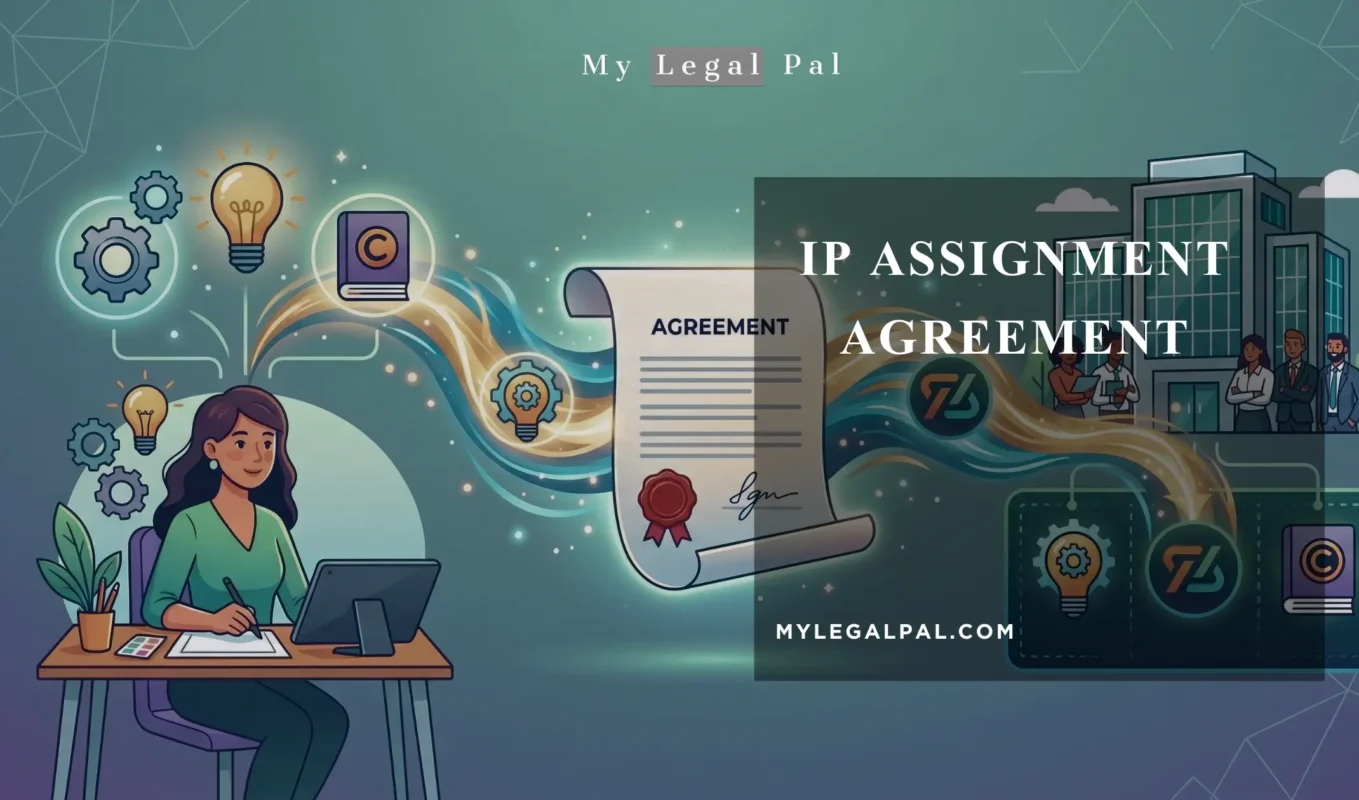
An IP assignment agreement is a legal contract that permanently transfers ownership of intellectual property from the creator, an employee, founder, contractor, or agency, to another party, typically the business that commissioned or employed them. Once properly executed, the assigning party retains no ownership rights at all; this is what distinguishes assignment from licensing, covered below.
Why IP assignment agreements matter
Intellectual property is often a startup’s single most valuable asset, and in most legal systems, the person who actually creates something owns it by default, regardless of who paid for it or whose idea it originally was. This default rule is precisely what makes IP assignment agreements essential rather than optional: without one, a company can spend years building on technology it does not legally own, a fact that typically surfaces only when it matters most, during a fundraising round, an acquisition, or a dispute with a departing co-founder.
What an IP assignment agreement covers
| IP Type | What It Protects | Common Examples |
|---|---|---|
| Patents | Novel inventions and processes | Technology, pharmaceuticals, mechanical devices |
| Copyrights | Original creative works | Code, designs, written content, music, art |
| Trademarks | Brand identity elements | Logos, brand names, slogans, trade dress |
| Trade Secrets | Confidential business information | Algorithms, formulas, customer lists, strategies |
| Domain Names | Online brand presence | Website addresses, digital identifiers |
The essential clauses
A properly drafted IP assignment agreement needs to clearly identify what is being assigned, specific enough to leave no ambiguity about which patents, copyrights, trademarks, or other IP are covered, rather than a vague, generic reference. It needs an explicit assignment of rights clause, the actual operative language transferring ownership, not merely permission to use. It should cover future IP created during the engagement, not only IP that already exists at signing, since an assignment limited to existing work leaves everything created afterward unprotected. Genuine consideration, something of value exchanged, even a nominal amount, helps ensure the assignment is enforceable as a contract rather than an unenforceable gift. Where relevant under the applicable law, a moral rights waiver addresses the separate, non-transferable rights some jurisdictions grant creators over how their work is used or attributed. And a warranty of originality, the assignor confirming the IP is genuinely their own work and doesn’t infringe a third party’s rights, protects the receiving party from inheriting someone else’s IP dispute.
IP assignment vs IP licence: the key difference
These are commonly confused, and the distinction matters enormously in practice.
| Factor | IP Assignment | IP Licence |
|---|---|---|
| Ownership transfer | Yes, full ownership transfers | No, owner retains ownership |
| Duration | Permanent | Typically time-limited |
| Reversibility | Generally irreversible | Can expire or be revoked |
| Best used for | Startup IP, employment IP, freelance work | Software licensing, franchising, partnerships |
| Consideration required | Yes, usually | Usually royalties or fees |
An assignment is the right tool when a business needs to own the IP outright, most founder, employee, and contractor relationships. A licence is the right tool when the creator or rights-holder needs to retain ownership while granting usage rights, common in software distribution or franchising.
Requirements across major jurisdictions
United States. Patent assignments must be in writing under 35 U.S.C. § 261. Copyright assignments require a written instrument signed by the assignor under 17 U.S.C. § 204. State law governs the enforceability of IP clauses in employment contracts, so provisions should not be assumed uniform across states.
United Kingdom. The Patents Act 1977 and the Copyright, Designs and Patents Act 1988 both require written, signed assignments. Moral rights exist under UK law and should be explicitly waived where the assignee needs full freedom to modify or use the work without attribution constraints.
European Union. The IP Enforcement Directive (2004/48/EC) governs enforcement, though specific assignment requirements vary by member state; a written instrument is universally required regardless of the state.
Australia. The Copyright Act 1968 (Cth) requires written assignments. Moral rights cannot be assigned under Australian law, but the creator can consent to specific uses that would otherwise infringe them.
Singapore. The Copyright Act 2021 and the Patents Act require written, signed instruments, and Singapore’s approach aligns closely with UK common law principles.
The consistent pattern across every jurisdiction above: get it in writing, get it signed, and do it before the work begins, not after.
India: written, signed, and specific by statute
Under the Copyright Act, 1957, an assignment of copyright must be in writing and signed by the assignor, and it must specifically identify the work being assigned, the duration of the assignment, and the territorial extent of the rights transferred. If duration is not specified, Indian law imposes a default five-year term under Section 19(2), and if territorial extent is not specified, the assignment is deemed to extend only within India under Section 19(6), a limitation that catches many businesses assuming a broader, unstated scope. Trademark and patent assignments carry their own written, signed requirements under the respective Trade Marks Act and Patents Act. Our trademark registration service and our guide on trademark registration in India cover the registration process that typically follows a trademark assignment.
Common IP assignment mistakes to avoid
Assuming employment automatically transfers IP ownership is a frequent and costly error; in most jurisdictions, an employer needs an explicit written assignment clause, and employment status alone is not enough. Engaging a contractor without an assignment clause is equally risky, since freelancers and contractors typically own what they create by default unless the engagement agreement says otherwise, our guide on work for hire versus independent contractor agreements covers this distinction directly. Limiting an assignment to existing IP and omitting future IP created during the engagement leaves ongoing work unprotected. Omitting consideration can make an assignment unenforceable as a contract in many jurisdictions. Failing to register the assignment with the relevant IP office, where required, weakens its enforceability against third parties. Ignoring moral rights where they exist, the EU, UK, Canada, and Australia among them, can complicate future use of the IP. And relying on a generic template found online without jurisdiction-specific review is a common way all of the above gaps end up baked into a document that looks complete but isn’t.
Pre-incorporation IP: the gap almost every founder has
This is the single most common IP assignment gap specific to founders, and it exists because of a basic timing problem: the company that needs to own the IP didn’t legally exist yet when the founder was actually building it. Most startups start with a founder writing code, designing a product, or developing an idea for weeks or months before incorporation, and a standard employment-style IP assignment, which only covers work “during employment,” doesn’t reach any of it.
The fix is a specific clause, not a generic one: an assignment of pre-incorporation IP, dated and referencing the actual period the work was done in, executed either as part of the founders’ agreement itself or as a standalone document signed at incorporation. It should list, as specifically as possible, what is being assigned, the original codebase, the initial designs, the core concept documentation, rather than a vague blanket statement, since a vague reference is exactly what creates ambiguity later about whether a specific asset was actually covered. Every founder, not just the one who did the early building, should sign this, confirming the company owns what was brought into it from day one.
When you hire an agency, not a developer directly: the flow-down problem
Engaging a development agency or outsourcing firm feels like it should solve IP ownership cleanly, one contract, one signature, done. In practice, it introduces a specific gap most clients never check for. The agreement between you and the agency typically says the agency assigns all resulting IP to you. What it usually doesn’t confirm is whether the agency itself has a valid assignment from the actual individual developers who write the code, whether they’re the agency’s employees, sub-contractors, or freelancers pulled in for the project. If that internal chain is missing or incomplete, the agency never legally owned the IP it just told you it was assigning, and an assignment can’t transfer something the assignor doesn’t actually hold.
This is not a hypothetical risk. Development agencies vary enormously in how carefully they handle their own contractor paperwork, and a client has no visibility into it unless they specifically ask.
Two ways to close this gap, and using both is the safer approach. First, build a specific representation and warranty into your agreement with the agency itself: the agency confirms it holds, or will obtain before delivery, a valid assignment from every individual who contributes to the work, and agrees to indemnify you if that turns out not to be true. This shifts the risk contractually, but a warranty is only as good as the agency’s ability to actually stand behind it. Second, and more robust, require the agency to have every individual developer who touches your project sign a direct, standalone deed of assignment covering their specific contribution, running either directly in your favour or in favour of the agency with your right to enforce it. This closes the gap at the source rather than relying on a representation about paperwork you can’t see.
What to actually ask an agency before signing. Does your standard developer contract include an IP assignment clause covering all work product, not just custom deliverables? Does it cover sub-contractors and freelancers your team brings in for specific projects, not only direct employees? Can you provide a signed assignment for the specific individuals who will work on our project? An agency that can answer these clearly and quickly is one that has actually solved this problem internally; hesitation or vague reassurance is itself useful information.
How to fix a gap you’ve already found
If you’re reading this because you’ve realised a signature is missing, from a co-founder who left early, a contractor from years ago, or an intern who touched the codebase, the fix is a retroactive assignment: the same person signs now, confirming the IP they created was always intended to belong to the company, with the effective date set back to when the work was actually done.
This works cleanly when the person is reachable and cooperative. It gets genuinely harder when they’re not: a departed co-founder who feels shortchanged, a contractor you’ve lost contact with, or someone who now senses they have the upper hand precisely because the gap exists. In that situation, treat it as a negotiation, not a formality, since the person now has something you need. Document your case for why the IP was always intended to belong to the company, correspondence, early agreements even if informal, evidence you paid for or directed the work, and get legal advice before approaching them, since how you open that conversation affects how much it ends up costing you to close the gap. This is exactly why signing assignments at the time work happens, not years later when a deal depends on it, is so much cheaper than the alternative.
What investors actually mean when they ask for your “chain of title”
When an investor’s lawyer asks for your IP chain of title, they mean a complete, unbroken paper trail showing exactly how the company came to own everything it claims to own: every founder, employee, and contractor who touched the product, in order, each with a signed assignment covering their specific contribution. A clean chain of title is simply the sum of doing the two things above correctly, pre-incorporation assignment and no gaps left unsigned along the way, not a separate document you create at the end. The practical founder takeaway: keep a running list of everyone who has ever contributed to your product or brand, alongside their signed assignment, from day one, rather than trying to reconstruct that list under pressure once an investor actually asks for it.
When you need an IP assignment agreement
Put one in place whenever a founder contributes pre-existing work to the company, when hiring an employee whose role involves creating IP, when engaging any freelancer, contractor, or agency for development, design, or content work, when commissioning a logo, brand identity, or other creative asset, and before any collaboration where more than one party might later claim ownership of what’s produced. The right time to sign one is before the work begins, not after a dispute or a due diligence process makes it urgent.
Frequently asked questions
Is an IP assignment agreement the same as a work-for-hire clause?
Not exactly. A work-for-hire clause, particularly under US copyright law, designates certain commissioned works as belonging to the employer from the moment of creation, without a separate transfer step. An IP assignment agreement is broader, covering patents and trademarks as well as copyright, and explicitly transfers ownership rather than relying on a doctrine that may not exist or apply the same way in every jurisdiction.
Can IP be assigned without payment?
In some common-law jurisdictions, IP can technically be assigned as a gift, but this carries real enforceability risk, since most jurisdictions require genuine consideration for a contract to be enforceable. Best practice is to include a consideration clause even where the amount is nominal, to ensure the assignment holds up if challenged.
Does an employment contract automatically assign IP to an employer?
This varies significantly by jurisdiction. In the UK, Section 39 of the Patents Act 1977 provides some automatic assignment for employee inventions created in the normal course of duties. In the US, the position varies by state. In India and many civil law countries, an explicit written assignment clause is required, and employment status alone should never be assumed to transfer IP rights.
What happens if a founder leaves without signing an IP assignment?
This is one of the most common and costly gaps startups face. A founder who leaves before signing an IP assignment may retain ownership of key IP, code, brand elements, or product concepts, even if the company has continued using and building on it. Resolving this after the fact typically requires negotiation and can involve significant legal cost, which is exactly why signing assignments at the outset, not after a departure, is the far cheaper path.
Do I need to register an IP assignment?
Registration requirements vary by IP type and jurisdiction. For patents, most major patent offices allow or require recording an assignment. For copyright, registration of the assignment is optional in some countries but provides real additional legal protection. For trademarks, recording the assignment with the relevant trademark office is generally recommended to establish a clear public record of ownership.
What is the difference between an IP assignment and an NDA?
An NDA protects confidential information by restricting who can share it, but it does not transfer ownership of anything. An IP assignment actually transfers legal ownership of intellectual property from one party to another. Businesses often use both together: an NDA to protect information during early discussions, and an IP assignment to formally transfer ownership once the engagement actually begins.
How do I assign IP that was created before the company was incorporated?
Through a specific pre-incorporation assignment, dated and referencing the actual period the work was done, since a standard employment-style clause only covers work done “during employment” and doesn’t reach anything built before the company existed. Every founder should sign it, listing as specifically as possible what’s being assigned, the original code, designs, or core concept documentation, rather than a vague blanket reference that leaves room for later dispute about what was actually covered.
What if a departed co-founder or old contractor never signed an IP assignment?
Fix it with a retroactive assignment, the same person signing now with the effective date set back to when the work was actually done. This is straightforward if they’re cooperative, but treat it as a real negotiation if they’re not, since a gap like this can genuinely put them in the stronger position. Document your case, correspondence, informal agreements, evidence you directed or paid for the work, and get legal advice before approaching them, since how the conversation opens affects how much it costs to actually close the gap.
Authored and reviewed by Prakhar Rai, Advocate, founder of My Legal Pal. Prakhar is enrolled with the Bar Council of India and has over ten years of experience advising founders, freelancers, and businesses on IP assignment and ownership structuring across India and cross-border. He is an alumnus of the National Law School of India University, Bangalore, where he completed his Master of Business Laws, and of La Martiniere. Connect on LinkedIn.
This article is general information, not legal advice. IP assignment requirements vary significantly by jurisdiction and by IP type. For advice on your own agreement, speak to a qualified lawyer.
If you need IP properly assigned to your business, from a founder, employee, contractor, or agency, our team can help. We handle contract drafting, contract review and revision, and contract negotiation, and you can speak to our contract lawyers in India or the USA.