Last updated on October 9th, 2026 at 12:01 pm
TL;DR: Contract review is the systematic process of examining every clause in an agreement before you sign it, covering scope, payment, liability, termination, and dispute resolution. Most costly contract mistakes come from skipping this process under time pressure, not from genuinely complex legal language. High-stakes agreements, partnerships, major vendor deals, employment contracts for key staff, real estate, IP, and international contracts, almost always warrant professional review.
Quick overview: This guide walks through what contract review actually involves, the five-step process lawyers use, the seven mistakes that cost businesses the most money, and a practical framework for deciding when you can review a contract yourself versus when you genuinely need professional help.
Running a business means dealing with contracts constantly. Vendor agreements, employment contracts, partnership deals, every document that crosses your desk shapes what your business can and cannot do for years afterward. Contract review is the process that stands between signing something you understand and signing something you will regret.
Most business owners assume contract review just means reading the document carefully. Contract review is the systematic process of examining every clause, term, and condition in a legal agreement before you sign it, and it goes beyond reading: it means understanding the legal implications, identifying risks, and negotiating better terms where needed. This guide walks through how that process actually works, the mistakes that cost businesses the most, and how to know when a contract genuinely needs a lawyer’s eyes on it.
Table of Contents
ToggleWhat Contract Review Actually Involves
Contract review means more than checking that the price and dates look right. It means understanding what each clause actually does, where the risk sits, and what you are agreeing to that you might not have noticed on a quick read.
Think of contract review as your business insurance policy: the cost of doing it properly is small compared to the cost of discovering a problem after you have already signed. A small marketing agency that signs a client contract without proper review might discover, months later, that the termination clause lets the client walk away on 24 hours’ notice while the agency owes 90 days. When that client pulls out of a major project, the agency loses tens of thousands in expected revenue overnight, and there is nothing in the contract that prevents it.
This is not a rare scenario. Poor contract review consistently leads to the same handful of problems: financial losses from unfavourable payment terms, legal disputes that drain time and resources, operational restrictions that limit growth, liability exposure that puts personal assets at risk, and missed opportunities from overly restrictive non-compete clauses.

What Makes Contract Review Genuinely Complex
Modern contracts are not simple handshake deals written in plain English. A few things make them harder to review than they look.
Legal terms carry precise meanings that go well beyond their everyday usage. Words like material breach, force majeure, or indemnification carry weight that goes beyond their common usage, and misreading any of them can mean misunderstanding what you are actually agreeing to. A clause that reads as boilerplate can have consequences you do not see immediately, an exclusive dealing clause can quietly prevent you from working with competitors, for instance. Different industries carry different risk profiles entirely, so a software licensing agreement and a construction contract need to be read with completely different concerns in mind. And clauses rarely exist in isolation. One provision can modify or override another elsewhere in the same document, creating a web of obligations that is genuinely hard to track without experience.
The Five-Step Contract Review Process
Lawyers follow a consistent structure when reviewing a contract, and the same structure helps even if you are reviewing it yourself before deciding whether to bring in professional help.
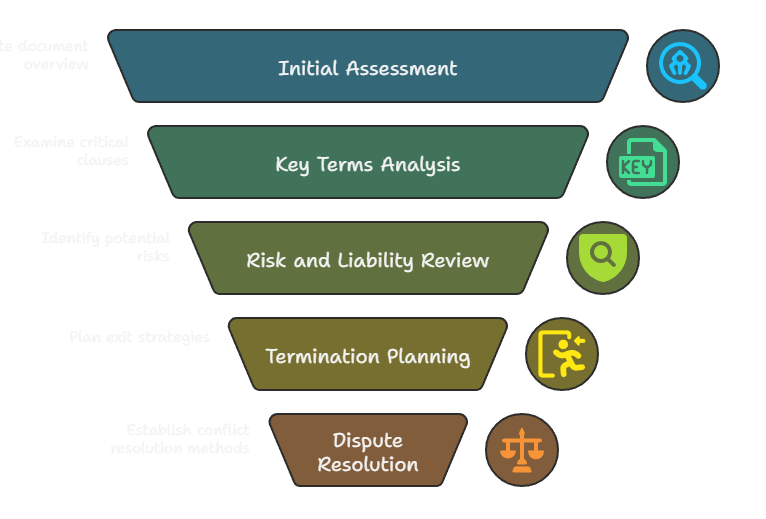
Step 1: Initial document assessment
Start with the big picture before diving into individual clauses. Identify what type of contract you are dealing with, since each type has standard elements you should expect to see. Check for completeness, all pages present, signature lines intact, referenced attachments actually attached. Confirm the parties are correctly identified with proper legal names, since mistakes here can make a contract unenforceable. And check the effective dates, including whether the contract auto-renews without you noticing.
Step 2: Key terms analysis
Focus on the terms that directly affect your operations and finances. The scope of work needs to be specific, vague descriptions are where disputes start later. Payment terms decide your cash flow, so check timing, penalties for late payment, and what happens if payment is disputed. Performance standards should be objective rather than subjective, since vague metrics tend to favour whoever gets to interpret them. And intellectual property ownership needs to be explicit, particularly for creative or technical work, since the default position in many jurisdictions is that the creator owns what they made unless the contract says otherwise.
Step 3: Risk and liability review
This is where the real financial exposure in a contract usually lives. Check the limitation of liability clause to see whether your exposure is capped or left open-ended; our guide on how not having a limitation of liability clause can kill your startup explains exactly why this single clause deserves more attention than almost anything else in the document. Review the indemnification clause to understand what you are agreeing to cover the other party for, which our indemnity clause guide breaks down in detail. Check whether the contract requires specific insurance coverage you do not currently carry. And review the force majeure provision to confirm it applies fairly to both sides; our force majeure guide covers exactly the kind of drafting gaps that make this clause fail when you actually need it.
Step 4: Termination and exit planning
Understanding how to get out of a contract matters as much as understanding how to fulfil it. Check what events trigger termination, whether for convenience or only for specific cause, and whether the notice period is the same for both parties (uneven notice periods are a common and expensive trap). Confirm what happens to confidential information and work product after the contract ends, and check which obligations survive termination and for how long. Our guide on termination of contract and its consequences walks through this in more depth.
Step 5: Dispute resolution mechanisms
Every contract should set out what happens when the parties disagree. Check the governing law clause, since this decides whose legal rules actually apply. Check whether disputes go to court, arbitration, or mediation, each carries different costs, timeframes, and procedures, and our comparison of mediation vs arbitration vs litigation breaks down which fits which situation. Check who pays legal costs if a dispute arises, and check where proceedings would actually take place, since being forced to litigate far from home adds real cost on top of whatever the dispute is actually about.
The Seven Mistakes That Cost Businesses the Most
Even careful business owners make the same handful of mistakes during contract review. Most of them are process failures, not legal knowledge gaps.
Focusing only on price and ignoring the terms. A great price with terrible terms, a payment schedule that wrecks your cash flow, or liability clauses that expose you to massive risk, can cost far more than the discount was worth. Evaluate the whole deal, not just the number at the top.
Assuming a “standard” contract is fair. The other party’s standard contract was written to protect their interests, not yours, and they have no incentive to include terms that favour you. Every contract is negotiable until you sign it, and that negotiation process, what some people call redlining, is worth understanding properly. Our guide on redlining and negotiating contract terms covers how to do this without damaging the relationship.
Rushing through review under deal pressure. Speed kills thoroughness. If the other party will not allow reasonable review time, that itself is a signal about how they will handle the relationship once you are locked in. If you are negotiating a deal that matters, our guide on contract negotiation for startups covers why founders in particular should never sign under time pressure.
Not considering how your business might change. A contract that fits your business today can become a straightjacket as you grow, expand into new markets, or change direction. Read every clause with an eye on where the business is heading, not just where it is now.
Ignoring industry-specific risk. A clause that is harmless in one industry can be serious in another. Data security requirements reasonable for a consulting firm might be genuinely difficult for a small retailer to meet. General contract knowledge does not always cover industry-specific exposure.
Not reading the fine print. Automatic renewal clauses, choice of law provisions, and dispute resolution procedures are routinely buried in the boilerplate at the end. Read everything, even the parts that look standard.
Not documenting modifications. Verbal agreements do not override written contract terms. If something changes during negotiation, get it in writing and signed before you sign the main agreement, otherwise you remain bound by the original terms regardless of what was discussed.
When Should You Seek Professional Contract Review?
Not every contract needs a lawyer, and not every contract is safe to handle alone. The decision comes down to stakes, complexity, and how much is genuinely at risk if something goes wrong.
Contracts that almost always need professional review. Partnership and joint venture agreements, since they create long-term shared decision-making and shared liability. Major supplier or vendor contracts that represent a significant share of your revenue or costs. Employment contracts for key personnel, especially anything involving equity or non-compete terms. Real estate transactions, given the financial scale involved. Licensing and intellectual property agreements, where getting ownership wrong can be expensive to fix later. And international or cross-border contracts, where governing law, currency, and regulatory compliance add real complexity. If you are entering a negotiation on any of these, our contract review services cover both reviewing what you have received and drafting from scratch.
Contracts where it depends on circumstances. Service provider agreements outside your normal scope, technology and software contracts with data security or SLA terms, franchise agreements, and high-value insurance contracts all sit in a middle tier. The right call depends on contract value, your experience with similar agreements, and your own risk tolerance.
Contracts you can usually handle yourself. Standard purchase orders with familiar suppliers, simple service agreements for routine work like maintenance or cleaning, and basic membership agreements rarely involve the kind of risk that justifies professional review.
A pattern we see: A small agency signs what looks like a standard client services agreement, focused mostly on the price and the project scope. Eighteen months later the client terminates the relationship with almost no notice, citing a clause buried in the boilerplate that nobody flagged at signing, while the agency’s own notice obligation to the client was far longer. The clause was not hidden maliciously. It simply was never reviewed by anyone who knew what to look for, because the deal moved fast and review felt like a formality.
Need a Professional to Review Your Contract?
A checklist can help you spot common issues, but complex liability provisions, indemnities, termination rights, and cross-border obligations may require closer legal analysis.
My Legal Pal offers contract review and revision services for businesses, founders, and professionals who need help understanding contractual risks and negotiating appropriate changes.
Request a Contract Review before signing your next important agreement.
Frequently Asked Questions
What does a contract review lawyer actually check?
A contract review lawyer examines the scope of work, payment terms, liability and indemnification clauses, termination and exit provisions, and dispute resolution mechanisms, checking each against your actual business situation rather than just confirming the document is internally consistent. They also flag clauses that look standard but carry meaningful risk, and identify gaps where the contract is silent on something that matters.
How much does contract review cost?
Costs vary by complexity and the lawyer’s fee structure, but for most standard commercial contracts, professional review is a modest cost relative to the value of the deal or the risk being avoided. Fixed-fee review is increasingly common and more predictable than hourly billing, since you know the cost upfront regardless of how long the document takes to work through properly.
How long does contract review take?
A straightforward commercial contract can often be reviewed within a day or two. More complex agreements, partnership documents, multi-jurisdictional contracts, or anything with significant negotiation history, can take longer, particularly if the review surfaces issues that need to be raised with the other party before signing. Building review time into your deal timeline from the start avoids the pressure that leads to rushed, incomplete review.
Can I review a contract myself?
For simple, low-risk, low-value contracts with familiar terms, yes, many business owners review these competently on their own. For anything involving significant money, liability exposure, intellectual property, or a long-term relationship, the risk of missing something that only becomes visible to someone with legal training increases substantially, which is exactly where professional review earns its cost.
What is the biggest mistake people make in contract review?
Treating it as a quick read-through rather than a structured process. Most expensive contract mistakes do not come from impossibly complex legal language. They come from rushing under deal pressure, focusing only on price, and skipping the fine print because it looks like boilerplate. A consistent process, working through scope, payment, risk, termination, and dispute resolution in order, catches far more than an unstructured read does.
Do I need a lawyer for every contract I sign?
No. Routine, low-value, low-risk agreements with familiar terms, standard purchase orders or simple service agreements, can usually be handled without professional review. The contracts that consistently warrant a lawyer’s involvement are the ones with real financial stakes, long-term commitments, IP implications, or cross-border complexity, where the cost of a missed clause is meaningfully higher than the cost of having it checked.
Written by Prakhar Rai
Prakhar Rai is the founder of My Legal Pal and a licensed attorney. He started the practice after watching businesses that operate across borders get legal advice in fragments: a clause here, a reaction to a problem there, with no one looking at the whole picture or thinking a few steps ahead. With more than a decade in business and corporate advisory, he came to a simple view. As companies started running on cross-border deals, digital platforms and overlapping regulation, they needed legal strategy built around how they actually work, not just documents drafted after the fact. My Legal Pal is built on that idea: foresight and clarity first, paperwork second. He studied at La Martiniere College, holds an LL.B, and earned a Master of Business Laws from the National Law School of India University, Bangalore, specialising in corporate, banking, intellectual property, finance and securities law. That mix of academic grounding and hands-on advisory work shapes how he and the team approach every matter: commercially, not just technically.
Connect with Prakhar on LinkedIn.
This article is published for informational and educational purposes only. It does not constitute legal advice. Contract review needs vary by jurisdiction, industry, and the specific terms of each agreement. Always consult a qualified lawyer for advice specific to your situation.