Last updated on September 21st, 2026 at 12:01 pm
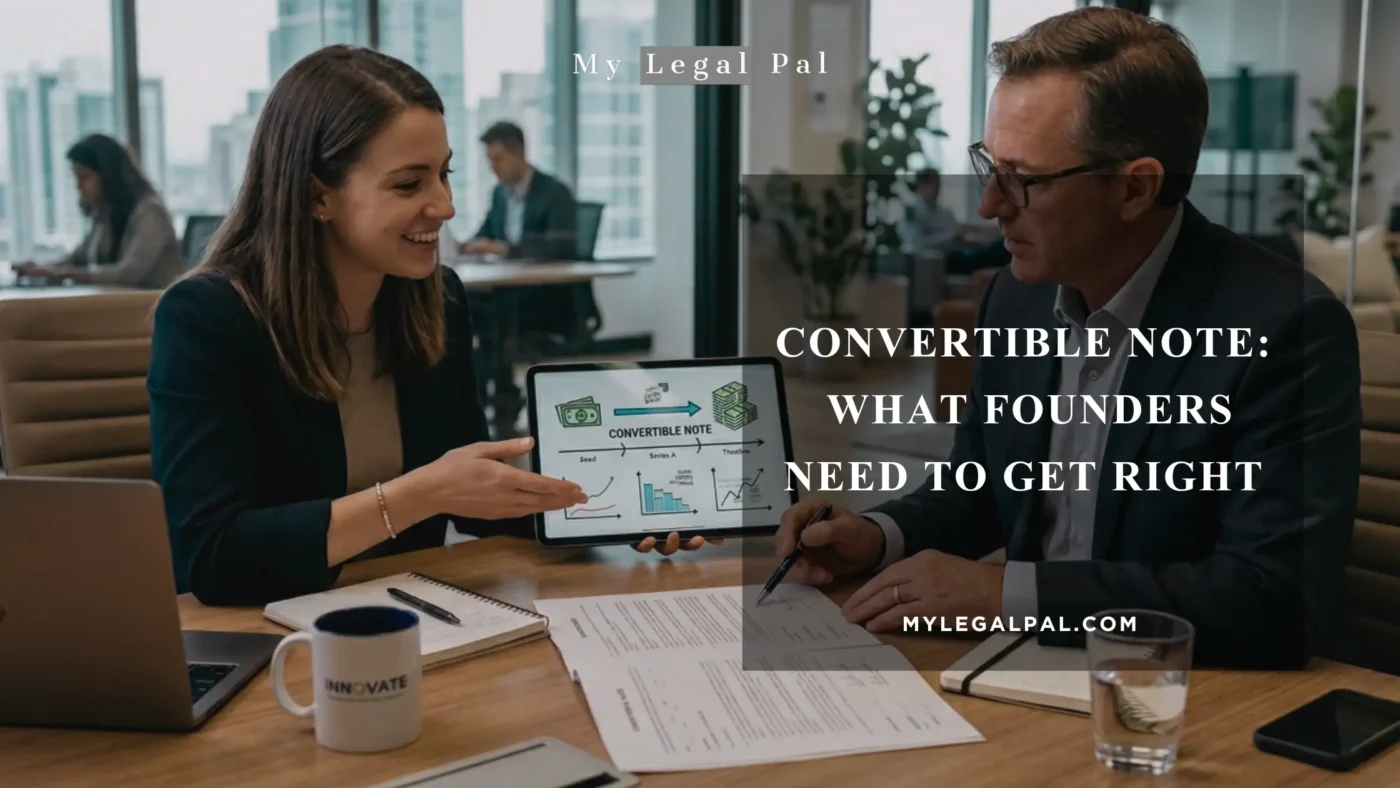
TL;DR: A convertible note is a short-term loan that converts into equity when your next round triggers it. Convertible note agreement drafting decides the principal, the interest, the maturity date, the valuation cap, the discount, and the conversion triggers. These clauses control your dilution and your risk.
Quick overview: This guide walks through what a convertible note agreement is, the clauses that drafting must get right, the AI-versus-non-AI cap divide now shaping how those caps get benchmarked, what changes when the company is based in India, the mistakes founders most often make, and whether you genuinely need a lawyer to draft one. For the fuller comparison against a SAFE, with real conversion math, our guide on SAFE agreement versus convertible note covers that directly, and our SAFE note review guide covers the closely related instrument.
There is a moment many founders only experience once. They raised a convertible note 18 months ago, expecting to close a Series A inside a year. The product is doing well, the market shifted, the round took longer than planned, and now the maturity date is six weeks away with no priced round signed. The note investor is asking what happens next. The agreement they signed quickly back then is now the document that controls every option in front of them.
This is the part of fundraising that does not get talked about enough. Convertible note agreement drafting is treated as a quick technical step because the instrument itself looks simple. It is not simple. The clauses inside it decide how much you give away, how much time you have, and what happens when reality does not match the plan. Below is what every clause does, what changes in India, and where founders most commonly get hurt.
What is a convertible note agreement?
A convertible note agreement is the contract for a short-term loan that converts into equity when a defined event occurs, usually a qualified priced round. Until conversion, it is debt. After conversion, it is equity. The agreement governs every economic and risk consequence in between, including how much equity the investor receives and what happens if conversion never triggers.
The instrument typically includes a valuation cap, a discount rate, an interest rate, and a maturity date, and each of those does specific work in the drafting. The differences between a convertible note and a SAFE matter at the drafting stage too, so if you are still weighing the two, our piece on how a SAFE and a convertible note compare is worth reading first.
Cap benchmarks now vary sharply by category, see our SAFE Note Review guide for current AI vs. non-AI cap ranges
Why the drafting is what actually matters
The agreement reads short. It behaves long. That is the gap that catches founders out.
A convertible note defers the hard question, what is the company worth, to a future event. It does not defer the consequences of the terms you wrote down today. The interest compounds whether you are paying attention or not. The maturity date arrives whether or not your fundraise is on schedule. The valuation cap locks in the upper bound of your dilution before you have any idea what the priced round will look like.
A well-drafted note gives you room. A poorly drafted one closes options you did not realise you needed. The mechanics of this are similar to what we covered in our SAFE note review guide, but a convertible note carries something a SAFE does not: a hard maturity date with debt consequences. That changes the drafting calculus in important ways.
The core clauses every convertible note agreement must get right
A convertible note agreement comes down to a small number of clauses doing most of the heavy lifting. Get these right and the instrument is a clean, fast way to raise capital. Get them wrong and the note can take more equity, or take it sooner, than you intended.
Principal amount and parties. The clause that names the company, the investor, the loan amount, and the date. Straightforward, but worth confirming. Errors here, or vague identification of the parties, create problems later, especially in India where the issuing entity must be a DPIIT-recognised private limited company.
Interest rate. Convertible notes accrue interest, typically between 4 and 8 percent annually. The interest is not paid in cash. It accumulates on the principal and converts into equity along with it. That sounds harmless until you do the math: a note sitting unconverted for two years at 6 percent interest is quietly adding real additional principal to what eventually converts, on top of the original amount.
Maturity date. The date by which the note must convert or be repaid. This is the clause that turns a fundraising instrument into a debt event if your timeline slips. Maturity dates usually fall between 18 and 24 months.
Valuation cap. The maximum company valuation at which the note converts into equity, functioning the same way as a SAFE’s cap. Whether a proposed cap is actually fair now genuinely depends on which category your company sits in. Data from major startup finance platforms through 2025 and into 2026 shows a real divide: AI and machine learning companies are commanding caps running roughly two to three times higher than non-AI startups at the same stage, driven by a disproportionate concentration of early-stage capital into the category. A convertible note cap that would look aggressive against non-AI comparables can sit squarely at market rate for an AI infrastructure company, and the reverse is just as true. Benchmarking against the right comparable set matters more now than it did even two years ago. Our guide on essential contracts every AI startup must have covers the broader documentation an AI-focused raise typically needs alongside this.
Discount rate. An alternative conversion mechanism, usually 15 to 25 percent, giving the investor a discount off the price paid by new investors in the priced round. Where a note has both a cap and a discount, the investor typically converts at whichever produces more shares, which is worth modelling precisely rather than assuming.
Conversion triggers. The specific events that cause the note to convert, most commonly a qualified financing round above a defined size. Poorly defined triggers, or triggers that do not address what happens on an acquisition or a down round, are a common source of dispute later.
Pro-rata rights and MFN clause. Some notes grant the investor the right to participate in future rounds to maintain their percentage ownership, which can meaningfully affect your cap table in later rounds. As with SAFEs, MFN clauses can pull better terms back retroactively across the stack, which compounds dilution in ways founders rarely model.
Convertible note drafting in India: the compliance layer you cannot skip
In India, drafting a convertible note is not just a commercial exercise. It is a compliance exercise. The agreement has to satisfy specific requirements under the Companies Act, 2013 and FEMA rules, and missing them invalidates the carve-out that makes the instrument workable in the first place.
The conditions are clear. A convertible note in India is defined under the Companies (Acceptance of Deposits) Rules, 2014 as an instrument evidencing receipt of money initially as debt, repayable at the holder’s option or convertible into equity on specified events. To qualify under the carve-out, rather than being treated as a regulated deposit, the issuer must be DPIIT-recognised as a startup, the minimum amount per investor must be ₹25 lakh in a single tranche, and the note must be converted or repaid within 10 years of issue.
When foreign investors are involved, the layer thickens. The company must complete CN filings within 30 days of issuance through the RBI’s FIRMS portal, with the FIRC, KYC of the investor, and DPIIT certificate. The company must also operate in a sector where 100 percent FDI is allowed under the automatic route, or obtain prior government approval.
Two practical points the drafting must address head-on. First, splitting a single foreign investor’s cheque to dodge the ₹25 lakh single-tranche rule does not work and creates real compliance exposure. Second, leaving the conversion pricing open-ended is not allowed. You need a formula at issue and fair-value compliance at conversion for non-resident holders.
This is why an India convertible note drafted by lawyers familiar with both Companies Act and FEMA requirements looks different from a US Delaware-corp template. The same drafting that works in California will not pass Indian regulatory review, and copy-pasting a foreign template is one of the more common ways Indian rounds end up needing emergency restructuring later. Our company registration service can help structure the entity side of a raise correctly from the outset.
The drafting mistakes founders make most often
Most convertible note disputes do not come from bad-faith investors. They come from drafting decisions that looked harmless at the time.
The biggest pattern is the maturity mismatch. If you believe you will raise a Series A in 18 months and you take a note with an 18-month maturity, you are playing with fire. A single month of delay turns a healthy fundraise into a debt event. The fix is to push for a maturity that runs 6 to 12 months beyond your projected priced-round close, not exactly to it.
Other patterns that come up often: stacking multiple notes with different caps and discounts without modelling the cumulative dilution, accepting full ratchet anti-dilution clauses where weighted average is the fair market standard, agreeing to guaranteed returns or cash-interest payments that effectively turn the instrument into debt rather than deferred equity, and silent or unfavourable conversion mechanics if no qualified financing closes by maturity. These are exactly the kinds of provisions we cover in our piece on the clauses that quietly slash a startup’s valuation.
A pattern we see: a founder issues a 24-month convertible note expecting to close a Series A by month 15. The market shifts, the round slips to month 22, and the maturity is now four weeks away. The investor agrees to extend, but only on tighter terms, including a lower cap and an added pro-rata right. What started as a clean note becomes a renegotiation under pressure. A maturity date set with a 9-month buffer would have avoided the entire situation.
Do you need a lawyer to draft your convertible note?
Not legally, but in practice, yes. A convertible note is more complex than a SAFE, and the consequences are harder to reverse once the maturity clock is running. If you are working through this for a specific round, our contract negotiation lawyer guide covers what to actually look for in the person negotiating on your behalf, and our guide on cap tables and fully diluted ownership covers where these conversion mechanics ultimately land once the priced round closes.
What a professional convertible note drafting engagement looks like
A good drafting engagement starts at the term sheet stage and runs through to the post-issue filings. The lawyer aligns the term sheet with the legal document so nothing is renegotiated in the drafting itself. They model the dilution under realistic scenarios so you see the consequences of the cap, discount, interest, and maturity in numbers, not abstractions. They draft the conversion mechanics for every realistic trigger, not just the qualified financing. They check any side letter, because side letters often carry the terms that matter most. And in India, they handle the board and shareholder approvals, the CN filings with the RBI, and the Companies Act paperwork that the carve-out depends on.
That combination, commercial modelling plus jurisdiction-specific compliance plus plain-English explanation, is what separates real convertible note drafting from a templated fill-in exercise. Our term sheet negotiation guide covers the negotiation stage that typically precedes this drafting work.
Conclusion
A convertible note is a short, fast instrument with long, slow consequences. Four things are worth holding onto. First, the clauses that decide your outcome are the ones founders read fastest, particularly the maturity date and the interaction between cap and discount. Second, whether your cap is genuinely fair now depends on which category, AI or non-AI, your company actually sits in, since the two are being priced on different scales in 2026. Third, in India, the drafting is also a compliance exercise, and missing a condition can re-characterise the instrument and create real exposure. Fourth, the cheapest time to fix a term is before you sign it.
If you are issuing a convertible note, or being offered one, get the drafting handled before you commit. My Legal Pal drafts and reviews convertible note agreements for founders in India and internationally, models your dilution, and makes sure the document satisfies both the commercial terms and the compliance conditions that apply. You can see how our online contract review and drafting for startups works, or visit MyLegalPal.com to get your convertible note drafted.
Frequently asked questions
What is a convertible note agreement?
A convertible note agreement is the contract for a short-term loan that converts into equity when a defined event occurs, usually a priced equity round. It defers the question of the company’s valuation to that future event while fixing the economic terms, cap, discount, interest, maturity, today. The agreement governs how much equity the investor receives and what happens if conversion never triggers.
How is a convertible note different from a SAFE?
The most important difference is debt. A convertible note is a loan with a maturity date and accruing interest. If conversion has not triggered by maturity, the principal plus interest is due. A SAFE has no maturity date, no interest, and no repayment obligation, so it cannot create a debt event. Convertible notes are usually preferred when investors want more downside protection, while SAFEs are preferred when founders want maximum flexibility.
What is a typical interest rate and maturity for a convertible note?
Interest rates typically run between 4 and 8 percent annually, with around 5 to 7 percent as the common median. Maturity dates usually fall between 18 and 24 months, though founders should aim for a maturity that runs 6 to 12 months beyond their projected next round close, not exactly to it, to avoid a debt event if the round slips.
Can a startup issue a convertible note in India?
Yes, but only if it is recognised by DPIIT as a startup, the minimum investment per investor is at least ₹25 lakh in a single tranche, and the note converts or is repaid within 10 years. Foreign investments also require FEMA compliance, including CN filings with the RBI within 30 days through the FIRMS portal. Missing these conditions can cause the note to be re-characterised as a regulated deposit.
Do I need a lawyer to draft a convertible note agreement?
Not legally, but in practice yes. The agreement is more complex than a SAFE, and the consequences are harder to reverse. For any round of meaningful size, foreign investor involvement, or unusual structure, professional drafting almost always costs far less than the dilution or compliance exposure of getting it wrong.
This article is general information, not legal advice. Convertible note terms, market benchmarks, and India’s regulatory requirements change over time. For advice on your own note, speak to a qualified lawyer before you sign.
Written by Prakhar Rai, founder of My Legal Pal and licensed attorney (LL.B; Master of Business Laws, NLSIU Bangalore). Connect on LinkedIn.
If you’re issuing or reviewing a convertible note, our team can help get the drafting right the first time. Speak to our contract lawyers in India or the USA today.