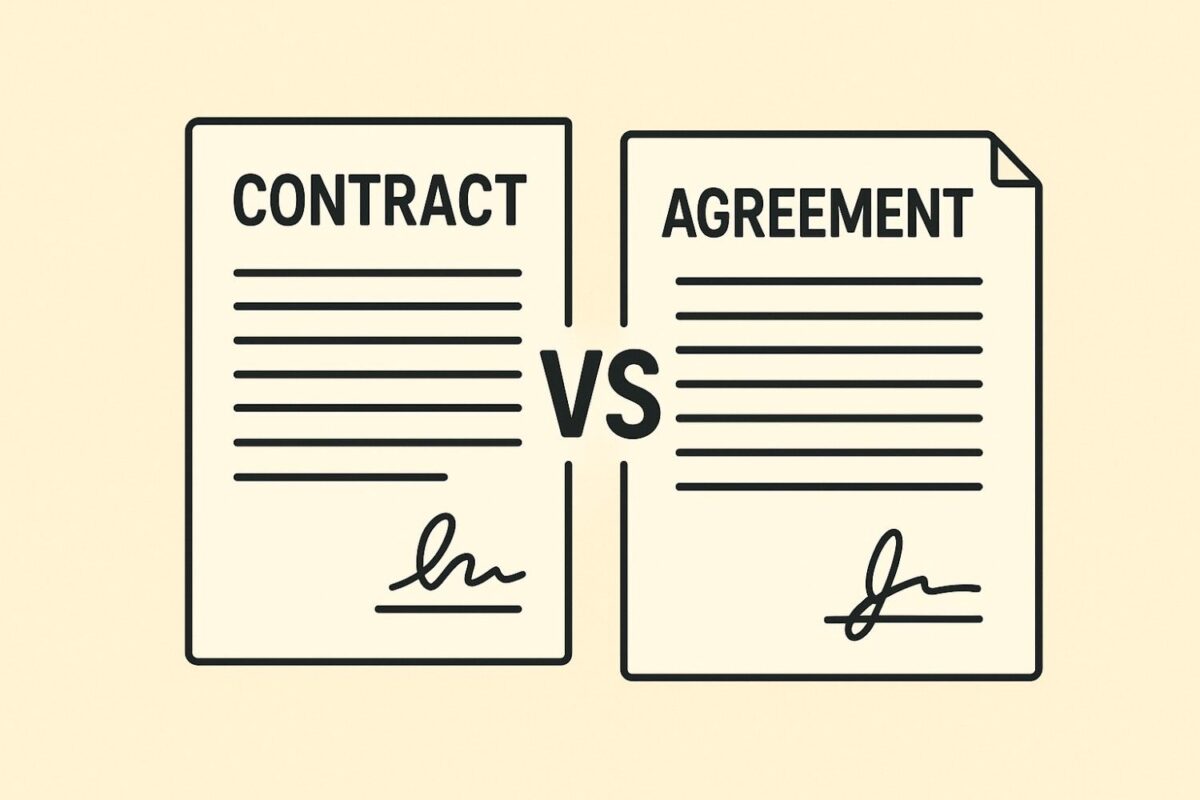
Contract vs Agreement: What’s the Legal Difference?
13 Aug
Last updated on August 9th, 2026 at 09:20 am
TL;DR: Every contract is an agreement, but not every agreement is a contract. An agreement is simply two or more people saying yes to the same thing. It becomes a contract only when it is legally enforceable, which generally requires an offer, acceptance, something of value exchanged, capable parties, a lawful purpose, and a genuine intention to be legally bound. Get any of those wrong and you may have a friendly understanding, not a document a court will enforce.
Quick overview: This guide explains what separates an agreement from a contract, the specific elements that make an agreement legally enforceable, real-world examples that make the line clear, whether contracts have to be written, and what actually happens when each one is broken.
You have probably used the words “contract” and “agreement” interchangeably your whole life. Most people do. They are close cousins in the legal world, but they are not identical twins, and the gap between them is not legal trivia. It decides whether you can actually do anything when someone fails to hold up their end of a deal.
Understanding the difference between a contract and an agreement matters well beyond the classroom. It affects how you handle a freelance gig, a vendor relationship, a verbal promise from a business partner, or a casual “sounds good!” reply that turns out to carry more weight than you intended. This guide breaks the distinction down in plain language, with the legal elements explained properly and real examples to make it click.
An agreement is two or more people saying yes to the same thing. That is genuinely the whole concept at its simplest.
You and your neighbour agree that you will water their plants while they are on holiday. You and a friend agree to split the dinner bill. Your band agrees to play at the local coffee shop for tips. These are all agreements, and what they have in common is straightforward: people discuss terms, everyone says okay to those terms, and there is mutual understanding between them.
Notice what is missing from that list. Legal enforcement. Your neighbour cannot sue you if you forget to water their begonias, though they might quietly stop inviting you to their next barbecue. An agreement creates a social or moral expectation. It does not, by itself, create a legal one.
What Is a Contract?
A contract is an agreement that the law will actually enforce. The cleanest way to understand this comes from contract statutes that define the relationship directly: a contract is simply an agreement that is enforceable by law. Every contract starts life as an agreement, and it only becomes a contract once it satisfies the legal requirements that make it enforceable.
This is the entire distinction in one sentence: Contract = Agreement + Enforceability by Law. As one breakdown of this principle puts it, an agreement becomes a contract only when legal requirements are fulfilled, and not every agreement clears that bar. A husband promising his wife a piece of jewellery is, in most legal systems, treated as a social or domestic arrangement rather than something a court will step in to enforce, even though it is a perfectly genuine agreement.
The Essential Elements That Turn an Agreement Into a Contract
For an agreement to become a contract, it generally needs to satisfy a recognisable set of ingredients. Legal systems around the world phrase these slightly differently, but the underlying logic is consistent almost everywhere.
Offer and acceptance
Someone makes an offer, and someone else accepts it on the same terms. “I’ll pay you $500 to design my website.” “Deal.” Clean and simple in theory, though disputes often arise over whether a genuine offer was ever made, or whether what looked like acceptance was actually a counteroffer that changed the terms.
Consideration
This is the legal term for something of value changing hands on both sides. Money is the obvious example, but it can be services, goods, or even a promise to do, or not do, something. The key requirement is that both sides give something up. As one explanation of this principle puts it, a promise without consideration is treated as a gift rather than a bargain, and a gift, however sincerely meant, is not something a court will force someone to follow through on.
Capacity to contract
Both parties need to be legally able to enter into a contract. This generally excludes minors, people who are mentally incapacitated, and anyone who lacks the legal standing to bind themselves to an agreement. A contract signed by someone without capacity is typically void or voidable from the outset, regardless of how clearly both sides understood and intended the deal.
Free and genuine consent
Both parties must actually agree to the same thing in the same sense, and that agreement must be given freely. Consent obtained through coercion, fraud, undue influence, or misrepresentation undermines the contract, because the law is not interested in enforcing a “yes” that was not genuinely given.
Lawful object
You cannot contract to do something illegal. An agreement to sell stolen goods, commit fraud, or do anything contrary to public policy will not be enforced by any court, and frankly, an unenforceable contract would be the least of your problems in that scenario.
Intention to create legal obligations
Both parties need to actually intend that the arrangement carries legal consequences. This is precisely why purely social or domestic arrangements, plans with friends, casual favours between neighbours, generally are not treated as contracts even when every other element appears to be present. The parties never intended the law to get involved if one side did not follow through.
Contract vs Agreement: Real-World Examples
Seeing the distinction in action makes it click faster than any definition.
Agreement only. You tell your roommate you will clean the bathroom this week if they handle the dishes. You shake on it. This is a genuine agreement, but it is not legally binding. If your roommate decides to order takeout all week and never washes a single dish, you cannot take them to court over it.
Full contract. You hire a contractor to renovate your kitchen for $15,000, with specific materials and a completion date set out in a signed document. This satisfies every element: a clear offer, a clear acceptance, consideration flowing both ways (money for services), capable parties, and a lawful, clearly intended legal arrangement.
The grey area. Your brother agrees to lend you his car for a month while yours is being repaired, and you agree to cover gas and insurance in return. There is consideration on both sides and mutual understanding, but depending on how formal the arrangement is and the law that applies, the informality between family members can make enforcement genuinely uncertain.
Do Contracts Have to Be Written?
Not always, but writing one down is almost always the smarter move. Many contracts are perfectly valid when made verbally, provided they satisfy the legal elements above. The real issue is not validity. It is proof. Memory is unreliable, and people consistently remember the same conversation differently once money or blame is involved.
That said, some jurisdictions specifically require certain categories of contract to be in writing to be enforceable at all. In the United States, for example, a long-standing legal doctrine known as the Statute of Frauds requires written contracts for categories including real estate transactions, agreements that cannot be completed within a year, and contracts for goods above a certain value. Other legal systems take a different approach. Many recognise verbal contracts as enforceable across the board, provided every other element of a valid contract is present, while still strongly favouring written agreements because they are far easier to prove if a dispute ever reaches a court.
The practical lesson is the same everywhere: even when the law does not insist on paper, putting an agreement in writing protects you from the “but I thought you meant” conversation that shows up later, usually right when it matters most.
Why This Distinction Matters for Your Business
If you are running a business or freelancing, this distinction is not academic. Every client relationship, vendor arrangement, and partnership you enter into is either a contract or merely an agreement, whether or not you ever use either word out loud.
Verbal agreements can absolutely become contracts, but they are far harder to prove if something goes wrong. Email exchanges routinely create binding contracts even when neither side meant for that to happen. That casual “sounds good!” reply to a detailed project proposal may well have just accepted a contract on terms you barely skimmed.
This is exactly why businesses rely on a structured set of documents rather than informal exchanges: terms of service for websites, service agreements for ongoing relationships, purchase orders for one-off transactions, and employment contracts for staff. Each of these exists to remove the ambiguity that a casual exchange leaves behind. If your business depends on something more specific, such as protecting code or content created for you, the same logic applies through documents like an IP assignment agreement, which makes ownership explicit rather than assumed. Getting any of these professionally drafted, rather than relying on a quick exchange of messages, is what our contract drafting services are built around.
Red Flags: Situations That Look Like Contracts but Aren’t
Some arrangements look contractual on the surface but are not legally binding at all.
Social agreements usually are not contracts. Promising to attend a friend’s birthday party will not land you in court if you bail at the last minute. Agreements lacking consideration do not hold up either. If someone promises to give you their old laptop for nothing, they can change their mind freely, because nothing of value was exchanged in return. And impossible or illegal agreements are void from the start. You cannot contract to deliver the moon, and you certainly cannot contract to commit a crime, regardless of how enthusiastically both sides agreed to it.
What Happens When a Contract Is Broken vs an Agreement Is Broken?
If someone breaks a contract, you generally have real legal remedies available. These can include monetary damages to cover your losses, specific performance forcing the other party to do what they promised, or cancellation of the contract along with the return of any money already paid. Understanding exactly what to do in that moment matters, and our guide on what to do if someone breaches a contractwalks through the practical steps, while our piece on termination of a contract and its consequences explains how a relationship can be properly wound down when it has run its course.
If someone breaks a mere agreement, your remedies are far more limited. You may have hurt feelings or genuine inconvenience, but in most cases, no legal recourse at all. This is the practical weight the word “contract” carries that “agreement” simply does not.
Conclusion
Every contract is an agreement, but not every agreement is a contract, and the difference comes down entirely to legal enforceability. Three things are worth holding onto. First, an agreement only becomes a contract once it satisfies a recognisable set of elements: offer, acceptance, consideration, capacity, lawful object, and a genuine intention to be bound. Second, writing things down is not always legally required, but it is almost always the difference between a clear understanding and a costly dispute later. Third, knowing which one you are dealing with tells you exactly what you can and cannot do if the other side does not follow through.
Whether you are hiring a contractor, entering a business partnership, or simply trying to understand a document someone has handed you, knowing where you stand legally gives you genuine confidence. For anything that matters, especially in business, getting it properly drafted is worth far more than relying on a friendly exchange of messages. Visit our business contracts guide for the wider picture, or get in touch with My Legal Pal to have your next agreement turned into something that actually holds up.
My Legal Pal. Making Legal Simple.
Frequently Asked Questions
Is every agreement a contract? No. Every contract is an agreement, but not every agreement is a contract. An agreement only becomes a contract once it satisfies the legal requirements for enforceability, generally an offer, acceptance, consideration, capable parties, a lawful purpose, and a genuine intention to create legal obligations. Purely social or domestic arrangements, for example, are usually agreements without being contracts.
Can a verbal agreement be a contract? Yes, in most legal systems a verbal agreement can absolutely be a binding contract, provided it satisfies the same legal elements a written one would need. The real challenge with a verbal contract is not validity but proof. Without anything in writing, disputes often come down to two people remembering the same conversation differently, which makes enforcement harder even when the agreement was genuinely binding.
What makes an agreement legally enforceable? An agreement becomes legally enforceable when it includes a clear offer and acceptance, consideration flowing between both parties, capable and consenting parties, a lawful purpose, and a genuine intention by both sides to be legally bound. Missing any one of these elements can mean the arrangement remains a simple agreement rather than an enforceable contract.
Does a contract have to be in writing? Not always. Many contracts are valid whether spoken or written, provided they satisfy the necessary legal elements. Some categories of contract, however, are required by law to be in writing in certain jurisdictions, commonly things like real estate transactions or agreements that cannot be completed within a year. Even when writing is not required, putting an agreement in writing is almost always the safer choice, since it removes ambiguity if a dispute arises later.
What happens if someone breaks an agreement that isn’t a contract? Generally, very little in legal terms. If an arrangement does not meet the requirements of an enforceable contract, breaking it typically leaves you without a legal remedy, even if you genuinely relied on the other person following through. You may be left with disappointment or inconvenience, but courts will not usually step in to enforce a purely social or informal understanding.
Can a minor enter into a binding contract? Generally no. Most legal systems treat minors as lacking the legal capacity to enter into a binding contract, with limited exceptions for things like necessities. A contract signed by a minor is typically void or voidable, regardless of how clearly the terms were understood and accepted at the time, which is exactly why capacity is treated as a core requirement rather than a technicality.
Written by Prakhar Rai
Prakhar Rai is the founder of My Legal Pal and a licensed attorney. He started the practice after watching businesses that operate across borders get legal advice in fragments: a clause here, a reaction to a problem there, with no one looking at the whole picture or thinking a few steps ahead. With more than a decade in business and corporate advisory, he came to a simple view. As companies started running on cross-border deals, digital platforms and overlapping regulation, they needed legal strategy built around how they actually work, not just documents drafted after the fact. My Legal Pal is built on that idea: foresight and clarity first, paperwork second. He studied at La Martiniere College, holds an LL.B, and earned a Master of Business Laws from the National Law School of India University, Bangalore, specialising in corporate, banking, intellectual property, finance and securities law. That mix of academic grounding and hands-on advisory work shapes how he and the team approach every matter: commercially, not just technically.
This article is published for informational and educational purposes only. It does not constitute legal advice. The legal requirements for a valid contract can vary by jurisdiction. Always consult a qualified lawyer for advice specific to your situation.
Prakhar Rai is the founder of My Legal Pal and a licensed attorney. He started the practice after watching businesses that operate across borders get legal advice in fragments: a clause here, a reaction to a problem there, with no one looking at the whole picture or thinking a few steps ahead.
With more than a decade in business and corporate advisory, he came to a simple view. As companies started running on cross-border deals, digital platforms and overlapping regulation, they needed legal strategy built around how they actually work, not just documents drafted after the fact. My Legal Pal is built on that idea: foresight and clarity first, paperwork second.
He studied at La Martiniere College, holds an LL.B, and earned a Master of Business Laws from the National Law School of India University, Bangalore, specialising in corporate, banking, intellectual property, finance and securities law. That mix of academic grounding and hands-on advisory work shapes how he and the team approach every matter: commercially, not just technically.