
What Is an IP Assignment Agreement?
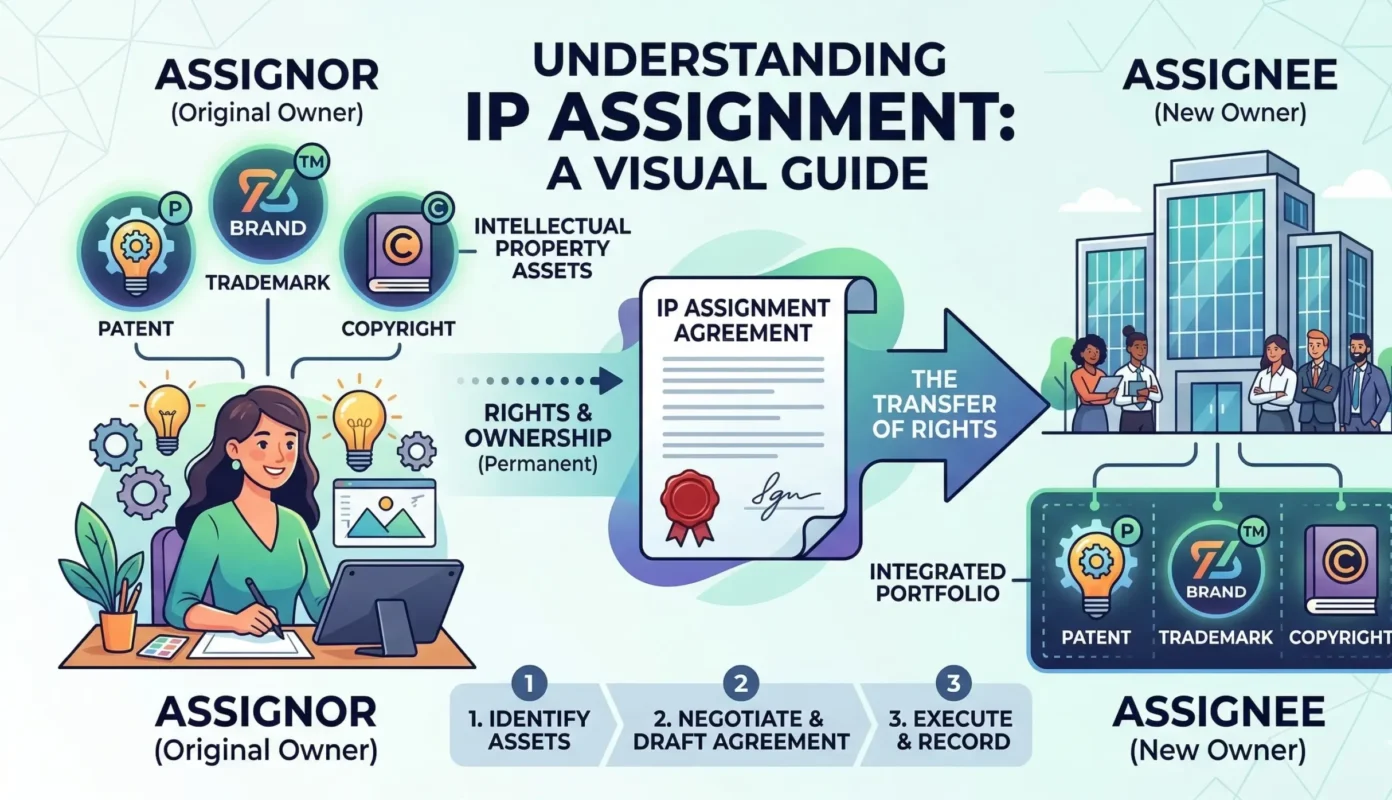
An IP Assignment Agreement (also called an Intellectual Property Assignment Agreement or IP Transfer Agreement) is a legally binding contract through which the creator or owner of intellectual property (IP) formally transfers their rights to another party, typically a business, employer, or investor.
Whether you are a startup founder assigning IP to your company, a freelancer handing over a custom-built product, or an employer protecting company inventions, this document is one of the most critical contracts in any IP-driven business.
Without a properly executed IP assignment agreement, ownership of your most valuable assets such as your brand, your code, your patents, your creative work remains legally ambiguous. Courts across jurisdictions including the US, UK, EU, India, and Australia have repeatedly ruled against companies that failed to formalise IP ownership.
|
⚡ Quick Answer : An IP Assignment Agreement is a contract that transfers ownership of intellectual property including patents, copyrights, trademarks, and trade secrets, from one party to another. It is commonly used by startups, freelancers, and businesses to ensure the company, not an individual, legally owns all work created in connection with the business. |
Why IP Assignment Agreements Matter in 2026
In the modern knowledge economy, intellectual property is often the single most valuable asset a company holds. A missing or defective IP assignment can:
- Block a funding round — investors and VCs routinely review IP ownership during due diligence
- Invalidate an acquisition — buyers will walk away if IP ownership is unclear
- Create costly legal disputes — ex-founders or contractors may claim ownership of core technology
- Expose your business to infringement claims — if IP ownership is uncertain, your right to use it is too
- Affect patent applications — IP must be correctly assigned to file in the company’s name
What Does an IP Assignment Agreement Cover?
A comprehensive IP assignment agreement typically addresses the following types of intellectual property:
| IP Type | What It Protects | Common Examples |
| Patents | Novel inventions & processes | Technology, pharmaceuticals, mechanical devices |
| Copyrights | Original creative works | Code, designs, written content, music, art |
| Trademarks | Brand identity elements | Logos, brand names, slogans, trade dress |
| Trade Secrets | Confidential business info | Algorithms, formulas, customer lists, strategies |
| Domain Names | Online brand presence | Website addresses, digital identifiers |
Key Clauses in an IP Assignment Agreement
Any enforceable IP assignment agreement should include these essential clauses:
- Definition of Assigned IP
Clearly describe what is being assigned such as patents, copyrights, trademarks, trade secrets, or all of the above. Be as specific as possible to avoid later disputes about scope.
- Consideration
For an IP assignment to be legally valid in most jurisdictions, there must be ‘consideration’ (something of value exchanged). This can be monetary payment, equity, employment, or even a nominal amount such as $1 / £1 / ₹10. Without consideration, a contract may be unenforceable.
- Representations and Warranties
The assignor (the party transferring IP) must confirm they actually own the IP being transferred, it is free of third-party claims, and it does not infringe existing rights. This protects the assignee (receiving party) from unknowingly acquiring encumbered IP.
- Further Assurances
This clause requires the assignor to sign additional documents and assist the assignee in formally registering the IP (e.g., with patent offices, copyright registries), even after the main agreement is executed.
- Moral Rights Waiver
Particularly relevant in the EU, UK, Canada, and Australia, where creators retain ‘moral rights’ (such as the right to attribution) even after assigning economic rights. The assignee typically requires a waiver of these moral rights.
- Governing Law and Jurisdiction
Specify which country’s or state’s law governs the agreement and where disputes will be resolved. For global businesses, this clause requires careful consideration.
| Authoritative Perspective: What Legal Experts & Courts Say
IP assignment agreements are not a ‘nice to have’, they are foundational legal infrastructure for any IP-intensive business. Key authoritative positions include: • The USPTO (United States Patent & Trademark Office) requires IP to be formally assigned to a legal entity before patents can be filed in that entity’s name. • The UK Intellectual Property Office (UK IPO) recognises that oral assignments have no legal effect, IP transfers must be documented in writing and signed by the assignor. • WIPO (World Intellectual Property Organization) guidelines note that IP assignment clauses in employment contracts must be explicit; courts will not imply an assignment. • In Akazoo S.A. v. Various Parties (Delaware, 2022), investor litigation was complicated significantly by IP ownership ambiguity traced to missing assignment documentation. • The Indian Copyright Act, 1957 (as amended) specifies that copyright assignments must be in writing, signed, and must identify the works, duration, and territorial extent. 📌 The consistent message from regulators and courts worldwide: get it in writing, get it signed, get it right. |
IP Assignment Agreement vs. Licence Agreement: Key Differences
Many people confuse IP assignment with IP licensing. The distinction is fundamental:
| Factor | IP Assignment | IP Licence |
| Ownership transfer | Yes, full ownership transfers | No, owner retains ownership |
| Duration | Permanent | Typically time-limited |
| Reversibility | Generally irreversible | Can expire or be revoked |
| Best used for | Startup IP, employment IP, freelance work | Software licensing, franchising, partnerships |
| Consideration required | Yes (usually) | Usually royalties or fees |
| ⚠️ IMPORTANT DISCLAIMER
The template below is provided for REFERENCE AND EDUCATIONAL PURPOSES ONLY. It is not legal advice and does not constitute a valid legal document without review by a qualified lawyer. IP law varies significantly by jurisdiction. It is strongly recommended that you engage a qualified contracts lawyer or IP solicitor to draft a custom IP Assignment Agreement tailored to your specific business, jurisdiction, and circumstances. |
Sample IP Assignment Agreement Template
| INTELLECTUAL PROPERTY ASSIGNMENT AGREEMENT
This Agreement is entered into as of [DATE] (“Effective Date”) between: Assignor: [FULL LEGAL NAME], residing at [ADDRESS] (“Assignor”) Assignee: [COMPANY NAME], a [TYPE OF ENTITY] incorporated under the laws of [JURISDICTION], with its principal office at [ADDRESS] (“Assignee”) 1. Assignment of Intellectual Property The Assignor hereby irrevocably assigns, transfers, and conveys to the Assignee all right, title, and interest in and to all Intellectual Property created, conceived, or developed by the Assignor in connection with [describe scope, e.g., the business of the Assignee / the Project defined in Schedule A], including but not limited to all patents, patent applications, copyrights, trademarks, trade secrets, domain names, and related rights, whether currently existing or developed in the future during the term of the Assignor’s engagement with the Assignee. 2. Consideration In consideration of the assignment set forth herein, the Assignee shall pay the Assignor the sum of [AMOUNT / OR: issue [X] shares of [CLASS] stock] (the “Consideration”), receipt of which is hereby acknowledged. 3. Representations and Warranties The Assignor represents and warrants that: (a) Assignor is the sole and lawful owner of the Assigned IP; (b) the Assigned IP is free and clear of all liens, encumbrances, and third-party claims; (c) the Assigned IP does not, to Assignor’s knowledge, infringe any third-party intellectual property rights; and (d) Assignor has full right and authority to enter into this Agreement. 4. Further Assurances Assignor agrees to execute such additional documents and take such further actions as Assignee may reasonably request to perfect, record, and enforce the Assignee’s rights in the Assigned IP, including filing assignments with relevant IP offices worldwide. 5. Moral Rights Waiver To the fullest extent permitted by applicable law, Assignor hereby irrevocably and unconditionally waives all moral rights (including rights of attribution and integrity) in the Assigned IP in favour of the Assignee and its successors and assigns. 6. Governing Law This Agreement shall be governed by and construed in accordance with the laws of [JURISDICTION], without regard to its conflict of law provisions. Any disputes shall be subject to the exclusive jurisdiction of the courts of [JURISDICTION]. 7. Entire Agreement This Agreement constitutes the entire agreement between the parties with respect to the subject matter hereof and supersedes all prior and contemporaneous agreements, representations, and understandings. IN WITNESS WHEREOF, the parties have executed this Agreement as of the date first written above.
|
IP Assignment Laws by Jurisdiction
| Jurisdiction | Key Requirement |
| 🇺🇸 United States | Assignments must be in writing per 35 U.S.C. § 261 (patents). Copyright assignments require a written instrument signed by the assignor (17 U.S.C. § 204). State law governs enforceability of employment IP clauses. |
| 🇬🇧 United Kingdom | Patents Act 1977 and CDPA 1988 require written, signed assignments. Moral rights exist and should be explicitly waived. |
| 🇪🇺 European Union | IP Enforcement Directive 2004/48/EC governs enforcement. Assignment requirements vary by member state but writing is universally required. |
| 🇮🇳 India | Trademark, Copyright and Patent Act mandates written, signed assignments specifying duration, territory, and rights transferred. |
| 🇦🇺 Australia | Copyright Act 1968 (Cth) requires written assignments. Moral rights cannot be assigned but can be consented to. |
| 🇸🇬 Singapore | Copyright Act 2021 and Patents Act require written, signed instruments. Singapore is a common-law jurisdiction aligned with UK principles. |
7 Common IP Assignment Mistakes to Avoid
- Assuming employment = IP ownership: In many jurisdictions, an employer must have an explicit written assignment clause — employment alone is not enough.
- Using a contractor without an assignment clause: Freelancers and contractors often own what they create by default. Always include an IP assignment clause in every services agreement.
- Leaving out ‘future IP’: An assignment that only covers existing IP leaves future inventions unprotected. Good agreements cover IP created during the engagement.
- Missing consideration: An assignment with no consideration (‘for free’) may be unenforceable as a contract in many jurisdictions.
- Failing to register the assignment: In many countries, IP assignments should be recorded with the relevant IP office to be enforceable against third parties.
- Ignoring moral rights: In the EU, UK, Canada, and Australia, failing to waive moral rights can complicate future use of the IP.
- Using a generic template without legal review: IP law is highly jurisdiction-specific. A template valid in the US may be incomplete or unenforceable in India, Germany, or Australia.
When Do You Need an IP Assignment Agreement?
You should put an IP assignment agreement in place in any of the following situations:
| Business Scenarios
• Founders assigning IP to a newly incorporated company • Employees creating IP in the course of employment • Contractors or freelancers building products or content • Co-founders contributing pre-existing IP to a joint venture • Mergers, acquisitions, or business asset sales |
Creative & Tech Scenarios
• Software developers or engineers hired to build a product • Designers creating logos, brand assets, or UI/UX • Authors or writers producing content for a business • Researchers developing patentable innovations • Agency work delivered to a client company |
Conclusion: Protect Your Most Valuable Asset
An IP Assignment Agreement is not bureaucratic paperwork, it is the legal foundation that determines who actually owns your business’s most valuable assets. Whether you are an early-stage startup preparing for investment, a growing company onboarding contractors, or a freelancer delivering work to clients, getting IP assignment right from the start will save you from expensive disputes, failed due diligence processes, and potentially catastrophic loss of ownership.
Use the template in this article as an educational reference to understand the structure and key clauses involved. Then, take the critical next step: consult a qualified IP lawyer or contracts solicitor of My Legal Pal to have a custom agreement drafted that is fully enforceable in your jurisdiction and tailored to your specific situation.
| 💡 Pro Tip: For startup founders specifically, ensure every founder signs an IP assignment agreement before the company is incorporated (or immediately upon incorporation). This is standard practice in Silicon Valley, London, Singapore, and every other major startup ecosystem worldwide because investors will check. |
Frequently Asked Questions (FAQs)
Q: Is an IP assignment agreement the same as a work-for-hire clause?
A: Not exactly. A work-for-hire clause (particularly under US copyright law) designates certain commissioned works as belonging to the employer from creation. An IP assignment agreement is broader and transfers ownership of all types of IP including patents and trademarks and not just copyright. In jurisdictions where work-for-hire doctrine does not apply, a formal IP assignment is essential.
Q: Can IP be assigned without payment?
A: Technically, in some common-law jurisdictions, IP can be assigned as a ‘gift’, but this is legally risky. Most jurisdictions require ‘consideration’ (something of value) for a contract to be enforceable. Best practice is always to include a consideration clause, even a nominal amount such as $1 / £1, to ensure enforceability.
Q: Does an employment contract automatically assign IP to an employer?
A: This varies by jurisdiction. In the UK, Section 39 of the Patents Act 1977 provides some automatic assignment for employee inventions created in the course of their normal duties. In the US, the position varies by state. In India and many civil law countries, you need an explicit written assignment clause. Never assume employment alone transfers IP rights.
Q: What happens if a founder leaves without signing an IP assignment?
A: This is one of the most common and costly startup failures. If a founder leaves before signing an IP assignment, they may retain ownership of key IP, including code, brand elements, or product concepts, even if the company has continued to use and develop that IP. Addressing this post-departure requires negotiation and may involve significant legal costs or litigation.
Q: Do I need to register an IP assignment?
A: Registration requirements vary. For patents, most major patent offices (USPTO, EPO, IPO, IPIndia) allow or require recording of assignments. For copyright, registration of assignments is optional in some countries but provides important legal protections. For trademarks, recording an assignment with the trademark office is generally recommended to establish public record of ownership.
Q: Can I use an IP assignment agreement template found online?
A: A template is a useful starting point for understanding what an IP assignment agreement should contain. However, because IP law is highly jurisdiction-specific and the consequences of an incorrectly drafted assignment can be severe (including loss of IP ownership), it is strongly recommended that you have any IP assignment agreement reviewed and customised by a qualified contracts lawyer or IP solicitor familiar with the relevant jurisdiction.
Q: What is the difference between an IP assignment and a confidentiality agreement (NDA)?
A: An NDA (Non-Disclosure Agreement) protects confidential information by restricting who can share it, but does not transfer ownership. An IP assignment actually transfers legal ownership of intellectual property from one party to another. Businesses often use both together, an NDA to protect information during early-stage discussions, and an IP assignment to formally transfer ownership upon engagement.
| Legal Disclaimer
This article is for informational and educational purposes only. It does not constitute legal advice. The sample template provided is a reference document only and should not be used as a final legal agreement without review by a qualified lawyer. IP laws vary significantly across jurisdictions. Always seek professional legal advice for your specific situation. |

Prakhar Rai | Founder & Attorney
