Last updated on August 2nd, 2026 at 05:03 pm
TL;DR: Terms and Conditions are more than a standard legal document. They establish the contractual relationship between your business and its users, define acceptable use, protect your intellectual property, limit liability, and provide a framework for resolving disputes. Without properly drafted and enforceable Terms, businesses may struggle to remove abusive users, protect their platform, or defend legal claims. In 2026, modern Terms and Conditions should also address AI-generated content, subscription billing, user-generated content, APIs, cybersecurity, digital products, cross-border users, and evolving consumer protection requirements. Businesses should use clear clickwrap acceptance, regularly update their Terms as products and laws change, and ensure they work alongside documents such as a Privacy Policy, Cookie Policy, and Disclaimer to create a comprehensive legal framework.
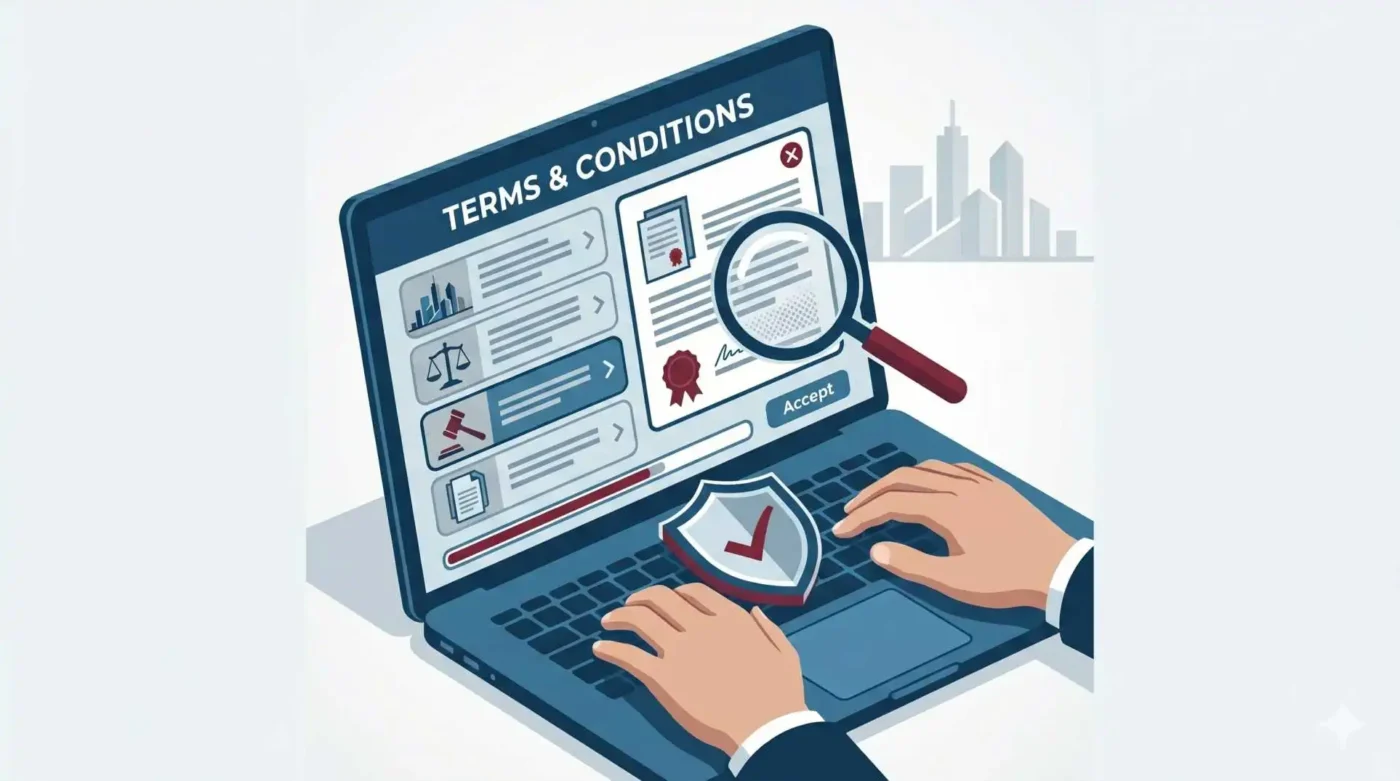
Terms and conditions are the legal agreement between a business and the people who use its website, app, or service. They set out the rules a user has to follow, what the business is and is not responsible for, and what happens when someone breaks those rules. You will also see them called Terms of Service, Terms of Use, a User Agreement, or in some cases an End User Licence Agreement.
Most people scroll straight past them and click accept. Most business owners treat them as a formality to deal with later. Both are mistakes, just on opposite sides of the same agreement.
This guide explains what terms and conditions actually do, what belongs in them, why a weak set is almost as risky as having none at all, and when you genuinely need them drafted properly rather than copied from somewhere else.
What Are Terms and Conditions, Exactly?
Terms and conditions are a binding contract formed between you and your user at the moment they accept them. That contract governs the relationship for as long as the user is on your platform. It tells them what they are allowed to do, what they are not, and the basis on which you are providing your product or service.
The name varies but the function is broadly the same. Terms of Use tends to describe the rules for using a product or service. Terms of Service is the version software and online businesses use most often. An End User Licence Agreement comes into play when someone installs or downloads software onto their own device. Whatever the label, the document is doing the same job: turning your relationship with the user into something enforceable.
If you want the wider context on how this fits with other commercial documents, our business contracts guide walks through the full picture. It is also worth understanding the basic difference between a contract and an agreement, since the two words get used loosely but mean specific things in law.
Why Terms and Conditions Matter
Terms and conditions are not decoration. They are the thing you reach for when something goes wrong, and they only help if they were written properly before the problem arose.
A clear set of terms gives you a legal basis to suspend or remove a user who is abusing your platform. They limit your liability when your service has downtime or an error causes a user loss. They establish who owns the content and the intellectual property on your platform. They set out how disputes get resolved and which country’s law applies. Without these, you are exposed on every one of those fronts.
They also do something less obvious. They build trust. A user who can see clear, fair terms is more comfortable transacting with you than one who finds nothing, or finds something obviously copied and inapplicable. For a business of any size, that matters.
What Goes Into a Set of Terms and Conditions
The exact contents depend on your business, but most well-drafted terms cover a recognisable set of provisions.
Acceptance of terms
A statement that by using the product or service, the user agrees to be bound. How this acceptance is captured matters more than most people realise, which we come back to below.
Description of the service
A clear account of what you are offering, its features, and its limitations.
User responsibilities and acceptable use
What the user can and cannot do. For platforms that host content or give API access, this often sits in a separate, more detailed document. Our piece on what an acceptable use policy is explains when you need that as a standalone document.
Intellectual property
Who owns the brand, the content, and the software, and what users are allowed to do with it. If contractors or freelancers built any part of your product, this connects directly to the question of whether you even own what you are licensing, which our guide on why startups lose ownership of their own product covers in detail.
Privacy and data protection
How you handle user data. In most cases this is a separate privacy policy referenced from your terms, because data protection law in most countries requires a dedicated document.
Limitation of liability
The cap on what you can be held responsible for. This is one of the most commercially important provisions in the whole document. Leaving it out, or getting it wrong, is a genuine risk, as we explain in how not having a limitation of liability clause can kill your startup.
Termination and suspension
The conditions under which you can end or pause a user’s access.
Governing law and dispute resolution
Which country’s law applies and how disagreements are handled, whether through the courts, arbitration, or another mechanism.
The Acceptance Mechanism: Where Many Businesses Slip Up
Having good terms is not the same as having enforceable terms. How a user accepts them decides whether a court will hold them to it.
Courts draw a clear line between clickwrap and browsewrap. A clickwrap agreement requires the user to take an active step, ticking a box or clicking “I agree,” before they can proceed. A browsewrap agreement simply links to the terms at the bottom of a page and assumes the user accepted them by continuing to use the site. Clickwrap agreements are far more reliably enforced. Browsewrap terms are frequently challenged and often fail, because the user can credibly say they never saw or agreed to them.
If your terms sit as a quiet link in your footer rather than something a user actively accepts, you may find them difficult to rely on at the exact moment you need them.
What Happens Without Proper Terms and Conditions
A business operating without adequate terms has no clean contractual basis to deal with the situations that terms are designed for. You cannot point to an agreed rule when removing an abusive account. You have no agreed cap on your liability when a user claims your service caused them a loss. You have no clear position on who owns content uploaded to your platform. And you have no agreed forum for resolving a dispute, which means it gets resolved wherever the other party chooses to bring it.
A weak or copied set of terms creates a related problem. Terms lifted from another company’s website are drafted for that company’s business, that company’s jurisdiction, and that company’s risks. They may be unenforceable for you, non-compliant with the laws that actually apply to your users, or simply silent on the issues that matter most to your specific business. Our article on why contract templates can be dangerous for your business goes into why borrowed documents so often fail when tested.
2026 Legal Considerations for Modern Terms and Conditions
Terms and Conditions have evolved significantly over the last few years. Businesses today operate across multiple jurisdictions, rely on cloud services, artificial intelligence, subscription billing, APIs, and user-generated content. As a result, a generic set of website terms is no longer enough. A modern Terms and Conditions agreement should address today’s legal and commercial realities while remaining flexible enough to adapt as your business grows.
AI Services and AI-Generated Content
If your business uses artificial intelligence in any way, whether through chatbots, AI-generated content, image generation, coding assistants, or automated recommendations, your Terms and Conditions should specifically address it.
Your terms should explain:
- that AI-generated responses may contain errors or inaccuracies;
- that users should independently verify important information;
- who owns AI-generated outputs where permitted by applicable law;
- whether users retain ownership of prompts they submit;
- whether the business may use user inputs to improve its services, subject to applicable privacy laws and user choices; and
- that AI-generated content should not be treated as legal, medical, financial, or other professional advice unless expressly stated.
These provisions help manage user expectations while reducing the risk of disputes arising from reliance on automated systems.
Subscription and Automatic Renewal Terms
Many online businesses now operate on recurring subscription models rather than one-time purchases.
Your Terms and Conditions should clearly explain:
- subscription pricing;
- billing frequency;
- automatic renewal;
- cancellation procedures;
- free trial conditions;
- payment failures;
- refunds where applicable; and
- when access to the service may be suspended or terminated.
Clear subscription terms reduce customer disputes and improve compliance with consumer protection laws in many jurisdictions.
User-Generated Content
If users can upload reviews, photos, videos, comments, documents, or other content, your Terms and Conditions should explain:
- who owns uploaded content;
- the licence granted to your business to display or process that content;
- prohibited content;
- your right to remove content;
- procedures for reporting copyright infringement; and
- consequences of repeated violations.
This is particularly important for marketplaces, SaaS platforms, social platforms, online communities, and educational websites.
Intellectual Property and Digital Assets
Modern businesses often create valuable digital assets including software, databases, AI models, training materials, templates, videos, and online courses.
Your Terms should clearly state:
- ownership of your intellectual property;
- restrictions on copying or redistribution;
- whether users receive ownership or only a limited licence;
- commercial use restrictions; and
- consequences of intellectual property infringement.
This helps protect your business from unauthorised copying and misuse.
API Access and Developer Use
If your platform provides an API or developer tools, your Terms should include additional rules covering:
- API usage limits;
- authentication requirements;
- prohibited automated activity;
- reverse engineering restrictions;
- rate limiting;
- scraping restrictions; and
- suspension of developer access for misuse.
Dedicated API provisions can significantly reduce abuse while protecting platform stability.
Cybersecurity and Account Protection
Cybersecurity has become a major legal and commercial concern for online businesses.
Your Terms should require users to:
- maintain secure passwords;
- protect login credentials;
- avoid sharing accounts without authorisation;
- notify you of suspected security breaches; and
- refrain from attempting to interfere with the security of the platform.
Businesses should also reserve the right to suspend accounts where security concerns arise.
International Users and Cross-Border Business
Many websites now serve customers around the world.
Your Terms should explain:
- the governing law;
- dispute resolution procedures;
- jurisdiction;
- currency and payment terms;
- tax responsibilities where applicable; and
- any geographic restrictions on the availability of products or services.
This provides greater certainty when disputes involve users from different countries.
Consumer Protection Requirements
Terms and Conditions cannot override mandatory consumer rights.
Depending on the jurisdiction, certain legal protections may apply regardless of what your contract says, including statutory warranties, cooling-off periods, refund rights, or protections against unfair contract terms.
Businesses should ensure their Terms remain consistent with applicable consumer protection laws in every market where they operate.
Recording User Acceptance
Having well-drafted Terms is only part of the process. You should also be able to demonstrate that users actually accepted them.
Businesses should maintain records of:
- the version of Terms accepted;
- the date and time of acceptance;
- IP address or device information where appropriate;
- user account details; and
- any subsequent acceptance of updated Terms.
Using a clear clickwrap mechanism, where users actively click “I Agree” before accessing the service, is generally more reliable than passive browsewrap notices.
Updating Your Terms and Conditions
Your Terms should not remain unchanged indefinitely.
Businesses should review and update them whenever there are significant changes to:
- products or services;
- pricing models;
- privacy practices;
- payment providers;
- applicable laws;
- international expansion;
- AI functionality; or
- security practices.
Whenever material changes are made, businesses should consider notifying users and obtaining renewed acceptance where appropriate.
Common Mistakes Businesses Make
Many businesses unintentionally weaken their legal protection by:
- copying Terms from another website;
- using generic online templates without legal review;
- failing to include limitation of liability provisions;
- omitting intellectual property protections;
- relying on browsewrap instead of clickwrap acceptance;
- failing to update Terms as the business evolves;
- creating inconsistencies between their Terms, Privacy Policy, and Cookie Policy; or
- using documents that do not reflect the jurisdictions where they actually operate.
Well-drafted Terms should be tailored to your specific business model, products, customers, and legal obligations rather than borrowed from another company.
Terms and Conditions Are Only One Part of Your Legal Framework
For most online businesses, Terms and Conditions should work alongside several other legal documents, including:
- Privacy Policy
- Cookie Policy
- Disclaimer
- Refund and Cancellation Policy
- Acceptable Use Policy
- End User Licence Agreement (EULA), where applicable
- Data Processing Agreement for B2B services
- Service Level Agreement (SLA), where appropriate
Together, these documents create a comprehensive legal framework that protects both the business and its users while helping demonstrate compliance with applicable laws and industry best practices.
Frequently Asked Questions
Are terms and conditions legally binding?
Yes, when they are properly presented and accepted. A set of terms that a user actively agrees to, typically through a clickwrap mechanism, forms a binding contract. Terms that are merely linked in a footer without any active acceptance are far weaker and are often unenforceable, because the user can argue they never agreed to them.
Do I legally need terms and conditions for my website?
There is no single law that forces every website to have terms and conditions, but operating without them leaves you exposed on liability, intellectual property, acceptable use, and dispute resolution. If your site collects any personal data, you are separately required in most jurisdictions to have a privacy policy. For any business website handling users, customers, or transactions, terms are a practical necessity rather than an optional extra.
What is the difference between terms and conditions and a privacy policy?
Terms and conditions govern the rules of using your product or service and the contractual relationship between you and the user. A privacy policy specifically explains how you collect, use, store, and share personal data. They are separate documents serving separate purposes, and in most countries a privacy policy is legally required wherever you handle personal data. They are usually cross-referenced, with the terms linking to the privacy policy.
Can I copy terms and conditions from another website?
You should not. Copying another site’s terms is a copyright issue, and more importantly the borrowed document is drafted for a different business, a different jurisdiction, and a different set of risks. It may be unenforceable for you and may not comply with the laws that apply to your users. Terms should be drafted for your specific business, product, and the markets you operate in.
What is the difference between Terms of Service and an End User Licence Agreement?
Terms of Service govern a user’s access to and use of an online product or service, usually accepted through a clickthrough at signup. An End User Licence Agreement applies where a user downloads or installs software onto their own device, and it governs what they can do with that software, including restrictions on copying, modifying, and redistributing it. A pure browser-based service often needs only Terms of Service, while a product with a desktop or mobile app typically needs both.
Get Your Terms and Conditions Done Properly
Terms and conditions are one of those documents that look like a formality right up until the moment you need to rely on them. A clear, enforceable, properly drafted set protects your business across liability, intellectual property, acceptable use, and dispute resolution. A weak or borrowed set often does none of those things when tested.
My Legal Pal contract lawyers drafts and reviews terms and conditions, privacy policies, and the full set of website and platform documents for businesses across India and internationally, tailored to your product, your users, and the law that actually applies to you. We offer unlimited revisions so the final document genuinely fits your business.
Visit My Legal Pal to get your terms and conditions drafted or reviewed.
My Legal Pal. Making Legal Simple.
This article is published for informational and educational purposes only. It does not constitute legal advice. Requirements for terms and conditions vary by jurisdiction and by the nature of your business. Always consult a qualified lawyer for advice specific to your situation.