Terms and conditions questions people actually ask.
What is the difference between terms and conditions, terms of service, and terms of use?
Functionally, they are the same document under different conventional names. “Terms and conditions” (often “T&Cs”) is the most common term in the UK, India, and e-commerce generally. “Terms of service” (ToS) is common for SaaS and online platforms, particularly in the US. “Terms of use” is common for websites and content platforms. The legal content is the same: the contract between you and your users. The name is a convention, not a legal distinction.
What is the difference between terms and conditions and a privacy policy?
They are two separate documents that do different jobs. Terms and conditions are the contract governing how users may use your platform: acceptable use, IP, payment, liability, termination. A privacy policy is a disclosure document explaining what personal data you collect, why, how you use it, and what rights users have over it, required by GDPR, the UK GDPR, India’s DPDPA, California’s CCPA, and equivalent laws. Most platforms legally need both. The terms can be optional in some contexts; a privacy policy is mandatory the moment you collect any personal data.
Are terms and conditions legally required?
Terms and conditions are not strictly mandatory by law in most jurisdictions, but operating without them leaves you without contractual protection: no enforceable acceptable-use rules, no liability cap, no clear IP position, no defined termination rights. A privacy policy, by contrast, is legally mandatory wherever you collect personal data. In practice, any platform that handles users, payments, or content needs both.
Can I just use a free terms and conditions generator?
A generator produces generic boilerplate that is not tailored to your platform, your business model, or your jurisdiction. For a hobby site with no users and no transactions, it may be adequate. For any platform with paying users, user-generated content, app store distribution, or regulatory exposure, a generated template typically lacks the calibrated liability cap, the correctly scoped IP and content licences, the enforceable acceptance mechanism, and the jurisdiction-specific compliance that make the document actually protect you. The most expensive terms of service is the generated one that fails when you rely on it.
Do I need different terms for my website and my app?
Often yes. A website and a mobile app involve different relationships, different distribution channels, and different compliance requirements. Apps must satisfy Apple App Store and Google Play guidelines (account deletion, subscription disclosure, in-app purchase rules) that websites do not. A platform with both usually needs terms that cover each surface correctly, sometimes one document with app-specific sections, sometimes two.
What is browsewrap vs clickwrap?
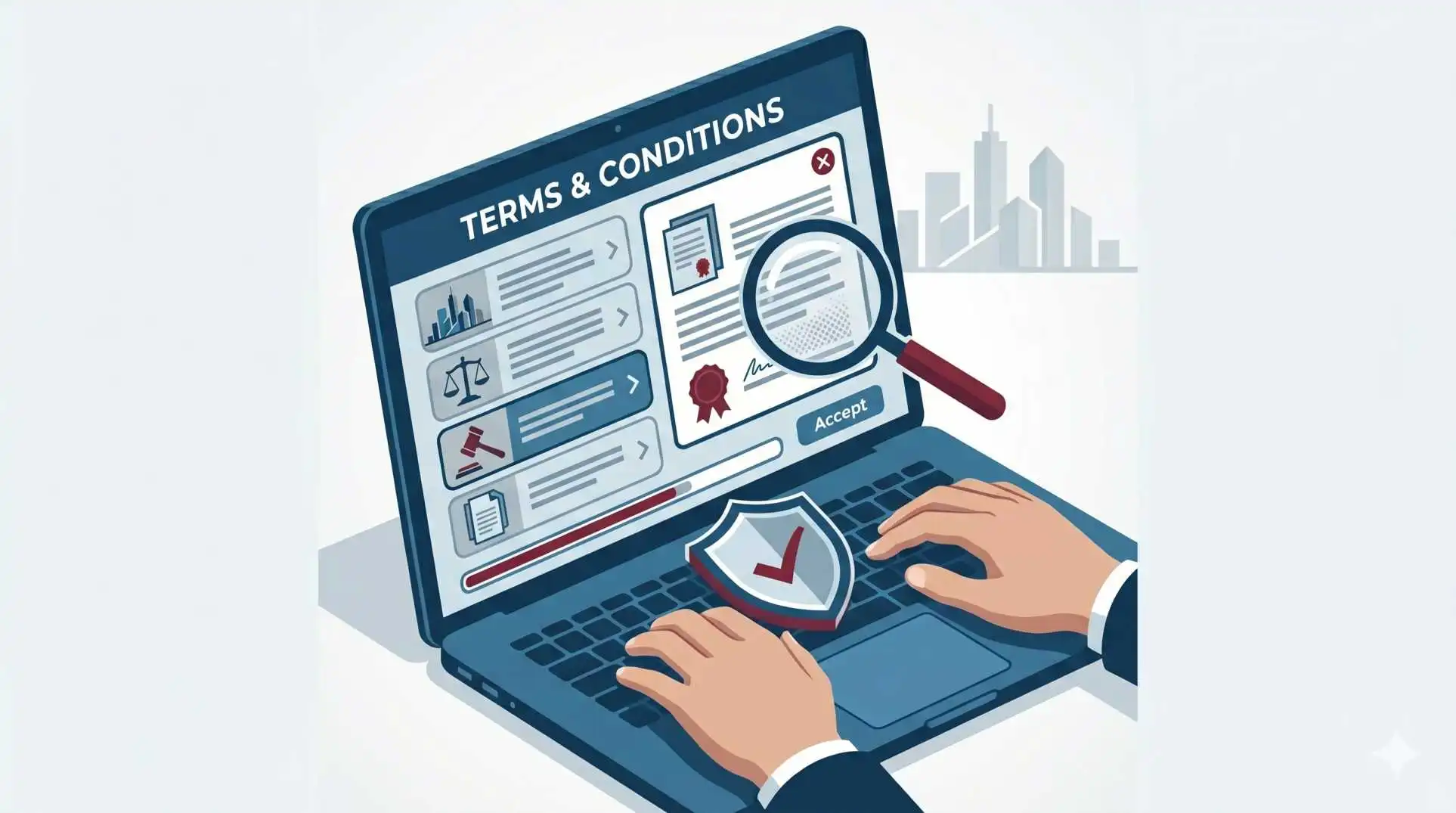
Two ways users accept terms. Browsewrap places the terms behind a link (often in the footer) and assumes use of the site implies agreement. Clickwrap requires an affirmative action, ticking “I agree” or clicking “Accept”, before the user proceeds. Clickwrap is significantly more enforceable; courts in multiple jurisdictions have refused to enforce browsewrap terms where the user could not reasonably have known they were agreeing. How your platform captures acceptance affects whether your terms hold up at all.
How do terms and conditions relate to my other contracts?
Your terms and conditions govern the standard relationship with ordinary users. For larger or custom relationships, an enterprise customer, a vendor, an investor, you will usually need a separately negotiated agreement. If you need one drafted, see contract drafting; if you have received one to assess, see contract review.