Last updated on August 14th, 2026 at 02:09 pm
Here is a situation that plays out in startup due diligence rooms more often than anyone in the industry likes to admit.
A founder has spent two years building a product. They raised a pre-seed round, grew to fifteen thousand users, got introduced to a Series A investor who liked what they saw, and spent three weeks preparing for the investment process. Then the investor’s lawyers started asking questions about IP ownership.
Who wrote the original codebase? A freelance developer, hired in the first six months. Was there an IP assignment agreement? No, there was a contract for services with a rate and a delivery schedule. Who owns that code? The developer. The company does not.
The round does not close until this is fixed. Fixing it requires finding the developer, explaining the situation, and asking them to sign a retrospective assignment. Sometimes they cooperate. Sometimes they ask for money. Sometimes they have moved countries and are difficult to reach. Sometimes they understand what leverage they hold and they use it.
This story is not unusual. Versions of it happen constantly, across all stages, in every industry where software, design, or creative work is central to the product. And it is entirely preventable.
The Default Legal Position Nobody Tells Founders About
The starting point under copyright law in the United States, the United Kingdom, India, Australia, and most countries that follow common law principles is this: the person who creates something owns it.
Not the person who paid for it. The person who made it.
This is not a quirk or a loophole. It is a fundamental principle of intellectual property law that predates the software industry by decades. Copyright in a creative work vests automatically in the author at the moment of creation. A freelance developer who writes code owns that code. A designer who creates a logo owns that logo. A copywriter who produces your website content owns that content.
The only way that ownership transfers to the person who paid is through a written agreement that explicitly assigns it.
Payment alone does not transfer IP. A signed invoice does not transfer IP. A project brief does not transfer IP. A verbal agreement does not transfer IP in any jurisdiction that requires a written assignment for copyright. You need a specific written clause that says, in clear terms, that the IP in the work being created is assigned to you.
Most startup founders do not know this when they hire their first developer or designer. By the time they find out, they have often already paid for work they do not legally own.
How the IP Ownership Gap Gets Created
Understanding how this happens helps you prevent it. There are several distinct ways startups end up without ownership of their own product.
The freelancer situation. A startup in its early stages cannot afford full-time developers, designers, or content creators. They hire freelancers from platforms like Upwork or Toptal, or through personal networks, and pay them to build components of the product. The engagement is documented with a rate, a brief, and sometimes a simple services agreement. The services agreement covers the commercial terms. It says nothing about who owns what is produced. The freelancer delivers the work, gets paid, and walks away legally owning the copyright in everything they built.
The agency situation. Many startups hire agencies to build their initial product, brand, or marketing assets. Agencies almost always use their own standard contract. That contract typically includes a clause confirming that the agency retains ownership of all work until full payment is received, and sometimes even after full payment unless an IP assignment is explicitly included. Startups that sign agency contracts without reading them carefully often discover that payment did not result in ownership.
The co-founder contribution situation. A technical co-founder who wrote the first version of the product before the company was incorporated may own that code personally. Once the company exists and the co-founder becomes an employee or a director, there is still no automatic assignment of that pre-incorporation work to the company. If that co-founder later leaves the business, the code they wrote before the company existed may leave with them, or at least create a genuine ownership dispute.
The employee grey area. Employment law in most jurisdictions provides that work created by an employee in the course of their employment belongs to the employer. But “in the course of their employment” is narrower than most founders assume. Work created by an employee outside their defined role, in their personal time, using personal equipment, may not automatically vest in the company. An employee who developed a feature in the evenings on their personal laptop has an arguable claim that the work falls outside the statutory automatic assignment.
The contractor who is really an employee. Startups that classify workers as contractors to manage costs sometimes find that those workers are actually employees under applicable law. In that case, the contractor classification fails, the worker may be treated as an employee, but the IP assignment provisions of the contractor agreement may not be valid if the whole characterisation of the relationship was wrong.
What Happens to Your Startup When the IP Is Not Yours
The practical consequences of an IP ownership gap range from inconvenient to catastrophic depending on the stage of your business and the significance of the missing assignment.
You may need a licence from the person who owns it. If a freelancer or developer owns the code underlying your product, you are not technically authorised to use it without their permission. You have an implied licence to use the specific deliverable they produced, but that implied licence has limits. You may not be able to modify it, sublicence it, or build on it in ways that go beyond the specific use the developer reasonably anticipated when they were engaged.
The freelancer can ask for payment to transfer. Once a freelancer understands they own IP that is valuable to your business, they are in a position to charge you for the assignment. Some will ask for a nominal amount. Some will calculate a fee based on the commercial value of the IP to your business. A developer who built your core authentication system, your recommendation engine, or your payment infrastructure knows what that code is worth to you if it cannot be reassigned to someone else. This is not extortion. It is the legal position they are entitled to take.
Investors can and do reject startups over missing IP assignments. This is the most commercially immediate consequence for most growth-stage startups. Serious investors conduct IP due diligence as a standard part of their process. They want to see that the company legally owns its core technology, design assets, brand elements, and all other IP central to the business. Missing IP assignments are a deal blocker, not a negotiable point. Some investors will pause a round while gaps are remediated. Others will price the risk into a lower valuation. Some will walk away entirely if the gap is significant or if the missing assignments are from people who are difficult to locate.
An acquisition can collapse at the same point. Buyers in M&A transactions conduct thorough IP due diligence because they are acquiring the product. If the product does not legally belong to the company being sold, the transaction does not work. This problem surfaces at the worst possible moment, when a deal is already negotiated and closing is expected.
Your ability to enforce your IP is compromised. If you discover that a competitor has copied your product and you want to take legal action, you need to be the legal owner of the IP to bring that action. A company that does not hold the copyright in its own codebase has no standing to sue for copyright infringement.
The Documents That Fix This Problem
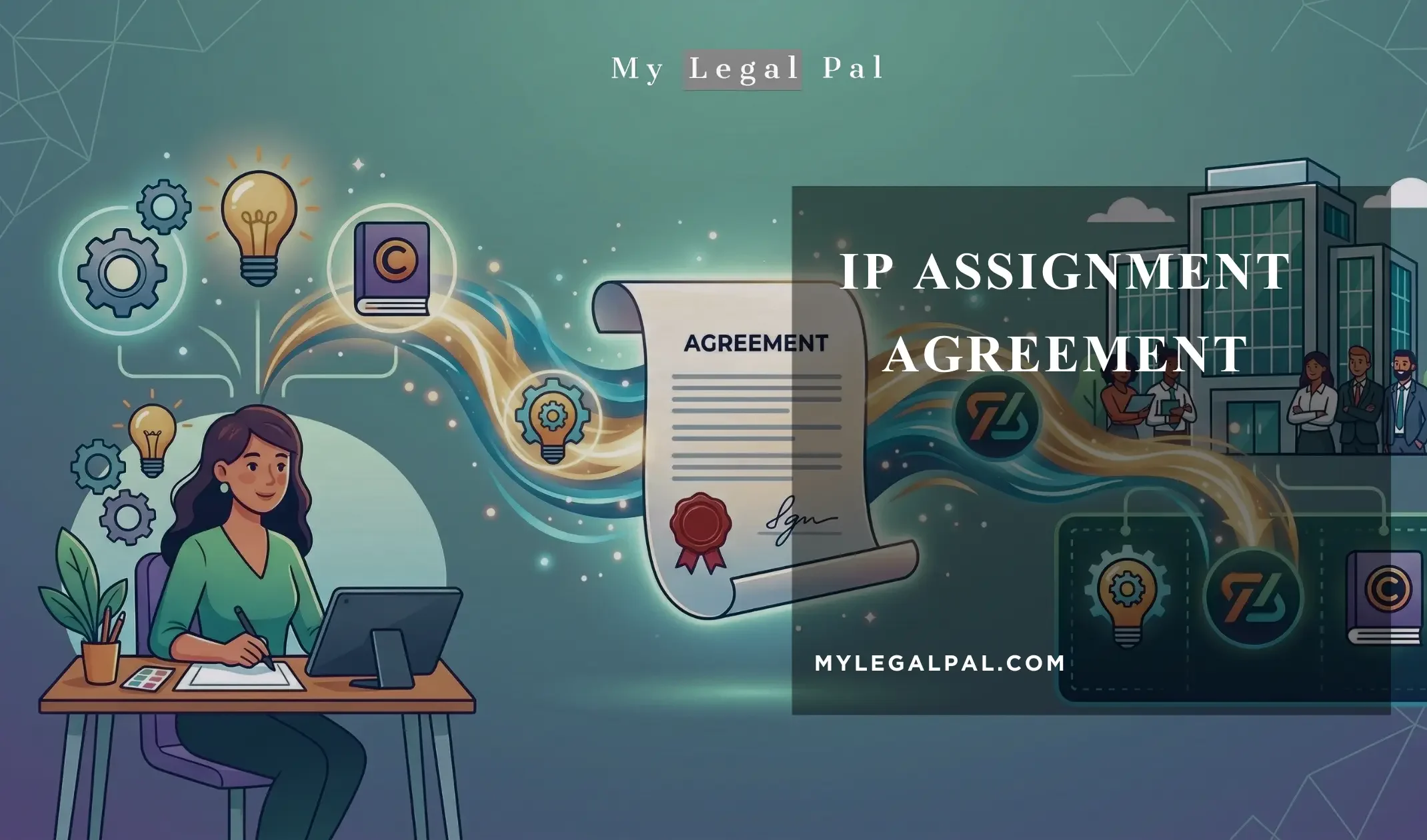
The good news is that the solution is a single, specific document: an IP Assignment Agreement.
An IP assignment agreement is a written contract that transfers ownership of intellectual property from the creator to the company. For startups, this means having a valid assignment in place before any work begins, or securing a retrospective assignment from anyone who created IP for the company without one.
Every contractor or freelancer engagement should include an IP assignment clause as part of the services agreement. The clause does not need to be complicated. It needs to say, in clear terms, that all IP created in connection with the work is assigned to the company, that the assignment covers future work created during the engagement as well as work already completed, and that the contractor will take any further steps needed to formalise the assignment, including signing additional documents if required.
Every employment agreement should include an IP assignment clause that covers work created in the course of employment and clarifies what happens with work created adjacent to the role. A further assurances clause obliging the employee to cooperate with any formal registration or documentation of the assignment is also worth including.
Co-founder IP contributions should be documented separately from the shareholder or founder agreement. A specific IP assignment agreement covering pre-incorporation contributions, signed at or around the time of incorporation, is the clean way to establish that the company owns everything it was built from.
What to Do If a Developer Refuses to Transfer IP Without a Prior Agreement
This is the situation founders dread and it is also the one that is hardest to navigate.
If there was no IP assignment agreement from the start and the developer is now refusing to transfer ownership, your legal options are limited but not non-existent.
Start by understanding what the developer actually wants. Many developers who initially resist an assignment request are not trying to hold the company to ransom. They may not understand why this is being asked years after the fact, they may feel undervalued by how the request was made, or they may want some form of acknowledgement or compensation for work they were paid below market rate for at the time. A direct, honest conversation about why the assignment matters and what you are prepared to offer often produces a resolution.
If the developer is willing to assign but wants compensation, paying a reasonable amount for the assignment is almost always the right commercial decision. The cost of a negotiated assignment is virtually always lower than the cost of not having one when it matters.
If the developer refuses outright, your legal position depends on the specific circumstances. In some jurisdictions, implied licences arising from the payment and delivery of the work may give you broader rights than you have assumed. In some cases, the working relationship may have been characterised in a way that brings it closer to employment than contracting, which affects the default ownership position. In others, prior communications or project documentation may establish the intent that the company would own the work even without an explicit written assignment. A lawyer can assess your specific situation and advise on what options you actually have.
Do not simply continue to use and develop IP that is in a disputed ownership position without legal advice. The longer you build on it without resolution, the more complex and expensive the eventual dispute becomes.
Authoritative Perspective
The legal framework protecting original works through copyright has been reinforced by courts across multiple jurisdictions in ways directly relevant to startup IP ownership.
In the United States, the work-for-hire doctrine under 17 U.S.C. Section 101 covers works created by employees within the scope of their employment and a limited category of specially commissioned works. For independent contractors, a work qualifies as work for hire only if it falls within one of nine defined categories AND both parties expressly agree in a written instrument signed by them. Software code is not one of those nine categories. This means that without a written assignment agreement, a freelance developer in the US owns the code they wrote regardless of payment.
The UK Copyright, Designs and Patents Act 1988 Section 11(2) provides that where a literary work is made by an employee in the course of their employment, the employer is the first owner, subject to any agreement. For contractors and freelancers, the default is the same as the US position. Ownership rests with the creator without a written assignment.
In India, Section 17 of the Copyright Act 1957 vests copyright in the employer for works made by an employee in the course of employment. For works commissioned from independent contractors, the position is less clear and courts have taken varying views. The safest approach under Indian law, as in every other jurisdiction, is a written assignment agreement.
The National Venture Capital Association model documents, used as the baseline for most US venture investment transactions, require founders to make representations at closing that the company owns all material IP free of encumbrances. This is not a formality. It is a warranty with legal consequences if it turns out to be false.
Frequently Asked Questions
Q: Does paying a freelancer automatically transfer ownership of their work?
A: No, and this is the most important thing any founder can understand about IP law. Payment for services does not transfer copyright. The freelancer who was paid to write your code, design your interface, or create your brand assets owns that work by default under copyright law in the US, UK, India, and most other jurisdictions. Ownership transfers only through a written IP assignment agreement signed by the creator. Without one, you have an implied licence to use the specific deliverable, but you do not own it and cannot prevent the creator from using it elsewhere.
Q: Can a developer legally keep ownership of code after being paid?
A: Yes, legally, unless there was a written agreement assigning the copyright. This situation surprises many founders but it is entirely consistent with how copyright law works. The developer can retain ownership, use the code in other projects, and potentially licence it to others including your competitors, unless a written assignment prevents this. The developer owning code they were paid to write is not misconduct on their part. It is the default legal position in the absence of an assignment agreement.
Q: What happens to a startup if it does not own its own IP?
A: Several things can happen, none of them good. You may need a licence from the actual owner to continue using the technology in your product, and that licence may come with conditions or fees. The owner may charge you for an assignment once they realise the leverage they hold. Investors may refuse to proceed with a funding round until ownership is established. An acquirer may reduce the purchase price or walk away from a deal entirely if IP ownership is unclear. If a competitor copies your product, you may have no standing to enforce your IP because you are not the legal owner. The earlier these gaps are discovered and fixed, the less damaging they are.
Q: Can investors reject a startup because of missing IP assignment agreements?
A: Yes, and they regularly do. IP due diligence is a standard part of any serious investment process. Investors are buying into a company whose primary value is its technology, its brand, or its content. If that core IP does not legally belong to the company, the investment is not what it appears to be. Some investors will pause while gaps are fixed. Others will reduce the valuation to reflect the risk. Investors who discover that significant IP belongs to a departed co-founder or unreachable contractor may decline to proceed at all. Missing IP assignments have killed real deals.
Q: What should I do if a developer refuses to transfer IP because there was no agreement from the start?
A: Start with a direct conversation to understand what they want. Compensation, acknowledgement, or simply an explanation of why this matters years after the fact. Many developers who initially resist will cooperate once the situation is explained properly and a reasonable offer is made. If they want payment for the assignment, paying a reasonable amount is almost always cheaper than the alternative. If they refuse outright, consult a lawyer who can assess your position based on the specific circumstances, including the nature of the working relationship, any communications establishing ownership intent, and whether implied licence rights give you more protection than you assumed. Do not continue building on disputed IP without legal advice.
Q: Should I include an IP assignment clause in every contractor agreement?
A: Yes, without exception. There is no legitimate reason not to include an IP assignment clause in any contract with a developer, designer, copywriter, or other creative contractor. The clause is standard, it adds no cost, and it eliminates an entirely foreseeable and entirely avoidable legal risk. Any contractor who refuses to include a standard IP assignment clause in their engagement agreement is worth asking why, and their answer will tell you something useful about the commercial relationship you are about to enter.
Q: Does the IP assignment need to cover future work as well as the initial project?
A: Yes. An assignment that covers only the specific deliverables described in the initial scope leaves future iterations, improvements, and adjacent work in an ambiguous position. A well-drafted IP assignment clause covers all IP created in connection with the engagement from the effective date forward, not just the work described in the initial brief. This is particularly important for ongoing contractor relationships where the scope evolves over time.
Q: What is a present assignment of future IP?
A: A present assignment of future IP is a clause that operates as an immediate legal transfer of ownership of IP that does not yet exist, as and when that IP is created. Without this mechanism, an assignment of future IP might be treated as an agreement to assign in the future, requiring a further act to complete the transfer. A present assignment of future IP means that each new piece of work created under the agreement vests automatically in the company without any additional documentation being required.
Get Your IP Ownership Right Before It Becomes a Problem
If your startup has contractors, freelancers, or co-founders who contributed to the product without signing an IP assignment, the time to fix it is now, not when an investor asks the question.
My Legal Pal drafts IP assignment agreements, contractor service agreements with proper IP clauses, and employment agreements that establish clean IP ownership for startups at every stage. We also advise on retrospective assignments and help founders navigate situations where ownership is disputed or a developer has become difficult to reach.
Visit MyLegalPal.com to get your IP assignment agreements in place or to discuss an existing ownership gap with one of our commercial lawyers.
My Legal Pal. Making Legal Simple.
This article is published for informational and educational purposes only. It does not constitute legal advice. IP ownership law varies by jurisdiction. Always consult a qualified lawyer for advice specific to your startup and circumstances.