Reply to Trademark Objection · India · 2026 Guide

Reply to Trademark Objection in India

Got a trademark objection in your examination report? You usually have 30 days to reply, and a strong, well-argued response is what saves your application. This guide explains why objections are raised, how to read your examination report, how to draft a winning reply, and what happens at the hearing. Reply drafted by trademark attorneys, filed for you.

Received a trademark objection? Send us your application number.

Share your trademark application number or examination report and we will assess the objection, tell you how strong your position is, and draft and file a proper reply, well before your 30-day deadline. Clear fixed fee, confirmed upfront.

Or reach us directly
WhatsApp +91 8004800100 · contact@mylegalpal.com


    In short: A trademark objection is raised by the Trade Marks Registry in the examination report, usually under Section 9 (the mark is descriptive or non-distinctive) or Section 11 (it conflicts with an earlier mark) of the Trade Marks Act, 1999. You have 30 days from the date of the examination report to file a written reply. A good reply argues, with evidence and case law, why the objection does not apply. If the Registry is not satisfied, the matter goes to a hearing. Miss the deadline and your application is treated as abandoned. You can have a trademark attorney draft and file your reply.

    What is a trademark objection?

    A trademark objection is a formal concern raised by the Examiner at the Trade Marks Registry after your application is filed and examined. It is not a rejection. It is the Registry saying, in effect, “we see a problem with this mark, explain why it should still be registered.” The objection is set out in a document called the examination report, and you are given an opportunity to respond before any final decision is taken.

    This is a normal and very common stage. A large share of trademark applications in India receive an objection, often on technical grounds that a well-drafted reply can overcome. The key thing to understand is that an objection is the beginning of a conversation with the Registry, not the end of your application. What you do next, specifically, the quality of your reply, usually decides whether your mark proceeds to registration or is lost.

    The critical fact: you have a strict deadline. Under the current practice, you must file your reply to the examination report within 30 days of the date the report is issued. Miss it, and the Registry can treat your application as abandoned. This guide walks through why objections happen, how to read your report, how to reply, and what happens if it goes to a hearing. If you would rather have it handled, our trademark objection reply service drafts and files the response for you.

    The examination report: where the objection comes from.

    After you file a trademark application, the Registry examines it and issues an examination report. This is the document that contains the objection (or objections) you must reply to. Understanding it is the first step to a good response.

    Where to find it

    The examination report is uploaded to the Registry’s online system and is visible when you check your trademark status on the IP India portal. The application status will typically read “Objected.” The report itself lists the sections of the Trade Marks Act, 1999 under which the objection is raised, and the Examiner’s reasoning.

    What it contains

    A typical report states the objection grounds (most often Section 9 and/or Section 11), cites any conflicting marks the Examiner found, and may raise formal objections too, about the goods and services description, the applicant details, or the form of the application. Each ground needs to be addressed in your reply.

    The 30-day clock

    The date on the examination report starts your 30-day window to file a reply. This is the single most important date in the process. We cover how to read the report in detail in our guide on the trademark examination report and how to reply to it.

    Why trademark objections are raised: the grounds.

    Almost every objection falls under one of two sections of the Trade Marks Act, 1999. Knowing which one you are facing tells you how to reply.

    Section 9: absolute grounds for refusal

    Section 9 objections say there is something about the mark itself that makes it hard to register, regardless of other marks. The common triggers are:

    • The mark is descriptive. It directly describes the goods or services, their kind, quality, quantity, purpose, or value (for example, “Sweet” for confectionery). Descriptive marks are objected to because they should stay free for everyone to use.
    • The mark is non-distinctive. It is not capable of distinguishing your goods from others, too generic, or common to the trade.
    • The mark is deceptive or generic. It could mislead the public, or it has become the common name for the product.

    The reply to a Section 9 objection argues that the mark is distinctive, either inherently (it is suggestive or arbitrary, not descriptive) or through use (you have used it enough that the public associates it with you, “acquired distinctiveness”). Evidence of use, sales, and reputation matters here.

    Section 11: relative grounds for refusal

    Section 11 objections say your mark conflicts with an earlier mark already on the register or applied for. The Examiner cites one or more “conflicting marks” that they consider identical or deceptively similar, for similar goods or services, on the basis that the public could be confused.
    The reply to a Section 11 objection argues that there is no likelihood of confusion, that the marks are visually, phonetically, or conceptually different; that the goods or services differ; that the cited mark is not actually in use; or that both marks have honestly co-existed. Distinguishing your mark from each cited mark, one by one, is the core of the reply.

    Formal and procedural objections

    Some objections are technical: an imprecise goods and services description, a discrepancy in the applicant’s name, or a missing document. These are usually the easiest to resolve, by correcting or clarifying the detail, but they still must be answered. A frequent one relates to the specification of goods and services, which we cover in our note on the goods and services description mistake.

    How to reply to a trademark objection.

    A trademark objection reply (sometimes called a reply to the examination report) is a written legal response filed with the Registry. A strong reply is structured, argued, and backed by evidence and precedent. Here is what goes into one.

    1. Address every objection raised

    The report may raise several grounds. Your reply must answer each one, Section 9, Section 11, and any formal objection, separately and specifically. Leaving one unaddressed weakens the whole response.

    2. Argue distinctiveness (for Section 9)

    Explain why the mark is distinctive and registrable: that it is invented, arbitrary, or suggestive rather than descriptive; or, if it has been in use, that it has acquired distinctiveness through that use. Support this with evidence, the more the better.

    3. Distinguish the cited marks (for Section 11)

    Take each conflicting mark the Examiner cited and explain why there is no likelihood of confusion: differences in appearance, sound, and meaning; differences in the goods or services; different consumer bases and trade channels; or honest concurrent use. Where relevant, point out that the cited mark is not in use or has lapsed.

    4. Cite supporting case law

    A persuasive reply cites judgments of the High Courts and Supreme Court that support your position, on distinctiveness, on the tests for deceptive similarity, on acquired distinctiveness. This is where an experienced attorney adds real value; the right precedent can decide the outcome.

    5. Attach evidence of use, where it helps

    If you are arguing acquired distinctiveness or prior use, attach an affidavit and supporting evidence: invoices, advertising, sales figures, dates of first use, media coverage, and examples of the mark in the market. Strong evidence of reputation can overcome a Section 9 objection.

    6. File within the deadline

    The reply is filed online with the Registry within the 30-day window. Filing on time is essential, a late or missing reply can lead to your application being treated as abandoned.

    A trademark objection reply is not a form to fill in. It is a legal argument. The difference between a templated reply and a properly argued one, with the right case law and evidence, is often the difference between registration and abandonment.

    What happens after you file the reply.

    Filing the reply is not always the end. Here is the path from there.

    The Registry accepts the reply

    If the Examiner is satisfied by your reply, the objection is waived and your application proceeds. The mark is then advertised in the Trade Marks Journal, opening a four-month window for third parties to oppose it.

    The Registry is not satisfied: a hearing is scheduled

    If the reply does not fully satisfy the Examiner, the matter is set down for a hearing before a Hearing Officer. This is a normal next step, not a failure. At the hearing, you or your attorney appear (often via video) and argue the case in person. We explain how to prepare in our guide on the trademark hearing in India.

    After the hearing

    Following the hearing, the Hearing Officer either accepts the mark (it proceeds to advertisement) or refuses it. A refusal can be challenged, and reasons can be requested and appealed, so a refusal at this stage is not necessarily final.

    Then: advertisement and opposition

    Once accepted, the mark is advertised in the Journal. If no one opposes it within the opposition window, or any opposition is overcome, the mark proceeds to registration. Objection (from the Registry) and opposition (from a third party) are two different stages, and it helps to know which one you are at.

    How our advocates get trademarks accepted.

    An objection is not the end of your application, it is a stage our advocates handle routinely. We have drafted and filed objection replies, appeared at virtual hearings, and secured acceptance for trademarks across a wide range of classes and industries. Where a reply alone resolves the objection, the mark proceeds straight to advertisement. Where the Registry sets the matter down for a hearing, our advocates appear and argue the case in person until the mark is accepted.

    The approach is always the same, and it is what works: address every ground in the examination report, argue distinctiveness or distinguish the cited marks with the right case law, put in evidence of use where it helps, and then, if it goes to a hearing, show up and argue it properly. That is how objections turn into registrations.

    An example: acceptance at a virtual hearing under Rule 115

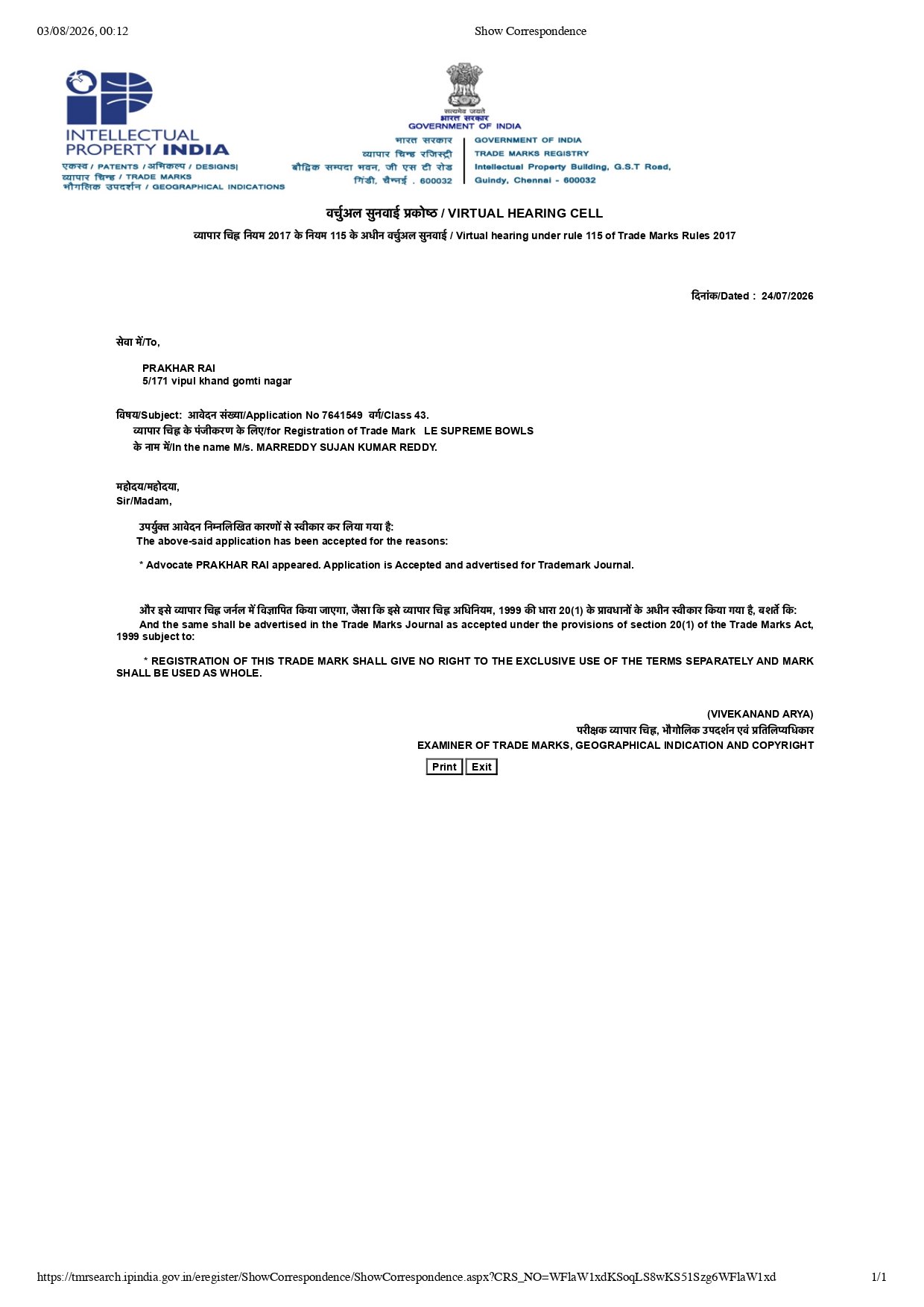
    The order below is one such result. After the application reached the hearing stage, our founder, Advocate Prakhar Rai, appeared at a virtual hearing under Rule 115 of the Trade Marks Rules, 2017, argued the case before the Examiner, and the trademark was accepted and ordered to be advertised in the Trade Marks Journal under Section 20(1) of the Trade Marks Act, 1999. It is one example of the objection replies and hearings our advocates handle for clients every month.

    One example of a Trade Marks Registry order accepting a client’s trademark after a virtual hearing under Rule 115, at which Advocate Prakhar Rai appeared. Applicant details redacted for privacy.

    What if you miss the 30-day deadline?

    This is the mistake that loses trademarks. If you do not file a reply to the examination report within 30 days, the Registry can treat your application as abandoned for failure to respond. Abandonment means the application is dead, you lose your filing date and your priority, and if you still want the mark, you generally have to start again with a fresh application, paying the fees again and losing the months you already waited.

    This is entirely avoidable. The moment you see your status change to “Objected,” start the clock. Do not wait. Even if the objection looks intimidating, most are answerable, but only if you reply in time. If your deadline is close, tell us your application number now and we will move quickly.

    Get your objection reply drafted by a trademark attorney

    Properly argued, backed by evidence and case law, filed before your deadline.

    Send your report

    Share your application number or examination report and we assess the objection and your position.

    Fixed quote

    We confirm a clear fixed fee and the deadline, usually within a couple of hours.

    We draft the reply

    A trademark attorney drafts a full, argued reply with the right precedents and, where needed, an evidence affidavit.

    We file it

    We file the reply with the Registry within your 30-day window and confirm it is done.

    We handle the hearing

    If a hearing is scheduled, we prepare and appear to argue your case.

    Related trademark guides and services

    Have your reply drafted and filed.

    How to read your report.

    How to prepare for the hearing.

    The next stage: third-party opposition.

    The full registration process.

    Our registration service.

    Reply to trademark objection: FAQs

    What is a trademark objection?
    A trademark objection is a concern raised by the Trade Marks Registry in the examination report after your application is examined. It is not a rejection, it is an opportunity to explain why your mark should be registered. Objections are most often raised under Section 9 (the mark is descriptive or non-distinctive) or Section 11 (it conflicts with an earlier mark) of the Trade Marks Act, 1999.
    How many days do I have to reply to a trademark objection?
    You have 30 days from the date of the examination report to file your reply. If you miss this deadline, the Registry can treat your application as abandoned, so it is important to act as soon as your status shows “Objected.”
    What happens if I do not reply to the objection?
    If you do not file a reply within the deadline, your application can be treated as abandoned for failure to respond. You lose your filing date and priority, and would generally have to file a fresh application and pay the fees again. Replying on time is essential.
    What is the difference between a Section 9 and a Section 11 objection?
    A Section 9 objection concerns the mark itself, that it is descriptive, non-distinctive, or generic. The reply argues the mark is distinctive, inherently or through use. A Section 11 objection concerns a conflict with an earlier mark, that yours is identical or deceptively similar to a mark already on the register. The reply distinguishes your mark from the cited marks and argues there is no likelihood of confusion.
    What happens after I file the reply?
    If the Examiner is satisfied, the objection is waived and your mark proceeds to advertisement in the Trade Marks Journal. If the Examiner is not satisfied, the matter is set down for a hearing, where you or your attorney argue the case. After the hearing the mark is either accepted or refused, and a refusal can be challenged.
    Is a trademark objection the same as an opposition?
    No. An objection is raised by the Trade Marks Registry during examination, before your mark is advertised. An opposition is filed by a third party after your mark is advertised in the Journal. They are two different stages, and the reply process for each is different.
    Can I reply to a trademark objection myself?
    You can, but a reply is a legal argument, not a form. A well-drafted reply addresses each ground, argues distinctiveness or distinguishes the cited marks, cites supporting case law, and attaches evidence where needed. A weak or templated reply is a common reason applications fail at this stage, so professional drafting significantly improves your chances.
    Will my trademark be registered after I reply?
    A good reply significantly improves your chances, but it is not automatic. If the Registry accepts the reply, your mark proceeds to advertisement and, if unopposed, to registration. If not, it goes to a hearing. The strength of the reply, its arguments, precedents, and evidence, is what most influences the outcome.
    Prakhar Rai

    Prakhar Rai | Advocate and Founder

    Written and reviewed by an advocate.

    This guide is written and reviewed by Prakhar Rai, an advocate enrolled with the Bar Council of India and the founder of My Legal Pal. An alumnus of the National Law School of India University (NLSIU), Bangalore, with a Master of Business Laws, Prakhar and the My Legal Pal team have handled trademark filings, objection replies, hearings, and oppositions for businesses and brand owners across India. Every objection reply is drafted by qualified professionals who argue the case on current law and Registry practice.

    Reviewed for legal accuracy by Prakhar Rai, Advocate (Bar Council of India). Last updated: July 2026.

    Received a trademark objection? Reply the right way.

    A properly argued reply, drafted by a trademark attorney and filed before your 30-day deadline, is what saves your application. Send us your application number and we will handle it.

    Call +91 8004800100