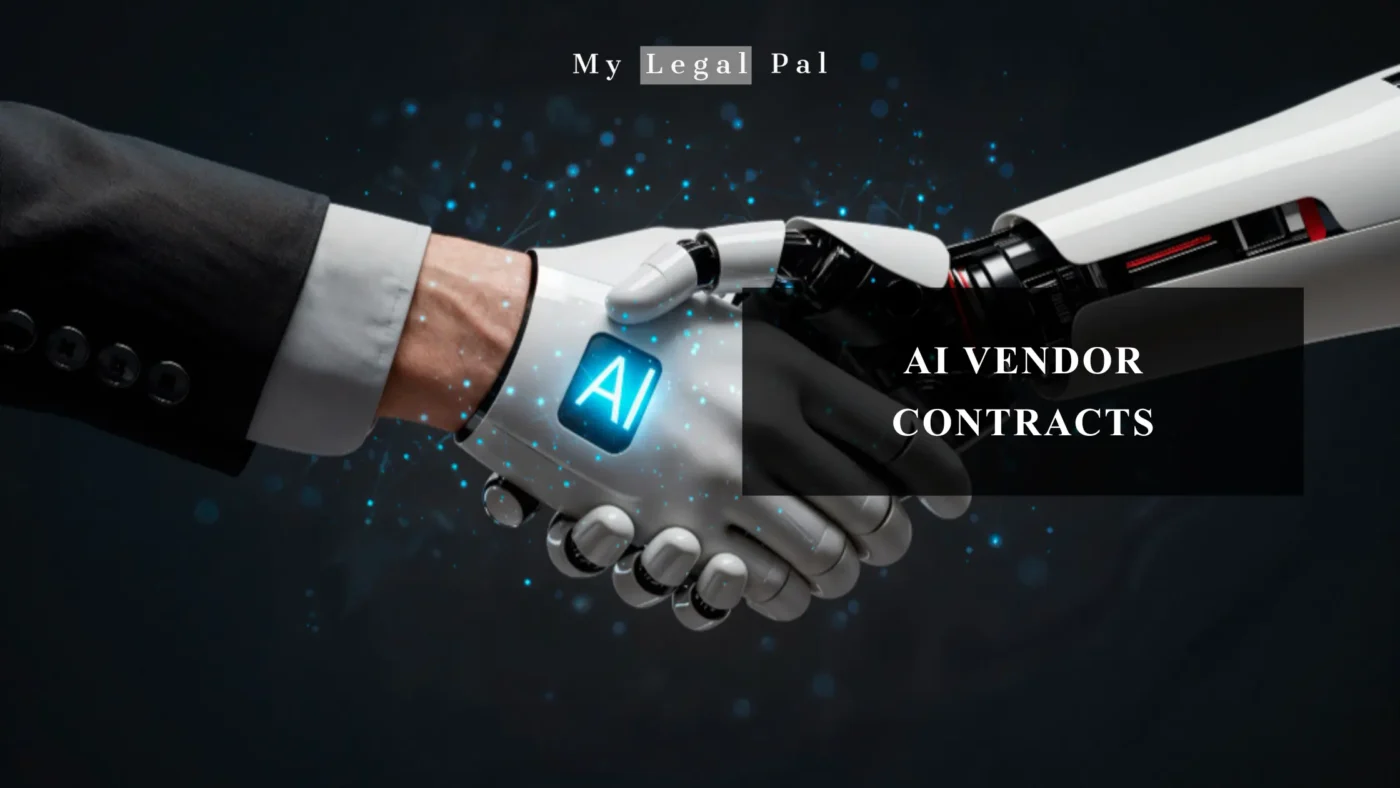
TL;DR: AI vendor contracts are not just software contracts with a new label. They quietly take rights that ordinary SaaS agreements do not: the right to train the vendor’s model on your data, ownership or control of the outputs you generate, and broad protection for the vendor when the AI gets something wrong. The two clauses that catch businesses hardest are data and training rights and output ownership, and they are linked. Before signing, check who can use your data, who owns what the AI produces, and who carries the risk when an output infringes someone else’s IP.
Quick overview: This guide is written for the business signing the contract, not just the lawyer reviewing it. It explains why AI vendor contracts differ from normal software agreements, walks through the clauses that actually matter with a practitioner’s view on each, looks closely at the two-way ownership trap around your data and the AI’s outputs, and sets out the specific position in India under the DPDP Act and the Copyright Act.
Your business runs on AI vendor tools now, whether or not anyone signed off on them as a strategic decision. A writing assistant here, a coding copilot there, a customer-service model, an analytics engine. Each one came with a contract almost nobody read past the pricing. That is the problem, because AI vendor contracts are not ordinary software contracts wearing a new name. They routinely take rights that a normal SaaS agreement never asked for, and they do it in language that looks standard until the moment it costs you something.
This guide walks through what actually matters in an AI vendor contract before you sign it. It is written for the person making the decision, with enough legal depth to be useful, but without assuming you have an in-house legal team to decode it. If you are running an AI-first business, it also pairs with our guide to the contracts every AI startup must have.
Why AI Vendor Contracts Are Different from Normal Software Contracts
A normal software contract is, at its core, a rental. You pay for access, the vendor keeps the software running, and neither side has much interest in the data you put through it beyond keeping it secure. An AI vendor contract quietly rearranges that relationship in ways that matter.
The difference is that your data is valuable to an AI vendor in a way it never was to a traditional software vendor. The information you feed into an AI tool, your documents, your customer queries, your proprietary processes, can be used to train and improve the vendor’s model. That is a fundamentally different bargain. You are not just renting software; you may be contributing, often unknowingly, to the very product the vendor sells to everyone else, including your competitors. On top of that, AI produces outputs, and outputs raise ownership and liability questions a normal software licence never had to answer. Who owns what the AI generates for you? Who is responsible when the AI gets something wrong? A traditional SaaS contract rarely had to think about either question. An AI contract lives or dies on both.
The Clauses That Actually Matter Before You Sign
Here is the practical spine of any AI vendor contract review, from the perspective of the business signing it. Some of these clauses carry far more weight than others, and I have flagged where our firm takes a specific position.
Data usage and training rights
The single most important clause, covered in detail below. This governs whether the vendor can use your data to train its model, and on what terms.
Ownership of the outputs
The second most important, and closely linked to the first. This determines whether you actually own what the AI produces for you, or merely hold a licence to use it.
Liability and indemnity for AI errors
AI systems produce wrong answers, fabricate facts, and occasionally generate content that infringes third-party rights. This clause decides who carries that risk, and getting the liability position wrong can be costly. More on the indemnity point below, because it is where I see the most dangerous gaps.
Warranties and performance
Many AI contracts warrant almost nothing about whether the tool actually works, disclaiming accuracy, fitness, and reliability entirely. Check what the vendor actually commits to, because it is often far less than you assume.
Confidentiality and data security
Standard in principle, but worth confirming how your data is stored, who can access it, and whether it is genuinely segregated from the vendor’s broader training and product operations.
Model changes and continuity
AI models get updated, retrained, deprecated, and occasionally withdrawn. A model that behaves one way today can behave differently after an update you were never told about. Check whether the vendor can materially change the model without notice.
Termination and data return
When you leave, what happens to your data, and to anything the model already learned from it? Getting your data back is one question; getting it out of a model it already trained is a much harder one.
The Two-Way Ownership Trap: Your Data In, The AI’s Output Out
The two clauses worth slowing down on are data and training rights and output ownership, because together they create a trap most businesses walk straight into. On one side, your data goes into the tool and may be used to improve the vendor’s model. On the other side, the outputs come back and you may not fully own them. You can end up in a position where you own neither what you put in nor what you got out. Let me take each side in turn, with our firm’s actual position.
Data and training rights: conditional, not automatic
The instinct in most guides is to tell you to refuse any training on your data outright. Our view is more measured, because a blanket refusal is not always necessary or realistic. Our position is that training on your data can be acceptable if the data is properly anonymised, and even then the answer should scale to how sensitive the underlying data is.
If a vendor wants to train on genuinely anonymised, aggregated data, where nothing traces back to an identifiable individual or reveals your proprietary information, that can be a reasonable trade, particularly if it is disclosed and priced accordingly. But the moment the data is sensitive, personal, commercially confidential, or capable of being de-anonymised, the position tightens sharply, and training rights should be restricted or removed. The mistake businesses make is treating this as a yes-or-no switch. It is a calibration, and the calibration depends entirely on what the data actually is. The clause to watch is any broad grant that lets the vendor use “your data” or “aggregated data” to “improve its services,” because that phrasing, left undefined, can quietly authorise exactly the training you would have refused if it had been spelled out.
Output ownership: you should own it, but ownership is not the whole story
On outputs, our position is clear: the customer should own the outputs the AI generates for them. If you are paying to use the tool and the output is central to your business, you should not be left holding a mere licence to your own work product, which is why a clear, present-tense assignment of ownership matters as much here as it does in any other contract.
But here is the nuance most competitor guides miss entirely, and it is important. Because generative AI produces outputs probabilistically, drawing on patterns learned from vast training data, an output the contract says you own can still overlap with, or reproduce, a third party’s existing intellectual property. Owning the output does not immunise you against a claim that the output infringes someone else’s copyright. So the ownership clause and the indemnity clause have to be read together. You want ownership of the output, and you want the vendor to stand behind the output if it turns out to infringe. Ownership alone, without addressing infringement risk, gives you a false sense of security, you own something that could still get you sued.
The Clause I Worry About Most: No Indemnity for IP Infringement in Outputs
If I had to point to the single most dangerous gap I see in AI vendor contracts, it is the absence of a proper indemnity for third-party IP infringement in the AI’s outputs.
Here is the exposure. The AI generates something for you, a piece of copy, an image, a block of code, and you use it in your business, reasonably assuming it is clean. Later, it turns out that output closely reproduces someone else’s protected work, and that third party comes after you, the business that used it, not the vendor whose model produced it. Many AI vendor contracts are drafted precisely to leave that risk with you. They disclaim responsibility for the outputs, offer no indemnity for infringement, and leave you carrying a liability you had no realistic way to detect.
So the position to push for is a vendor indemnity that covers third-party IP infringement arising from the AI’s outputs. That is the protection businesses most often lack and most need.
But I want to be honest about the other side of this, because it is AI, and pretending the vendor can absorb all the risk is not realistic advice. Because these outputs are generative and probabilistic, no vendor can guarantee an output will never resemble existing IP, and a customer cannot simply switch off their own vigilance because an indemnity exists. Even with a vendor indemnity in place, a sensible business still reviews high-stakes AI outputs before relying on them commercially, keeps a human in the loop for anything material, and does not treat “the contract says the vendor covers it” as a substitute for care. The mature position is to push hard for the indemnity and stay alert anyway. The indemnity is your backstop, not your blindfold.
What’s Different in India
If your business operates in India, or the AI vendor or its data processing touches India, two distinct legal layers apply, and both matter.
On data, the DPDP Act. India’s Digital Personal Data Protection Act, 2023 was notified on 13 November 2025 and is being implemented in phases, with the substantive data-processing obligations expected to come fully into force by May 2027. It applies to the processing of digital personal data in India, and it reaches foreign entities that offer goods or services to people in India, so a foreign AI vendor is not automatically outside its scope. For AI vendor contracts, the important point on training data is subtler than it is often stated. The DPDP Act does not expressly exempt anonymised data, but anonymised data is widely understood to fall outside its purview, because once data is genuinely and irreversibly anonymised, it is no longer personal data. That is exactly why our conditional position on training rights matters here: “anonymised” has to mean genuinely, irreversibly anonymised, not merely pseudonymised, because pseudonymised data that can be re-linked to an individual remains within the Act’s scope. If personal data is processed based on consent, the Act also carries a right to withdraw that consent, which raises the genuinely hard question of removing that data from a model it has already trained. The vendor contract should address where responsibility for all of this sits, since under the DPDP Act the business deploying the tool can bear fiduciary responsibility for processing carried out by a vendor it engaged.
On outputs, the Copyright Act. India’s Copyright Act, 1957 protects works authored by a human. It has no clear provision recognising a purely AI-generated output, with no human author, as a protectable copyright work. This creates a real gap: an output your AI vendor contract says you “own” may, under Indian law, not attract copyright protection at all if there was no meaningful human authorship, which means “ownership” of it can be far weaker than it sounds. For Indian businesses relying on AI-generated outputs as commercial assets, this is a genuine and under-appreciated limitation, and it is a strong reason to ensure meaningful human involvement in, and modification of, anything you intend to protect and rely on.
The Pre-Signing Checklist
Before you sign any AI vendor contract, run through these questions. Can the vendor train its model on your data, and if so, is that limited to genuinely anonymised data appropriate to its sensitivity? Do you own the outputs the AI generates for you, in clear, present-tense language? Is there a vendor indemnity covering third-party IP infringement in those outputs? What does the vendor actually warrant about the tool’s performance, and how much has it disclaimed? How is your data stored, secured, and segregated from the vendor’s training operations? Can the vendor materially change or withdraw the model without notice? And when you leave, what happens to your data, both the copy you get back and whatever the model already absorbed? If you cannot answer these clearly from the contract in front of you, the contract needs review before signature, not after a problem surfaces.
Conclusion
AI vendor contracts deserve more scrutiny than the software contracts they resemble, because they quietly ask for more: your data to improve the vendor’s product, control over the outputs you generate, and protection for the vendor when the AI gets something wrong. Three things are worth holding onto. First, data and training rights are a calibration, not a switch, acceptable for genuinely anonymised data, tightened sharply as sensitivity rises. Second, you should own the outputs, but ownership alone does not protect you from the risk that a generative output infringes someone else’s IP, which is why the indemnity clause matters as much as the ownership clause. Third, if India is involved, the DPDP Act shapes what can be done with the data and the Copyright Act’s human-author requirement can quietly weaken your claim to the outputs.
None of this means AI vendor tools should be avoided. It means the contract behind them should be read before it is signed. If you have an AI vendor agreement in front of you and you are not certain what it actually lets the vendor do with your data or your outputs, have it reviewed before you sign. My Legal Pal reviews AI vendor contracts for businesses in India and worldwide, flagging exactly the data, ownership, and indemnity gaps this guide describes. Visit MyLegalPal.com to have your contract reviewed before you commit to it.
My Legal Pal. Making Legal Simple.
Frequently Asked Questions
What is an AI vendor contract?
An AI vendor contract is the agreement between a business and a provider of an AI tool or service, governing how the tool can be used, what the vendor can do with the data you put into it, who owns the outputs it generates, and who is liable when something goes wrong. It differs from a normal software contract mainly because AI tools can use your data to train the vendor’s model and because AI outputs raise ownership and infringement questions that ordinary software never had to address.
Can an AI vendor use my data to train their model?
Only if the contract allows it, which many do through broadly worded clauses about using your data to “improve services.” Our view is that training on genuinely anonymised data can be acceptable, scaled to how sensitive the data is, but training on sensitive, personal, or confidential data should be restricted or removed. The key is to check exactly what the contract permits, since vague “aggregated data” language can authorise more than you would knowingly agree to.
Who owns the outputs an AI tool generates for my business?
It depends on the contract, and you should ensure it clearly states that you own the outputs. Even then, ownership is not a complete protection: because generative AI can produce outputs that overlap with existing third-party intellectual property, an output you “own” could still infringe someone else’s rights. That is why the output ownership clause should always be read together with the indemnity clause covering IP infringement.
What is the most dangerous clause missing from AI vendor contracts?
In our experience, the most dangerous gap is the absence of a vendor indemnity for third-party IP infringement in the AI’s outputs. Without it, if an output infringes someone else’s copyright, the business that used the output can be left carrying the liability, even though the vendor’s model generated it. Businesses should push for this indemnity, while also keeping human review over material AI outputs, since no indemnity fully removes the need for care with generative content.
How does India’s DPDP Act affect AI vendor contracts?
The Digital Personal Data Protection Act, 2023, notified in November 2025 and rolling out in phases through 2027, governs the processing of digital personal data in India and reaches foreign vendors offering services to people in India. It shapes what a vendor can do with personal data, including for training. Genuinely anonymised data is widely understood to fall outside its scope, though the Act does not expressly exempt it, so “anonymised” must mean truly irreversible anonymisation, not just pseudonymisation, which remains regulated.
Are AI-generated outputs protected by copyright in India?
This is a real grey area. India’s Copyright Act, 1957 protects works with a human author, and there is no clear recognition of purely AI-generated output, created without meaningful human authorship, as a protectable copyright work. This means an output your contract says you own may enjoy weak or uncertain copyright protection under Indian law. For outputs you intend to rely on commercially, meaningful human involvement in creating and refining them strengthens your position considerably.
Written by Prakhar Rai
Prakhar Rai is the founder of My Legal Pal and a licensed attorney. He started the practice after watching businesses that operate across borders get legal advice in fragments: a clause here, a reaction to a problem there, with no one looking at the whole picture or thinking a few steps ahead. With more than a decade in business and corporate advisory, he came to a simple view. As companies started running on cross-border deals, digital platforms and overlapping regulation, they needed legal strategy built around how they actually work, not just documents drafted after the fact. My Legal Pal is built on that idea: foresight and clarity first, paperwork second. He studied at La Martiniere College, holds an LL.B, and earned a Master of Business Laws from the National Law School of India University, Bangalore, specialising in corporate, banking, intellectual property, finance and securities law. That mix of academic grounding and hands-on advisory work shapes how he and the team approach every matter: commercially, not just technically.
Connect with Prakhar on LinkedIn.
This article is published for informational and educational purposes only. It does not constitute legal advice. The law governing AI, data protection, and intellectual property is developing quickly and varies by jurisdiction. Always consult a qualified lawyer for advice specific to your situation.