Last updated on July 13th, 2026 at 03:40 pm
You’ve closed a deal over WhatsApp. The client confirmed the order, you sent the invoice, they replied “Agreed ✓✓”. Payment comes in. Work gets done. Everyone’s happy. Until they’re not.
Six months later, there’s a dispute. You pull out the WhatsApp chat as proof of your agreement. You’re confident, it’s all there in writing, with timestamps, blue ticks showing they read it, and their explicit confirmation. Open and shut case, right?
Wrong. You just discovered the hard way that WhatsApp agreements, despite feeling official and documented, often fail spectacularly in court.
This isn’t a theoretical problem. Indian courts are flooded with cases where one party presents WhatsApp chats as evidence of contracts, and the other party successfully challenges them. Businesses lose lakhs of rupees. Freelancers can’t recover payments. Partnerships dissolve into expensive litigation.
The good news? WhatsApp agreements can work legally if you know what makes them valid and what destroys them in court. This guide explains exactly why WhatsApp contracts fail and, more importantly, how to fix them so your digital agreements actually hold up when disputes arise.
Are WhatsApp Agreements Legally Valid in India?
Let’s start with the fundamental question: can agreements made over WhatsApp be legally binding in India?
The short answer is yes, but with significant conditions.
The Information Technology Act, 2000 (specifically Section 4 and Section 5) and the Indian Evidence Act, 1872 (Section 65B) recognize electronic records as legally valid. The Indian Contract Act, 1872 doesn’t require contracts to be on paper—written, oral, or electronic agreements can all be binding if they meet basic contract requirements.
The Supreme Court of India has acknowledged electronic communications, including WhatsApp messages, as admissible evidence in multiple judgments. In Anvar P.V. v. P.K. Basheer (2014), the Supreme Court established procedures for admitting electronic evidence, including messages from platforms like WhatsApp.
More recently, various High Courts have accepted WhatsApp communications in cases ranging from property transactions to business agreements. The Delhi High Court, Bombay High Court, and others have ruled that WhatsApp messages can prove contractual terms when properly authenticated.
So why do WhatsApp agreements still fail in court?
Because there’s a massive gap between “can be valid” and “is admissible and enforceable.” Most WhatsApp agreements fail not because they’re on WhatsApp, but because people don’t understand the legal requirements for making electronic contracts enforceable.
The 7 Reasons WhatsApp Agreements Fail in Court
1. Lack of Proper Authentication
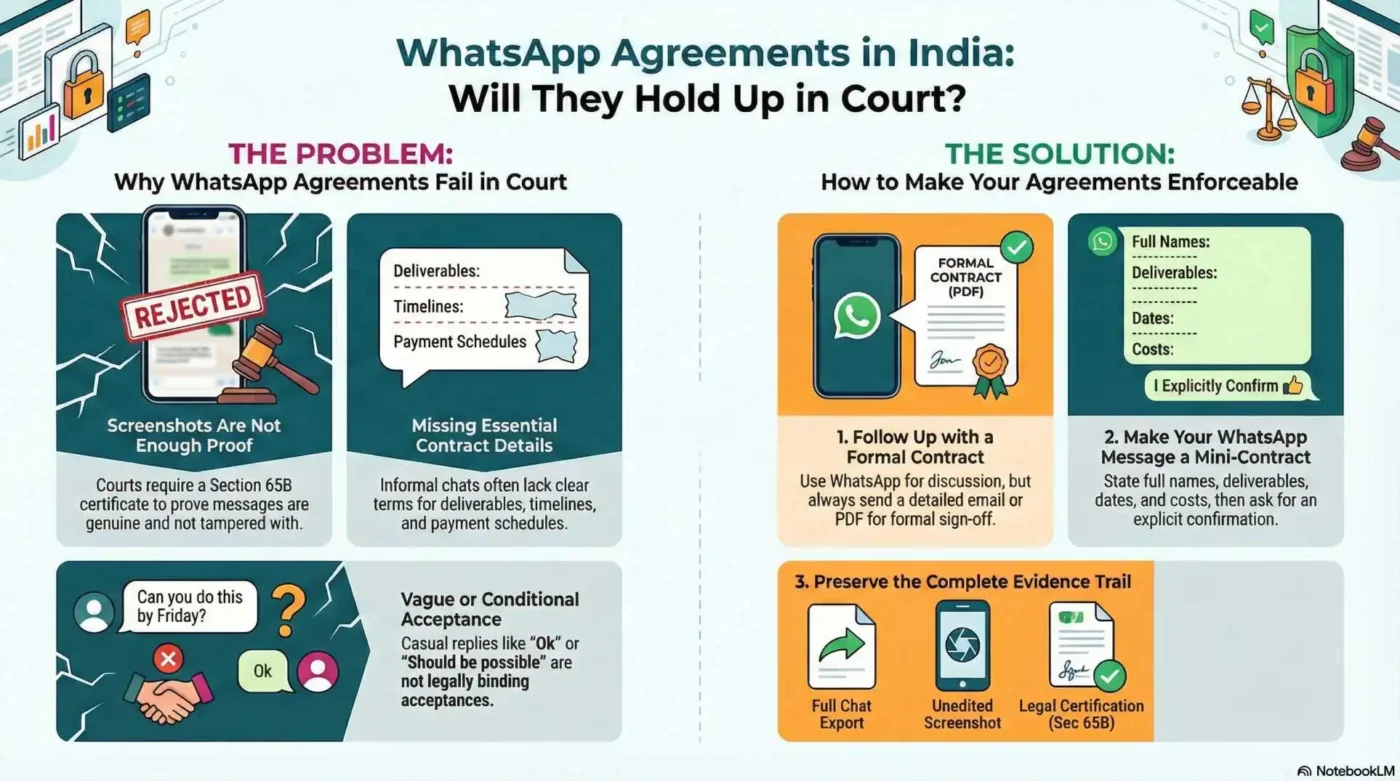
The Courts need proof that the messages are genuine and haven’t been tampered with.
The problem: You screenshot your WhatsApp chat and submit it to court. The other party claims:
- “That’s not my number”
- “I never sent those messages”
- “The screenshots are fake or edited”
- “Someone else had access to my phone”
Screenshots alone don’t prove authenticity. Section 65B of the Indian Evidence Act requires a certificate authenticating electronic records. This certificate must confirm:
- How the electronic record was produced
- That the device producing it was operating properly
- The record accurately reproduces the original information
- Details of the original device and process used
A Mumbai business owner tried to enforce a ₹15 lakh contract allegedly confirmed via WhatsApp. The court rejected the WhatsApp messages because there was no Section 65B certificate proving the messages were genuine. The business lost the entire claim.
Why it happens: Most people don’t know about Section 65B requirements. They assume screenshots with timestamps and blue ticks are self-authenticating. They’re not.
2. Missing Essential Contract Terms
Even if messages are authentic, they must contain all essential elements of a valid contract.
The Indian Contract Act requires:
- Offer: Clear proposal of specific terms
- Acceptance: Unambiguous agreement to those exact terms
- Consideration: Something of value exchanged by both parties
- Intention to create legal relations: Both parties meant this to be legally binding
- Certainty of terms: Key terms must be clear and definite
WhatsApp conversations often fail here:
“Can you design my website?” “Sure, ₹50,000” “Ok”
This seems like an agreement, but courts find it incomplete. What’s included in the website? How many pages? What’s the timeline? What about revisions? Payment terms? Delivery specifications?
WhatsApp’s informal nature encourages casual communication. People confirm deals in two messages that would need two pages in a formal contract. The informality that makes WhatsApp convenient for business makes it dangerous for legal enforcement.
3. Lack of Clear Identity Verification
Who exactly are you contracting with?
WhatsApp numbers can be:
- Registered under false names
- Used by multiple people (business numbers, shared phones)
- Changed or transferred to different people
- Operated by employees without authority
You might think you’re contracting with “Rajesh Kumar” because that’s the WhatsApp name, but you can’t prove in court that:
- The person is really Rajesh Kumar
- Rajesh Kumar has legal capacity to contract
- Rajesh Kumar has authority to bind the company you think you’re dealing with
- The same person used that number throughout the conversation
4. Unclear or Conditional Acceptance
WhatsApp chats are conversational. That makes distinguishing binding acceptance from negotiation difficult.
Problematic exchanges:
“Can you supply 1000 units at ₹100 each?” “Let me check with my manager” “Ok, we can do it” “Great!”
Is that a binding contract? Or was “Ok, we can do it” conditional on manager approval? What about “Great!”—is that acceptance or just acknowledgment?
Courts interpret ambiguous language against the party trying to enforce the contract. If acceptance isn’t clear and unconditional, there’s no contract.
Another example:
“Need the project by 15th March, can you deliver?” “Should be possible” “Ok then it’s confirmed”
“Should be possible” isn’t definite acceptance. Courts have ruled that conditional or tentative language doesn’t create binding obligations.
Why it happens: People use conversational language on WhatsApp that’s deliberately vague to keep options open. This negotiation flexibility destroys contractual certainty.
5. Inability to Prove the Other Party Received/Read Messages
Just because you sent a message doesn’t mean it was received or read. Even blue ticks don’t conclusively prove receipt in court.
The problem:
- Messages could be sent to wrong numbers
- The other party could claim their phone was lost/stolen when messages were sent
- They could claim someone else accessed their phone
- Blue ticks show message was delivered to the phone, not necessarily read by the person
For contracts, communication must be effectively received. Courts have questioned whether WhatsApp delivery equals legal receipt, especially when the recipient denies seeing messages.
6. Messages Taken Out of Context
WhatsApp chats are long, meandering conversations. Showing isolated messages without full context can misrepresent what was actually agreed.
The problem: You show the court:
“Yes, agreed to ₹5 lakhs”
What you don’t show is the message before that said:
“If you can deliver by 15th January with full installation, then yes, agreed to ₹5 lakhs. Otherwise, ₹4 lakhs only.”
Courts require complete conversations, not cherry-picked messages. The other party can produce the full chat showing your selected messages misrepresent the agreement.
Why it happens: People naturally focus on messages that support their position. But courts need complete context to understand what was really agreed.
7. No Digital Signature or Secure Method
The Information Technology Act, 2000 gives special legal status to digitally signed documents. Regular WhatsApp messages lack this enhanced security and authentication.
The issue: Digital signatures created through certified authorities (under IT Act Section 3) carry legal presumptions of authenticity. WhatsApp messages don’t have these presumptions. You must prove their authenticity, and the other party can challenge them.
Why it matters: In disputes, the burden of proof shifts. With digital signatures, the other party must prove tampering. With WhatsApp messages, you must prove authenticity.
Why it happens: Most people don’t even know digital signatures exist or how to use them for business agreements.
How to Fix WhatsApp Agreements and Make Them Enforceable
Now for the practical part: how do you use WhatsApp for business while ensuring your agreements hold up in court?
Solution 1: Follow Up WhatsApp Agreements with Formal Written Contracts
Best practice: Use WhatsApp for initial discussions and quick confirmations, but always follow up with formal documentation.
How to do it:
After reaching agreement on WhatsApp, send a formal email or document stating:
“As discussed and agreed via WhatsApp on [date], this confirms our agreement for [specific services/products] with the following terms:
[Detailed terms: deliverables, timelines, payment schedule, responsibilities, etc.]
Please reply to confirm your acceptance, or sign and return the attached agreement.”
This creates a paper trail with:
- Complete terms clearly stated
- Proper documentation format
- Clear acceptance documented
- Email headers providing authentication
Why it works: Courts prefer and trust formal written agreements. Even if someone challenges the contract later, you have multiple forms of evidence: WhatsApp initial agreement, formal written terms, and written acceptance.
Solution 2: Include Essential Contract Elements in WhatsApp Messages
If you must rely on WhatsApp alone, make your messages comprehensive.
Essential elements to include:
Parties: “This agreement is between [Full legal name, address] and [Full legal name, address]”
Offer with complete terms: “I offer to provide [specific deliverables/products] with [exact specifications] by [specific date] for [exact amount] paid [payment terms]”
Clear acceptance: “I accept these exact terms as stated”
Consideration: Make clear what each party gives and receives
Timelines: Specific dates, not “soon” or “ASAP”
Payment terms: Amount, currency, payment method, payment schedule
Example of a better WhatsApp agreement:
“I, Rajesh Kumar (ID: [Aadhaar/PAN number]), proprietor of ABC Services, agree to design a 5-page business website for Priya Shah (ID: [Aadhaar number]), proprietor of XYZ Boutique, including home, about, services, gallery, and contact pages, with 2 rounds of revisions, mobile responsive design, and basic SEO, to be delivered by 30th March 2025, for ₹50,000 (Rupees Fifty Thousand), with ₹25,000 advance paid today and ₹25,000 on delivery. Delivery via email with all files and access credentials. Please reply ‘I accept these terms’ if you agree.”
Response: “I, Priya Shah, accept these exact terms as stated above.”
This is much stronger evidence of a binding contract.
Solution 3: Maintain Proper Digital Evidence Trail
If disputes arise, proper evidence collection is crucial.
How to preserve WhatsApp evidence properly:
Take full screenshots: Capture entire conversations showing context, timestamps, and both parties’ numbers clearly visible.
Don’t crop or edit: Any editing gives the other party grounds to claim tampering.
Export chat: WhatsApp allows chat export including media. Export regularly and save with dates.
Get Section 65B certificate: When preparing for court, get a certificate from someone who can certify the electronic record (this usually requires a lawyer or forensic expert who knows the requirements).
Backup to multiple locations: Cloud storage, email to yourself, external drives. Digital evidence can be lost if phones are damaged or lost.
Print physical copies: Hard copies with timestamps create additional evidence layers.
Solution 4: Use WhatsApp for Business (Business API)
WhatsApp Business and WhatsApp Business API offer enhanced features.
Benefits for legal purposes:
Business profile verification: Verified business accounts are more credible in court.
Message templates: Standardized templates for quotes, confirmations, and terms create consistency.
Better recordkeeping: Business accounts have better tools for organizing and exporting chats.
Catalog features: Product catalogs with prices create verifiable offers.
Not a complete solution: Even WhatsApp Business messages need proper contract elements and documentation, but the professional features add credibility.
Solution 5: Implement Hybrid Documentation Systems
Combine WhatsApp convenience with legal safety.
Practical hybrid approach:
Step 1: Discuss and negotiate via WhatsApp (fast, convenient)
Step 2: Summarize agreement in WhatsApp message with all essential terms
Step 3: Send formal email with same terms attached as PDF
Step 4: Request email confirmation or digital signature
Step 5: Exchange the first payment/performance as additional confirmation
Why this works: You get WhatsApp’s speed and convenience while building multiple evidence layers. If anyone challenges the contract, you have:
- WhatsApp conversation showing negotiation
- WhatsApp message with terms
- Email with identical terms
- Digital or email acceptance
- Bank transfer or performance evidence
Courts find it nearly impossible to deny contracts supported by this level of documentation.
Solution 6: Include Dispute Resolution Clauses
Even in WhatsApp agreements, add a dispute resolution clause.
Sample clause to include:
“Any dispute arising from this agreement shall be resolved through arbitration in [city] under Arbitration and Conciliation Act, 1996. Both parties consent to jurisdiction of [city] courts.”
Why it matters: This prevents jurisdiction battles and clarifies how disputes get resolved. It also shows both parties intended to create legally binding obligations (important for contract formation).
Solution 7: Get Explicit Acknowledgment of Agreement Terms
Don’t assume. Get explicit confirmation.
Instead of: “Can you do this project?” “Yes”
Do this: “Please confirm you agree to: [list all terms]. Reply ‘I agree to all terms stated above’ if you accept.”
Response should be: “I agree to all terms stated above” (exact words)
Why it works: Courts look for clear, unambiguous acceptance. Generic “ok” or “yes” can be interpreted as acknowledgment rather than acceptance. Explicit confirmation removes ambiguity.
Solution 8: Understand When WhatsApp Isn’t Appropriate
Some agreements should never be on WhatsApp alone:
Never use only WhatsApp for:
- Property transactions (real estate sales, leases)
- High-value contracts
- Long-term agreements (multi-year commitments)
- Complex terms requiring detailed specifications
- Contracts requiring registration (sale deeds, partnership deeds, etc.)
- Agreements with significant legal consequences
For these, always use formal written contracts reviewed by lawyers, even if initial discussions happen on WhatsApp.
What to Do If You’re Already in a WhatsApp Contract Dispute
If you’re facing a dispute where WhatsApp messages are your only evidence:
1. Don’t delete anything: Preserve all messages, even those that seem unhelpful. Deleting evidence can be used against you.
2. Export and backup immediately: Save complete chat history in multiple formats and locations.
3. Gather corroborating evidence:
- Bank transfers matching the agreement
- Emails referencing the WhatsApp discussion
- Witnesses who knew about the agreement
- Any performance already completed
- Related documents (invoices, quotes, receipts)
4. Get Section 65B certificate: Consult a lawyer about obtaining proper certification for your electronic evidence.
5. Document authentication: Be prepared to prove:
- The WhatsApp number belongs to the other party
- They had access to the phone when messages were sent
- Messages weren’t tampered with
- You have the complete conversation
6. Consider settlement: Given the uncertainty of WhatsApp evidence in court, settlement might be more practical than litigation. Use your evidence as negotiation leverage rather than court proof.
7. Consult a lawyer immediately: Don’t wait. Electronic evidence requirements are technical and mistakes can make your evidence inadmissible.
Need Help With Contract Disputes or Documentation?
If you’re facing a contract dispute involving WhatsApp messages or need help creating enforceable agreements, My Legal Pal connects you with experienced contract lawyers.
Visit My Legal Pal to connect with contract law experts who understand both digital business practices and legal requirements.
Because your agreements should protect you, not put you at risk.
Frequently Asked Questions
Are WhatsApp messages legally binding in India?
Yes, WhatsApp messages can create legally binding contracts in India if they meet the requirements of the Indian Contract Act, 1872, offer, acceptance, consideration, and intention to create legal relations. However, they must be properly authenticated under Section 65B of the Indian Evidence Act to be admissible in court. Simply having WhatsApp messages isn’t enough; you need proper documentation and evidence that the messages are genuine, complete, and agreed to by authorized parties.
Can WhatsApp screenshots be used as evidence in court?
WhatsApp screenshots can be used as evidence in Indian courts, but they require authentication under Section 65B of the Indian Evidence Act. You need a certificate confirming the electronic record’s authenticity, how it was produced, and that the device was functioning properly. Screenshots alone without this certification are often rejected. Courts are skeptical of screenshots because they’re easily fabricated or edited, so corroborating evidence (bank transfers, emails, witnesses) significantly strengthens your case.
What is Section 65B certificate and how do I get one?
Section 65B of the Indian Evidence Act requires electronic evidence to be accompanied by a certificate authenticating it. The certificate must state: (1) how the electronic record was produced, (2) the device was operating properly, (3) the record accurately reproduces original information, and (4) details of the device and process. To obtain one, you typically need a lawyer or forensic expert who can examine your electronic evidence and provide certification meeting Section 65B requirements. This is essential for making WhatsApp messages admissible in court.
Can I make a legal contract entirely through WhatsApp?
Technically yes, but practically risky. A contract formed entirely through WhatsApp is valid if it contains all essential elements: clear offer, unconditional acceptance, consideration, and certainty of terms. However, WhatsApp-only contracts face significant enforcement challenges: authentication difficulties, lack of complete terms, identity verification issues, and courts’ skepticism of electronic evidence. For anything beyond small, simple transactions, follow up WhatsApp agreements with formal written contracts sent via email or proper documentation.
What should I do if someone denies a WhatsApp agreement?
If someone denies a WhatsApp agreement: (1) Don’t delete any messages—preserve everything; (2) Export and backup the complete chat; (3) Gather corroborating evidence like bank transfers, emails, or witnesses; (4) Obtain Section 65B certification for the electronic evidence; (5) Prove the WhatsApp number belongs to them and they had access when messages were sent; (6) Consult a contract lawyer immediately about evidence requirements; (7) Consider sending a formal legal notice demanding compliance; (8) Evaluate settlement versus litigation—WhatsApp evidence uncertainty may make settlement more practical.
Can WhatsApp calls be used as evidence like messages?
WhatsApp call recordings face even more challenges than text messages. Recording calls without consent may violate privacy laws. Call recordings require authentication proving: (1) who was on the call, (2) the recording is genuine and unedited, (3) the recording device was functioning properly. Courts are generally more skeptical of audio recordings than text messages because editing is harder to detect. If you need to rely on WhatsApp calls, document the call’s substance immediately in writing via WhatsApp message or email confirming what was discussed and agreed.