

Overview
Any Contract in Dubai and the UAE operate under a unique legal framework that blends civil law principles with Sharia law influences and free zone regulations. Whether you’re signing an employment contract, leasing commercial property, entering a partnership, or agreeing to a service contract, understanding what you’re committing to isn’t optional, it’s essential.
In this comprehensive guide, you’ll discover:
- The 7 critical contract clauses that can make or break your rights in Dubai
- How UAE contract law differs from other jurisdictions and why it matters
- Red flags that signal problematic contract terms
- Practical tips for negotiating better terms before signing
- Real-world examples of what happens when people overlook these clauses
- Your legal options if you’ve already signed a problematic contract
This isn’t generic contract advice. This is specific, actionable guidance for anyone dealing with contract in Dubai’s unique legal environment, from expat professionals reviewing employment offers to entrepreneurs establishing businesses in free zones.
By the end, you’ll know exactly what to look for, what questions to ask, and when to insist on changes before putting pen to paper.
Dubai attracts millions of professionals, entrepreneurs, and investors annually. The promise of tax-free income, world-class infrastructure, and a strategic location makes it irresistible. But here’s what catches many people off guard: UAE contract law operates differently than most Western legal systems, and what seems like standard contract language elsewhere can have unexpected implications here.
Understanding UAE Contract Law: The Foundation
Before diving into specific clauses, understand the legal framework governing your contract.
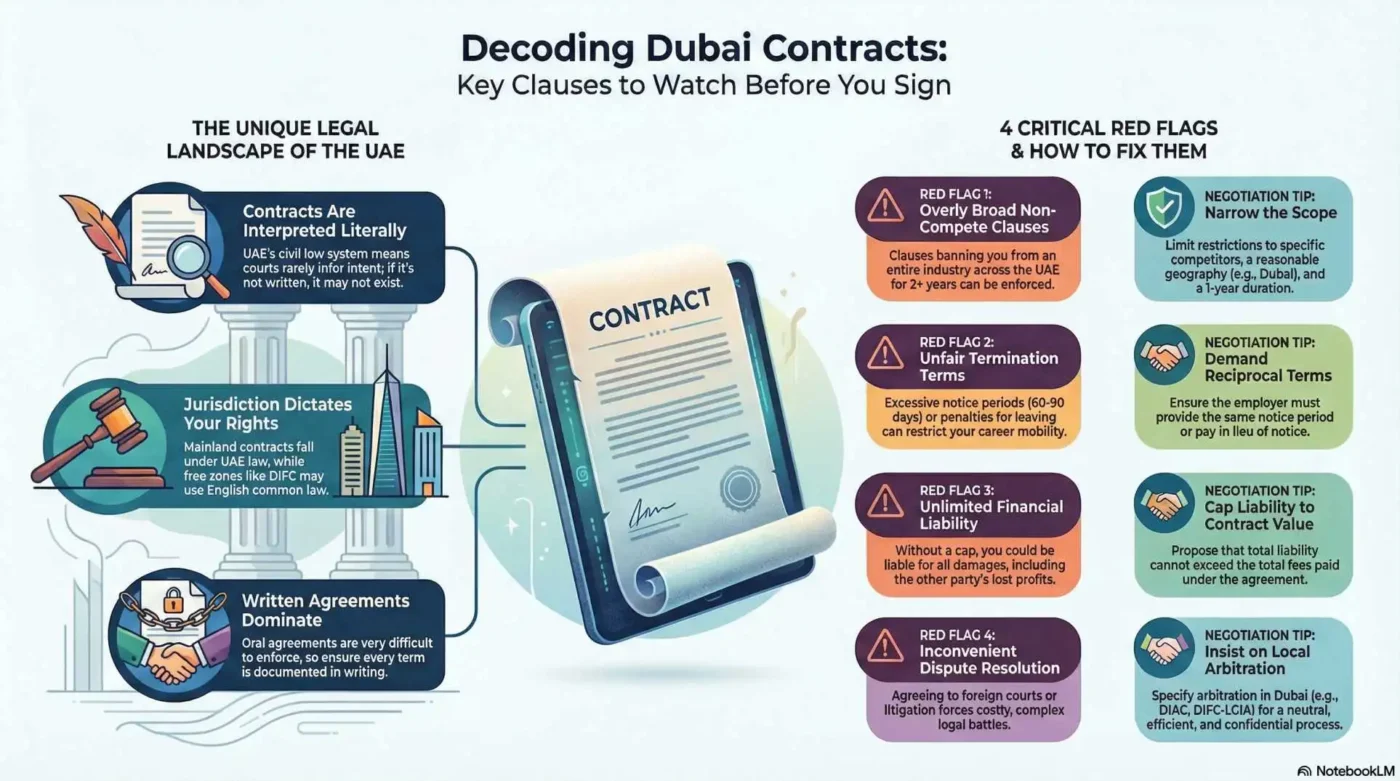
UAE Federal Law No. 5 of 1985 (Civil Transactions Law) is the primary legislation governing contracts in mainland Dubai. This civil law system differs fundamentally from common law systems in the UK, US, or India. Courts interpret contracts more literally, with less emphasis on “implied terms” or “good faith” interpretations that protect parties in other jurisdictions.
Sharia principles influence certain aspects of contract law, particularly regarding interest (riba), excessive uncertainty (gharar), and gambling (maysir). While commercial contracts are largely secular, Sharia principles can affect enforcement in certain situations.
Free zone regulations add another layer. Dubai has over 30 free zones (DIFC, JAFZA, Dubai Media City, etc.), each with its own legal framework. Contracts within free zones may be governed by free zone regulations rather than mainland UAE law. The Dubai International Financial Centre (DIFC) even applies English common law within its jurisdiction.
Key differences from other systems:
- Written contracts dominate: Oral agreements are harder to enforce. Get everything in writing.
- Interpretation is literal: If it’s not explicitly stated, it may not exist. Courts don’t read between lines.
- Limited consumer protection: Compared to European or North American standards, UAE consumer protection is less comprehensive. Contracts heavily favor whoever drafted them.
- Enforcement can be swift: Once you have a judgment, enforcement is relatively quick, but getting that judgment requires navigating the system properly.
Understanding this context helps you appreciate why specific clauses require extra scrutiny in Dubai contracts.
Clause 1: Governing Law and Jurisdiction
This clause determines which country’s laws apply to your contract and where disputes will be resolved. It seems technical but has enormous practical implications.
What to look for:
“This Agreement shall be governed by the laws of [jurisdiction] and any disputes shall be subject to the exclusive jurisdiction of the courts of [location].”
Why it matters:
If your employment contract says “governed by UAE law, jurisdiction in Dubai courts,” you’re subject to UAE legal standards and must litigate in Dubai. If it says “governed by English law, jurisdiction DIFC courts,” you’re under English common law with DIFC’s specialized courts.
Red flags:
- Foreign governing law with UAE jurisdiction: “Governed by Indian law, disputes in Dubai courts.” This creates confusion, Dubai courts applying Indian law is complex and expensive, requiring expert witnesses on Indian law.
- Inconvenient jurisdiction: If you’re a small business contracting with a large company, they might specify disputes must be heard in their home country. A Dubai-based small business agreeing to “exclusive jurisdiction of Singapore courts” faces enormous practical barriers to enforcing their rights.
- No arbitration option: For commercial contracts, arbitration is often preferable to court litigation in the UAE. If the contract mandates court-only resolution, you lose arbitration’s speed and confidentiality advantages.
What to negotiate:
- Arbitration clause: “Disputes shall be resolved through arbitration under DIAC (Dubai International Arbitration Centre) rules.” This provides neutral, efficient resolution.
- DIFC jurisdiction for commercial contracts: If both parties agree, DIFC courts offer common law interpretation, English language proceedings, and experienced commercial judges, often preferable for international business.
- Reciprocal jurisdiction: For equal-sized parties, consider “disputes may be brought in courts of UAE or [other jurisdiction] at the option of the claimant.” This prevents one party from having jurisdictional advantage.
Clause 2: Payment Terms and Currency
Payment clauses define when, how, and in what currency you’ll be paid. In Dubai’s multi-currency environment, this clarity is essential.
What to look for:
“Payment of [amount] in [currency] shall be made [timing] via [method] to [account details].”
Why it matters:
The UAE Dirham (AED) is pegged to the US Dollar, making it relatively stable. But many contracts involve multiple currencies, salaries in AED, bonuses in USD, or invoices in EUR. Exchange rate fluctuations, conversion fees, and payment delays can significantly impact actual amounts received.
Red flags:
- Vague payment timing: “Payment shall be made within reasonable time” is unenforceable. What’s “reasonable”? 30 days? 90 days? Without specificity, you have no recourse for late payment.
- No late payment penalties: If there’s no consequence for late payment, expect payment delays. UAE culture sometimes sees payment timing as flexible negotiation rather than strict obligation.
- Currency conversion ambiguity: “Payment in equivalent USD” without specifying the exchange rate or date of conversion leaves you vulnerable. The company might use unfavorable rates.
- Payment conditioned on uncontrollable factors: “Payment upon client satisfaction” or “payment when company receives payment from end client” transfers risk to you inappropriately.
What to negotiate:
- Specific payment dates: “Payment shall be made within 30 days of invoice date” or “salary paid on the first day of each month.”
- Late payment penalties: “Late payments shall incur interest at [X]% per month.” While Sharia prohibits riba (interest), commercial contracts can include late payment charges framed as “compensation for damages” rather than interest.
- Defined exchange rates: “Currency conversions shall use the UAE Central Bank exchange rate on the date of invoice.”
- Payment method specificity: “Payment by bank transfer to account [details]” prevents disputes about payment method.
- Partial payment terms for large projects: For substantial contracts, negotiate milestone payments rather than full payment on completion. “30% upon contract signing, 40% upon delivery of Phase 1, 30% upon final completion.”
Clause 3: Termination and Notice Period
Termination clauses define how and when either party can end the contractual relationship. In employment contracts, this is particularly critical.
What to look for:
“Either party may terminate this Agreement by providing [X] days written notice. Termination may also occur immediately upon [specific grounds].”
Why it matters:
UAE labor law provides baseline protections, but contracts can (and often do) add restrictions. Employers sometimes include lengthy notice periods or financial penalties for early termination that go beyond legal requirements. For commercial contracts, termination rights determine your flexibility if circumstances change.
Red flags in employment contracts:
- Excessive notice periods: UAE labor law typically requires 30 days notice for unlimited contracts, but some employers demand 60-90 days. While not automatically illegal, this significantly restricts your mobility.
- No employee termination rights: Contracts stating “employee cannot terminate except with employer approval” or “termination results in penalties equal to [X] months salary” are overly restrictive and may be unenforceable, but fighting this costs time and money.
- Automatic visa cancellation without grace period: Some contracts threaten immediate visa cancellation upon termination, leaving you days to exit the UAE. UAE regulations now provide grace periods, but contractual language can create pressure.
- Return of benefits as penalty: “Upon early termination, employee must return all bonuses and benefits received during employment” is unreasonable unless there’s a specific probation or vesting period.
Red flags in commercial contracts:
- Unilateral termination rights: “Company may terminate this Agreement at any time without cause or notice” while you have no equivalent right creates massive power imbalance.
- No termination for breach: If the contract doesn’t allow you to terminate when the other party breaches material terms, you’re stuck in a non-performing contract.
- Automatic renewal without clear opt-out: “This Agreement renews automatically for successive one-year terms unless terminated with 90 days notice before renewal date” can trap you indefinitely if you miss the notice window.
What to negotiate:
- Reciprocal notice periods: If you must give 60 days notice, employer should provide equivalent notice or pay in lieu.
- Clear termination for cause provisions: Define specific breaches that allow immediate termination without notice or penalty: “Either party may terminate immediately upon material breach including non-payment, violation of confidentiality, or illegal conduct.”
- Mutual termination rights: Both parties should have reasonable ability to exit, perhaps with different notice periods reflecting investment levels.
- Post-termination obligations clarity: Specify what happens after termination: return of property, final payment timing, handover of work product, reference letter provisions.
Clause 4: Non-Compete and Restrictive Covenants
Non-compete clauses restrict your ability to work for competitors or in similar industries after leaving. UAE law allows these restrictions, but courts assess reasonableness.
What to look for:
“Employee/Party agrees not to engage in competing business activities within [geographic area] for [time period] following termination.”
Why it matters:
Unlike many jurisdictions that heavily scrutinize or limit non-competes, UAE courts generally enforce reasonable restrictive covenants. This means a poorly negotiated non-compete can genuinely prevent you from working in your field in the UAE for extended periods.
Red flags:
- Overly broad scope: “Employee shall not work in any capacity in the technology industry in the UAE for three years.” This essentially bans you from your entire profession across an entire country, likely unreasonable but requires litigation to challenge.
- Excessive duration: Two years is generally considered reasonable in UAE; three years is questionable; longer periods rarely enforced. But even fighting an unreasonable restriction requires time and money.
- Unlimited geographic scope: “Worldwide non-compete for two years” is practically impossible to comply with and likely unenforceable, but creates uncertainty.
- No compensation: Some jurisdictions require employers to pay for non-compete restrictions. While UAE doesn’t mandate this, non-competes with no consideration (beyond your employment) may be challenged.
- Applies to all termination types: Non-competes should arguably not apply if the employer terminates you without cause, but many contracts don’t distinguish.
What to negotiate:
- Narrow scope: Limit to “direct competitors in [specific business line]” rather than entire industry. “Employee shall not work for companies engaged in luxury hotel operations in Dubai” is more reasonable than “employee shall not work in hospitality in UAE.”
- Reasonable geography: Limit to specific Emirates or cities. “Non-compete applies within Dubai and Abu Dhabi” is more enforceable than “entire UAE” or “GCC countries.”
- Limited duration: Negotiate for one year maximum if possible. “12 months following termination” is more acceptable than longer periods.
- Exceptions for termination without cause: “Non-compete shall not apply if Employee is terminated by Employer without cause.”
- Non-solicitation instead of non-compete: Consider negotiating a non-solicitation clause (not recruiting colleagues or contacting clients) rather than a full non-compete. This protects employer interests while preserving your career flexibility.
- Compensation for restriction: “If Employer elects to enforce non-compete, Employer shall pay Employee [X]% of final salary monthly during restriction period.” This creates cost to employer for enforcement.
Clause 5: Liability and Indemnification
These clauses determine who’s responsible when things go wrong and who pays for damages, losses, or legal costs.
What to look for:
“[Party] shall be liable for [types of damages] up to [amount or limitation]. [Party] shall indemnify and hold harmless [other party] from [specific claims or liabilities].”
Why it matters:
Liability clauses shift risk between parties. In Dubai’s business environment, well-drafted limitation of liability clauses can protect you from catastrophic financial exposure, while poorly drafted ones leave you vulnerable to unlimited claims.
Red flags:
- Unlimited liability: “Contractor shall be liable for all damages, losses, costs, and expenses arising from or related to this Agreement” without any cap creates open-ended exposure.
- Liability for consequential damages: “Party shall be liable for direct, indirect, consequential, special, and punitive damages” means you could be liable for the other party’s lost profits, business interruption, and other consequential losses that might dwarf your contract value.
- One-sided indemnification: “Service Provider shall indemnify and hold Client harmless from all claims, damages, and liabilities of any nature whatsoever” with no reciprocal protection is grossly unfair.
- Indemnity for the other party’s negligence: “Party A shall indemnify Party B even for claims arising from Party B’s own negligence or willful misconduct.” You shouldn’t be financially responsible for someone else’s wrongdoing.
- No liability cap proportionate to contract value: If you’re providing AED 50,000 in services, liability capped at AED 5 million is disproportionate.
What to negotiate:
- Mutual liability limitations: “Neither party shall be liable for indirect, consequential, special, or punitive damages.”
- Proportionate liability caps: “Each party’s total liability shall not exceed the total fees paid or payable under this Agreement” or “liability capped at AED [reasonable amount related to contract value].”
- Reciprocal indemnification: Both parties should indemnify each other for claims arising from their own breaches, negligence, or violations of law.
- Carve-outs from limitations: Standard exceptions to liability caps include: breach of confidentiality, intellectual property infringement, death or personal injury, and fraud or willful misconduct.
- Insurance requirements: “Each party shall maintain insurance with minimum coverage of [amount] and name the other party as additional insured.”
Clause 6: Confidentiality and Intellectual Property Rights
These clauses define who owns work product created during the contract and what information must remain confidential.
What to look for:
“All intellectual property created under this Agreement shall be owned by [party]. All confidential information shall remain confidential for [duration] following termination.”
Why it matters:
In Dubai’s innovation-focused economy, IP rights are increasingly valuable. Who owns software code, designs, inventions, or business processes created during your work matters enormously. Confidentiality obligations can restrict your career even after contract termination if too broad.
Red flags:
- Employer owns everything you create, period: “All inventions, designs, works, and ideas created by Employee during employment, whether or not related to Company business, shall be Company property.” This means even side projects or inventions on your own time could belong to your employer.
- Perpetual confidentiality of non-trade secrets: “All information received during this Agreement shall remain confidential in perpetuity.” Confidentiality should be limited to genuine trade secrets, and even those typically have reasonable time limits (5-10 years).
- Overly broad definition of confidential information: “All information of any nature related to Company or its business is confidential.” This could include information already publicly known or generally available.
- No carve-outs for prior IP: If you’re a consultant bringing existing methodologies, tools, or content, contracts should clarify you retain ownership of pre-existing IP.
- Assignment of moral rights: In some contracts, you’re asked to waive moral rights (attribution, integrity rights) even for creative works. This is significant for designers, writers, and artists.
What to negotiate:
- Limited IP assignment: “Intellectual property created specifically for this project and paid for by Client shall be Client property. All pre-existing IP and general methodologies remain with Service Provider.”
- Reasonable confidentiality definition: “Confidential information means trade secrets, proprietary business information, customer lists, and technical data specifically marked confidential. Excludes information that: (a) is publicly available, (b) was known to recipient prior to disclosure, (c) is independently developed, or (d) is required to be disclosed by law.”
- Time-limited confidentiality: “Confidentiality obligations shall remain in effect for [5 years] following termination, except for trade secrets which remain confidential while meeting legal definition of trade secret.”
- Personal project carve-outs: For employment contracts, add: “Employee retains ownership of inventions or works created entirely on personal time, using personal resources, unrelated to Company business.”
- Portfolio rights for creative work: Designers, developers, and creative professionals should negotiate: “Service Provider may include completed work in portfolio and promotional materials, subject to Client’s reasonable confidentiality concerns.”
Clause 7: Dispute Resolution and Escalation
This clause determines how disagreements will be resolved, from minor disputes to major breaches.
What to look for:
“Disputes shall first be resolved through [informal discussion/mediation]. If unresolved, disputes shall proceed to [arbitration/litigation] under [rules] in [location].”
Why it matters:
Litigation in UAE courts is time-consuming, expensive, and conducted in Arabic (requiring certified translations of all documents). Arbitration offers faster, more flexible resolution. A well-crafted dispute resolution clause can save months and hundreds of thousands of dirhams.
Red flags:
- No escalation process: Contracts that jump straight to “disputes shall be resolved in Dubai courts” with no mediation or negotiation requirements force costly litigation as the first resort.
- Arbitration with unfavorable terms: “Disputes shall be resolved by arbitration in [expensive foreign location] under rules requiring each party to bear their own costs regardless of outcome.” This makes enforcement prohibitively expensive.
- No emergency relief procedures: Some disputes require immediate injunctions or emergency orders. If your contract only allows arbitration with no provision for emergency relief, you might not be able to stop imminent harm quickly enough.
- Unclear arbitration procedures: “Disputes shall be resolved by arbitration” without specifying institution (DIAC, DIFC-LCIA, ICC), rules, number of arbitrators, or location creates ambiguity that requires resolving before you can even start resolving the underlying dispute.
What to negotiate:
- Tiered dispute resolution: “The parties shall first attempt to resolve disputes through good-faith negotiation for 14 days. If unresolved, disputes shall proceed to mediation under [DIAC/DIFC Mediation Rules] for 30 days. If mediation fails, disputes shall be resolved by arbitration.”
- Institutional arbitration with clear terms: “Arbitration shall be conducted under DIAC Rules by a sole arbitrator (or three arbitrators for disputes exceeding AED 1 million) in Dubai, in English language. The decision shall be final and binding.”
- Cost allocation: “Prevailing party shall be entitled to recover reasonable legal fees and costs from the non-prevailing party.” This creates incentive for reasonable positions.
- Emergency arbitrator provisions: “Either party may apply for emergency arbitrator relief under applicable institutional rules for urgent matters requiring immediate relief.”
- Confidentiality of proceedings: “All dispute resolution proceedings and outcomes shall remain confidential.”
Additional Clauses Requiring Attention
While the seven clauses above are critical, don’t overlook:
Force majeure: Defines what happens during events beyond parties’ control (pandemics, natural disasters, war). Post-COVID, this clause gets more scrutiny.
Amendments and modifications: “This Agreement may only be amended by written instrument signed by both parties” prevents verbal modifications from changing your rights.
Severability: “If any provision is found unenforceable, remaining provisions remain in effect” protects the overall contract if one clause fails.
Entire agreement: “This Agreement constitutes the entire agreement and supersedes all prior negotiations and agreements” means nothing discussed but not written into the final contract matters.
Protect Yourself Before You Sign
Dubai’s business environment offers tremendous opportunities, but those opportunities come with legal frameworks that differ from what many expats and international businesses expect. The contracts you sign determine whether your Dubai experience is successful or becomes a cautionary tale.
The seven clauses we’ve covered, governing law and jurisdiction, payment terms, termination provisions, non-compete restrictions, liability and indemnification, IP and confidentiality, and dispute resolution, are where most Dubai contracts create problems for the unwary.
Need Expert Contract Review in Dubai?
Navigating Dubai’s complex legal environment requires specialized expertise. Don’t sign important contracts without professional legal review.
Whether you’re reviewing an employment offer, commercial agreement, partnership contract, or any legal document in Dubai, our network of UAE legal experts provides affordable, accessible guidance.
Visit MyLegalPal.com today for professional contract review services tailored to Dubai’s legal environment.
Frequently Asked Questions
Are contracts in Dubai enforced differently than in other countries?
Yes, significantly. Dubai and UAE apply civil law principles rather than common law, meaning contracts are interpreted more literally with less emphasis on implied terms or equitable principles common in UK/US systems. Courts focus on what’s explicitly written rather than what parties might have intended. Additionally, certain provisions like non-compete clauses are enforced more readily than in many Western jurisdictions.
Do I need a Contract lawyer to review every contract in Dubai?
For routine, low-value transactions (gym memberships, mobile phone contracts), legal review is probably unnecessary. However, for employment contracts, commercial agreements, partnership arrangements, property transactions, or any contract involving significant value or long-term commitments, professional legal review is highly recommended. The cost of legal review (typically AED 2,000-10,000 depending on complexity) is tiny compared to potential losses from unfavorable terms. Dubai’s legal environment differs enough from most jurisdictions that even experienced business people from other countries benefit from local legal expertise.
Can I negotiate contract terms in Dubai, or are they fixed?
Absolutely, you can and should negotiate. While some employers or large companies present “standard contracts” implying they’re non-negotiable, nearly everything is negotiable if approached professionally. Key terms like notice periods, non-compete scope, payment terms, and liability limitations are commonly negotiated. Your leverage depends on your position, senior executives and specialized professionals have more negotiating power than entry-level employees, but everyone can request reasonable amendments. Many companies expect negotiation and build some flexibility into initial offers. Never assume terms are final just because they’re written down.
What happens if I break a contract in Dubai?
Contract breach in Dubai has serious consequences. The non-breaching party can sue for damages, specific performance (forcing you to fulfill obligations), or termination with compensation. For employment contracts, breaches can affect visa status and result in financial penalties. Courts can issue judgments requiring payment, and enforcement is relatively swift, bank accounts can be frozen, assets seized, and travel bans imposed until judgments are satisfied. Criminal complaints can be filed for certain contract breaches, particularly involving fraud or cheque dishonor. This is why understanding your obligations before signing is crucial, Dubai actively enforces contractual commitments.
Are electronic signatures valid on Dubai contracts?
Yes, electronic signatures are legally recognized in the UAE under Federal Law No. 1 of 2006 on Electronic Commerce and Transactions. However, certain documents still require physical signatures or notarization (property transactions, wills, powers of attorney). For standard commercial and employment contracts, electronic signatures through platforms like DocuSign are generally enforceable. However, ensure the contract itself doesn’t specify “wet signature required” or similar language. When disputes arise, electronic contracts with proper authentication (email trails, platform verification) are treated equivalently to physical signed documents by UAE courts.
What’s the difference between DIFC and Dubai mainland for contracts?
Dubai International Financial Centre (DIFC) is a free zone with its own independent legal system based on English common law, with DIFC Courts staffed by international judges. Contracts specifying DIFC jurisdiction and DIFC law are interpreted under common law principles familiar to UK/Commonwealth practitioners, with English-language proceedings and precedent-based decisions. Mainland Dubai contracts are governed by UAE Federal Law (civil law system), with Arabic as the official language, and different procedural rules. For international commercial contracts, many parties prefer DIFC jurisdiction for its common law framework and specialized commercial expertise. Your contract’s jurisdiction clause determines which system applies.
Can contracts override UAE labor law protections?
Partially. UAE labor law (Federal Decree-Law No. 33 of 2021) provides minimum standards that contracts cannot diminish such as minimum wage (where applicable), maximum working hours, leave entitlements, end-of-service benefits, and termination protections. However, contracts can provide better terms than legal minimums, and can add restrictions not prohibited by law.
What should I do if the other party wants to add a clause I don’t understand?
Never sign anything containing language you don’t fully understand. Request clarification in writing, ask the other party to explain the clause’s meaning and practical impact in plain language. Consult a Contract lawyer in Dubai for independent interpretation, especially for technical legal terms. If the clause seems problematic after clarification, negotiate for removal or modification.
Are online contracts and terms of service enforceable in Dubai like offline contracts?
Yes, online contracts including terms of service, end-user license agreements, and click-wrap agreements are generally enforceable in Dubai under electronic commerce laws, provided they meet basic contract requirements: clear acceptance mechanism (checkbox, “I Agree” button), opportunity to review terms before accepting, and recordkeeping of acceptance. However, certain types of online terms have special considerations
