Last updated on August 12th, 2026 at 01:08 pm
Why Influencers Lose Content Ownership Without Realising It
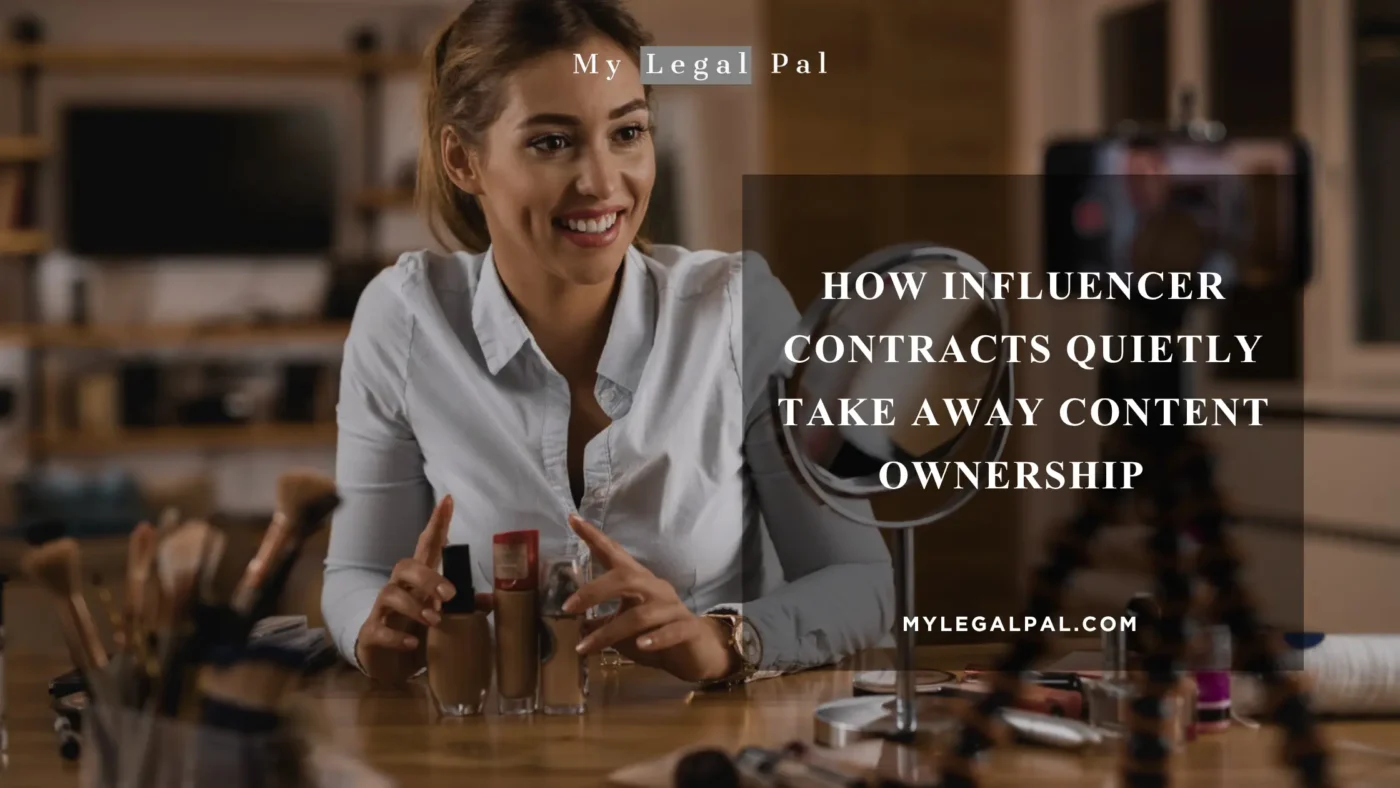
There is a belief that runs through creator culture, quietly and persistently, that you own what you make. You thought of the concept. You showed up, shot the content, edited it, and posted it. Of course it is yours.
Brand deal contracts say otherwise. And they say it in language that most creators do not fully read and almost none fully understand.
The influencer marketing industry crossed one hundred billion dollars globally in 2024. Brands are sophisticated buyers in that market. They have legal teams whose job is to acquire as much creative control as possible for as little money as possible. The contracts they send are not accident. Every clause in them reflects a deliberate commercial decision about ownership, rights, and future value.
Creators, especially those in the early and mid stages of their career, are signing those contracts with none of that context. They see a fee that feels good, a brand they respect, and a deadline that is already tomorrow. They sign. And somewhere in the document they just signed, they handed over the right to control, resell, adapt, and profit from content that took them years of audience-building to be in a position to create.
This article is not about scaring you away from brand deals. It is about making sure you understand what you are actually agreeing to, so that when you do sign, you sign on terms that are fair to you.
The Real Difference Between Content Ownership and Usage Rights
This is the confusion that sits at the centre of most influencer contract disputes, and most creators never had it explained to them clearly. Ownership and usage rights are not the same thing. They are not even similar things. They represent fundamentally different legal positions with completely different commercial consequences.
What Ownership Actually Means in Influencer Contracts
When you own a piece of content, you hold the copyright in it. That means you control every decision about what happens to it. You decide who can use it, on what platforms, for how long, for what purposes, and at what price. You can sell it. You can licence it to multiple parties. You can stop anyone from using it at any time. You can sue anyone who uses it without your permission.
The same ownership issues arise in startup, software development, and creative agency agreements. Many founders mistakenly assume that paying for content, designs, or code automatically transfers ownership, when in reality the contract determines who owns the intellectual property.
Ownership also means future value belongs to you. If that video goes viral three years from now and a brand wants to licence it for a campaign, you get paid. If a publisher wants to include it in a documentary, you get paid. If an advertiser wants to run it as a paid ad for the next five years, you get paid. Every derivative use has to come back to you.
What Usage Rights Allow Brands to Do With Your Content
A usage right, or content licence, is permission to use something you still own. You grant the brand the right to use your content in specific, defined ways, for a specific time period, on specific platforms. Outside those defined limits, they have no legal right to use it.
Used correctly, usage rights are the right structure for most brand deals. You get paid for creating the content. You also get paid, separately and specifically, for the right to use it. The brand gets what they need for their campaign. You keep ownership and can continue to monetise that content in ways the brand has not specifically licensed.
The problem is that most brand contracts blur this line, or erase it entirely.
Why Brands Prefer Ownership and Why It Is Risky for You
Brands prefer ownership because it is simpler and more commercially valuable for them. Once they own your content, they do not need to come back and renegotiate when they want to use it differently. They do not need to pay again when they want to run it as a paid ad in a new market. They do not need to worry about you withdrawing permission when your values and theirs diverge.
For you, the creator, it is the opposite. You lose the ability to charge for extended use. You cannot prevent the brand from using your face or your voice in contexts you would not have agreed to if asked. You cannot benefit from the long-term value of content that took real effort to create. And if the brand’s reputation suffers later, your image might be attached to their campaigns without any way to stop it.
7 Contract Clauses That Quietly Take Away Your Content Ownership
These are the specific clauses that cause the most damage to creator rights in influencer contracts. Some of them look standard. Some of them are hidden in definitions sections. All of them deserve your full attention.
| 01 | Work for Hire Clauses That Transfer Full Ownership Automatically
Three words that legally strip every right you have the moment you sign |
Work for hire is a legal doctrine, not just a phrase. Under copyright law in the United States, the United Kingdom, India, and most countries that follow similar frameworks, a work created as a work made for hire is owned by the commissioning party from the moment of creation, not by the creator.
When a brand includes a work for hire clause in your contract, they are not asking you to transfer ownership. They are stating, as a matter of legal fact, that the content you create belongs to them before you have even finished making it. There is no additional step. There is no subsequent transfer. Ownership never rests with you at all.
This single clause, even in a contract that otherwise reads fairly, removes your copyright entirely. You have no ability to reuse the content, no right to display it in your portfolio without permission, and no claim to any future revenue from it. Watch for phrases like “all content created under this agreement shall be deemed a work made for hire” or “creator assigns all intellectual property rights” immediately after a work for hire designation.
| 02 | Perpetual Usage Rights That Last Forever
In perpetuity means exactly what it sounds like, and that is the problem |
Usage rights become ownership in practice when they last forever. A contract that gives a brand the right to use your content in perpetuity is functionally equivalent to handing over ownership, because there is no realistic commercial difference between a right that lasts forever and a right that you own permanently.
The phrase “in perpetuity” appears in influencer contracts with remarkable regularity. It is often buried in a definitions section or in a usage rights clause that otherwise sounds reasonable. You might be granting rights for “marketing and promotional purposes” which sounds specific, and then the duration of those rights is defined later as perpetual or in perpetuity or for the full term of copyright, which in most jurisdictions means the creator’s lifetime plus 70 years.
A 70-year usage right on a sponsored Instagram reel you made in 2025, paid for with a flat fee, is not a usage licence. It is a buyout in legal clothing. Negotiate for specific time-limited durations: six months, one year, or two years. Anything beyond that should cost significantly more.
| 03 | Exclusive Rights Clauses That Block You From Reusing Your Own Content
You cannot repost your own video. You cannot licence it to anyone else. You are locked out. |
Exclusivity clauses come in two varieties. Category exclusivity means you cannot work with competing brands for a defined period, which is often reasonable and expected in brand deals. Content exclusivity means you cannot use the content you created for any purpose other than the brand’s campaign. That second type is the dangerous one.
A content exclusivity clause means that the video you shot, the photos you took, the creative direction you developed, cannot be reposted on your own channels for any other purpose, cannot be shared in your media kit, cannot be licensed to a third party, and cannot appear in your portfolio without the brand’s permission. You made the content. You cannot use it.
This clause most commonly appears in contracts for content that will be used in paid media or whitelisting arrangements, where the brand is running your content as an advertisement. They want exclusivity to prevent you from undermining their campaign by repurposing the same content elsewhere. That concern is legitimate. But exclusivity should be time-limited, scope-specific, and compensated separately from your creative fee.
| 04 | Paid Ads and Whitelisting Clauses That Extend Brand Control
Your face, your voice, their ad account, their targeting, forever |
Whitelisting is where a creator grants a brand access to their social media account to run paid advertisements from the creator’s handle. From the audience’s perspective, it looks like a sponsored post from a creator they follow. From a legal perspective, if the contract is poorly drafted, the brand has been granted the right to run ads using your identity, your audience, and your platform, potentially indefinitely and potentially in ways you never agreed to.
The paid ads and whitelisting clause is one of the most commercially significant in any influencer contract because it directly monetises your audience on the brand’s behalf. If that clause is unlimited in time, geography, or platform, the brand can run paid ads targeting your followers months or years after the original campaign ended, without additional payment to you and sometimes without additional notification.
Whitelisting rights should always be separately negotiated, separately priced, time-limited to the specific campaign period, platform-specific, and subject to your approval of the actual ad creative being used.
| 05 | Content Modification Clauses That Let Brands Alter Your Work
They can cut it, reframe it, add voiceovers, and you have no approval right |
Most creator contracts include some provision allowing the brand to edit your content. In practice this ranges from reasonable, trimming a video for different aspect ratios, to genuinely problematic, adding a voiceover that contradicts your original message, cutting your content together with footage from a completely different creator, or overlaying text that changes the meaning of what you said.
A broad content modification clause with no approval right means that content you created can be altered by the brand in ways you would never have agreed to, and used in contexts that damage your reputation, contradict your values, or misrepresent your views. Your face and your name remain attached to the content regardless of how it has been changed.
Any modification clause should require the brand to obtain your written approval before significant changes are made, define what constitutes a significant change, and give you the right to withdraw approval if the altered content no longer represents your views or brand.
| 06 | Multi-Platform Usage Clauses That Expand Beyond the Original Scope
Instagram post becomes TV ad becomes billboard becomes website hero image |
The original deal was for an Instagram reel. The contract says the brand can use the content across all media channels now known or hereafter invented. That phrase, which is entirely standard and almost never negotiated by creators, means the content you made for one platform can legally appear in television commercials, out-of-home advertising, print campaigns, websites, third-party publications, email marketing, and any new platform that is invented over the next seventy years.
Platform and channel scope is one of the most important and most overlooked elements of usage rights negotiation. Each additional channel represents additional value to the brand and should represent additional compensation to you. A flat fee that covers Instagram delivery is not the same thing as a flat fee that covers global multi-platform deployment across every medium ever created.
Negotiate your contract to list specific platforms explicitly. Instagram, TikTok, YouTube, brand website. Any platform not listed requires a separate negotiation and a separate fee.
| 07 | Buyout Clauses That Undervalue Your Content Long-Term
One payment today. Lifetime value for them. Nothing more for you. |
A buyout clause is where a brand pays a single fixed fee that covers all rights to your content permanently and across all channels. Full stop. No future payments, regardless of how the content performs, how long it is used, or how many additional channels it appears in.
Buyouts are not inherently wrong. For some categories of content, they are the right commercial structure. The problem is when buyout fees are set without any reference to the long-term value of the rights being transferred. A creator who accepts a one-time payment that undervalues their content by a factor of ten because they did not understand what they were agreeing to has no recourse once the contract is signed.
Before agreeing to a buyout, understand what you are selling. How long do you expect this content to be commercially useful? How widely is the brand likely to use it? Would the brand pay more than the offered buyout if they had to licence it through traditional channels? The answers to those questions should inform the price you ask for, or the decision to reject the buyout structure entirely in favour of a time-limited licence.
Real Scenario: How One Creator Lost Control of Viral Content
A lifestyle creator with 280,000 followers on Instagram was approached by a wellness brand for a partnership. The deal was straightforward: create four pieces of content featuring the brand’s product, deliver them over six weeks, receive a flat fee of £6,000.
The contract arrived on a Thursday. The creator had a callback from another client and a deadline for a separate project. They read the commercial terms, the fee, the deliverables, the posting schedule. They did not read page five, where the usage rights were defined.
The contract granted the brand perpetual, worldwide rights across all media to use the content in any way they saw fit, including paid advertising, without further payment or consent. It also included a work for hire clause, so the copyright never belonged to the creator at all.
The video she created in the third week performed extraordinarily well. It went viral within 48 hours. The brand began running it as a paid Facebook and Instagram ad targeting similar audiences globally. Over the next 18 months, that one video became the centrepiece of a campaign that the brand later told their investors had generated over £2 million in attributed sales.
The creator received no additional payment. She could not repost the video on her own channel because the exclusivity clause prevented it. She could not use it in her media kit because the brand owned the copyright. When she asked the brand about additional compensation, they pointed to the contract she had signed.
She had received £6,000 for content that generated £2 million in commercial value for someone else. That is not a coincidence. That is what an unsigned perpetual work for hire clause does in practice.
How to Negotiate Influencer Contracts Without Losing Ownership
Negotiating a brand contract does not require a law degree. It requires knowing which clauses to push back on, what to ask for instead, and what walking away from a bad deal actually looks like in practice.
Clauses You Should Remove or Rewrite Before Signing
The work for hire designation should be removed from any contract where you are not receiving compensation commensurate with a full ownership transfer. Replace it with a specific, time-limited licence that names the platforms, the duration, and the permitted uses. Something like: Creator grants Brand a non-exclusive licence to use the Content on Instagram and Brand’s owned website for a period of twelve months from the date of publication, for the purposes of organic social media posts and brand website content only.
The phrase in perpetuity should be replaced with a specific duration. Six months, twelve months, two years. If the brand insists on longer rights, the price should reflect that.
Any clause granting rights across all media now known or hereafter invented should be replaced with a specific list of named platforms and channels. Anything not on the list requires a separate agreement.
How to Limit Usage Rights by Time, Platform, and Geography
Think of usage rights in three dimensions. Every brand deal should define all three before you sign.
Time: How long can the brand use the content? Six months from posting is standard for most social campaigns. Twelve months is reasonable for digital campaigns. Anything beyond that should attract a premium.
Platform: Which specific platforms are covered? Name them. Instagram, TikTok, YouTube, brand website. A television commercial, an out-of-home campaign, or a third-party publication is a different negotiation.
Geography: Is the usage global or limited to specific markets? A creator with a primarily UK audience who grants global rights is effectively giving the brand the right to use their content in markets where they have no relationship, no reach, and no ability to monitor how their image is being used.
When to Charge More Instead of Giving Up Ownership
The standard structure in most influencer contracts is: creative fee for producing the content, plus usage fee for the rights being granted. Most creators are only invoicing for the first of those two things.
As a general benchmark, usage rights for three to six months on a single platform should add 15 to 25 percent to the base creative fee. Six to twelve months on multiple platforms should add 30 to 50 percent. Perpetual or buyout rights should add a minimum of 100 percent to the creative fee, and in most cases significantly more depending on your audience size and the brand’s intended use.
If a brand refuses to pay separately for usage rights but also refuses to limit the scope of those rights, that is telling you something important about how they value the content you create and how they intend to use it.
Influencer Contract Red Flags Checklist: Before You Sign Any Deal
Go through this list with every brand contract before you sign. If you are answering yes to most of the questions in the red flag column, you need to negotiate before you commit.
Your Content Is a Long-Term Asset. Start Treating It Like One.
The influencer contract conversation is changing. Creators are more informed than they were three years ago. Platforms are beginning to introduce creator-friendly default terms. Some brands, the more sophisticated ones, are starting to understand that fair contracts lead to better creative relationships.
But the contracts being sent to most creators today still default to maximum brand rights and minimum creator protections. That will not change automatically. It changes creator by creator, deal by deal, when the person sitting across from the brand deal knows what they are looking at.
You created the content. You built the audience that gives it value. You showed up, shot it, edited it, and posted it. You should not have to give away the rights to it for a flat fee because you did not read page five of the contract.
Read the contract. Understand the clauses. Negotiate the terms. And when something looks wrong, get a lawyer to look at it before you sign, not after.
Frequently Asked Questions
Q: Can a brand use my content forever if I signed a perpetual rights clause?
A: Yes, legally, if you signed a contract containing a perpetual usage rights clause, the brand is entitled to use your content for as long as the copyright in that content subsists, which in most jurisdictions means the creator’s lifetime plus 70 years. This is why it is essential to negotiate time-limited rights before signing rather than attempting to withdraw permission after the contract is executed.
Q: What is the difference between a licence and an assignment in influencer contracts?
A: An assignment transfers legal ownership of the copyright permanently to the brand. A licence gives the brand permission to use your content while you retain ownership. Assignments cannot generally be reversed. Licences can be time-limited, platform-specific, and scoped narrowly to particular uses. For most brand collaborations, a licence is the appropriate structure. An assignment is only appropriate where the fee reflects the full long-term commercial value of the content.
Q: Can I repost content from a brand deal on my own channels?
A: It depends on what your contract says. If the contract includes an exclusivity clause or a content exclusivity provision, reposting may constitute a breach of contract. If the contract included a work for hire clause or a full assignment, you may not have any legal right to repost at all without the brand’s permission, even though you created the content. Always check your contract before reposting.
Q: How much extra should I charge for usage rights?
A: A common industry benchmark is to add 15 to 25 percent of your creative fee for three to six months of usage on a single platform. For six to twelve months across multiple platforms, add 30 to 50 percent. For global rights or paid media use, the premium should be significantly higher. For perpetual or buyout arrangements, the total fee should be at least double your standard creative rate and often more, depending on the anticipated commercial value of the content.
Q: Do I need a lawyer to review an influencer contract?
A: For any contract involving significant fees, long usage periods, paid media or whitelisting rights, or work for hire language, yes. The cost of a contract review is almost always a fraction of what you stand to lose from signing a poorly structured agreement. My Legal Pal offers fixed-fee contract review services specifically for creators and influencers, covering the clauses that matter most to your ownership rights.
Your Content Is a Long-Term Asset. Start Treating It Like One.
The influencer contract conversation is changing. Creators are more informed than they were three years ago. Platforms are beginning to introduce creator-friendly default terms. Some brands, the more sophisticated ones, are starting to understand that fair contracts lead to better creative relationships.
But the contracts being sent to most creators today still default to maximum brand rights and minimum creator protections. That will not change automatically. It changes creator by creator, deal by deal, when the person sitting across from the brand deal knows what they are looking at.
You created the content. You built the audience that gives it value. You showed up, shot it, edited it, and posted it. You should not have to give away the rights to it for a flat fee because you did not read page five of the contract.
Read the contract. Understand the clauses. Negotiate the terms. And when something looks wrong, get a lawyer to look at it before you sign, not after.
Your content is your career. Your contracts should protect it.
My Legal Pal’s media and entertainment lawyers review influencer contracts, negotiate usage rights, and make sure you understand exactly what you are signing before you commit.
Get a Contract Review at MyLegalPal.com | My Legal Pal | Making Legal Simple.
My Legal Pal | Making Legal Simple