Last updated on August 12th, 2026 at 11:53 am
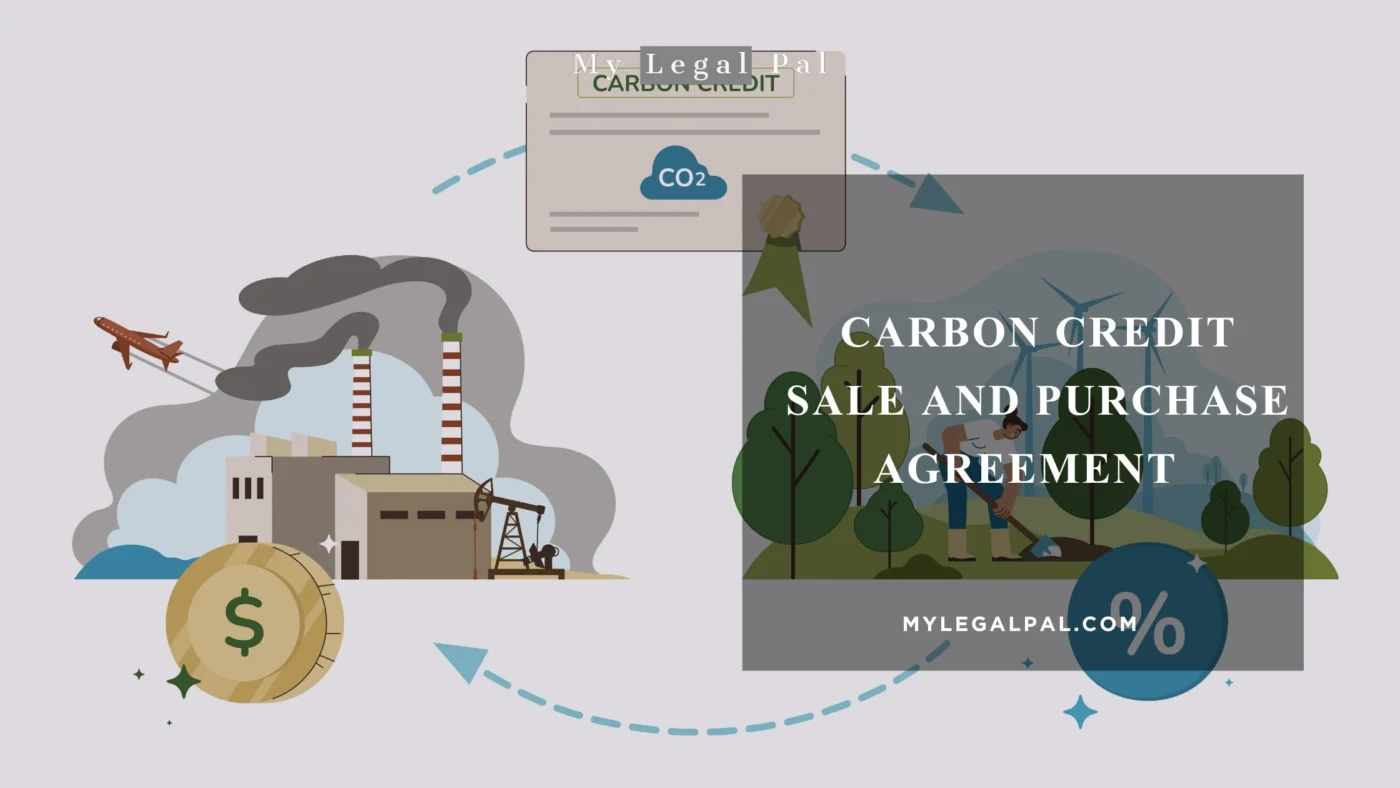
A Carbon Credit Sale and Purchase Agreement (CSPA) is a legally binding contract between a seller (typically a carbon project developer or credit holder) and a buyer (a corporation, fund, or government entity) that governs the transfer of carbon credits or carbon offsets. It sets out the credit specifications, volume, price, delivery obligations, verification standards, and remedies for non-delivery. As voluntary and compliance carbon markets scale globally, the CSPA has become one of the most commercially significant contracts in clean energy and sustainability transactions.
Understanding carbon credits before you sign anything
A carbon credit represents one metric tonne of carbon dioxide (or its equivalent in other greenhouse gases) that has been reduced, avoided, or removed from the atmosphere through a verified project. These credits can be sold to other parties who want to offset their own emissions.
The market splits into two main streams. The compliance market is mandatory. Companies in regulated industries (aviation, heavy industry, power generation) must hold enough credits to cover their emissions under schemes like the EU Emissions Trading System (EU ETS), the UK ETS, California’s Cap-and-Trade program, and others. The voluntary market is optional. Companies buy credits to meet net-zero commitments, sustainability targets, or ESG reporting requirements, typically through registries like Gold Standard, Verra (VCS), or the American Carbon Registry.
Both streams generate transactions, and every serious transaction needs a properly structured legal agreement. The consequences of a defective carbon credit agreement range from failed delivery and wasted capital to regulatory non-compliance and reputational damage. In high-profile cases, buyers have discovered after the fact that credits they paid for were double-counted, non-additional, or simply did not represent the emissions reductions claimed.
The Carbon Credit Sale and Purchase Agreement is the document that draws the legal line between a commercially sound transaction and one that exposes both parties to serious risk.
Why the legal agreement matters more than you think
The carbon market is not like buying listed securities where the terms are standardised and the underlying asset is fungible. Carbon credits differ by project type, registry, vintage year, geography, verification standard, and additionality claim. A credit from a reforestation project in Brazil is not the same legal or commercial asset as a credit from a methane capture project in South Africa, even if both represent one tonne of CO2e.
This heterogeneity means that the legal agreement has to do a lot of heavy lifting. It needs to specify exactly what is being sold, how quality will be verified, what happens if credits are invalidated after delivery, who bears the risk if a registry suspends credits, and how disputes about quantity or quality will be resolved.
Buyers who relied on informal agreements or standard sales contracts not designed for carbon credits have found themselves holding credits that were subsequently invalidated by registries, unable to claim the emissions reductions they paid for, with no contractual remedy. Sellers who did not document delivery obligations carefully have faced claims for non-delivery against project timelines that were genuinely beyond their control.
The CSPA is not just legal housekeeping. It is commercial protection in a market where the underlying asset is complex, the regulatory environment is evolving rapidly, and the reputational stakes are high. Our broader guide on what should be included in every business contract covers the drafting discipline that underlies a well-structured CSPA, even before you get to the carbon-specific provisions covered below.
Buying or selling carbon credits for the first time? My Legal Pal’s specialist commercial lawyers draft Carbon Credit Sale and Purchase Agreements for project developers, corporates, and trading desks across voluntary and compliance markets. Get Your CSPA Drafted at MyLegalPal.com.
Types of carbon credit transactions
Not all carbon credit purchases are structured the same way. Understanding the transaction type shapes the entire agreement:
Spot Transactions
The buyer purchases credits that already exist, have been verified, and are sitting in a registry account. Title transfers on payment. This is the simplest form and most closely resembles a standard asset purchase. Key risks are credit quality, registry status, and whether the credits have been previously retired.
Forward Purchase Agreements
The buyer agrees to purchase credits that do not yet exist, from a project that is still generating or verifying reductions. The seller commits to deliver a specified volume of credits by a specified date. This is common in large corporate net-zero programmes where buyers want to lock in future supply. The legal risk is significantly higher: project failure, delay, insufficient generation, and force majeure all become live issues.
Offtake Agreements
A long-term version of the forward purchase where the buyer agrees to purchase all or a defined portion of credits generated by a project over its lifetime (often 10 to 25 years). These are used to finance project development and require very detailed provisions on minimum delivery volumes, price review mechanisms, change of control, and what happens if the project underperforms.
ISDA-Based Emission Allowance Transactions
In compliance markets, particularly the EU ETS and UK ETS, many transactions are structured under ISDA Master Agreements with the Emissions Annex. This is the preferred structure for financial institutions and trading desks because it provides netting and close-out provisions in the event of default. Understanding whether a transaction falls under ISDA or a standalone CSPA is an important early structuring decision.
Essential clauses in a Carbon Credit Sale and Purchase Agreement
Every CSPA, regardless of market or transaction type, needs to get these provisions right:
Credit Specifications
This is the most important clause in the agreement and the one most often drafted too vaguely. The specification must define the project type (forestry, renewable energy, methane capture, blue carbon, direct air capture, etc.), the registry and standard (Verra VCS, Gold Standard, ACR, Plan Vivo, etc.), the vintage year or range of acceptable vintages, the geography of the project, the serial number range where credits already exist, and any co-benefits or SDG labels attached to the credits. A buyer who receives credits that technically meet a loose specification but not their actual requirements has no recourse without a tight credit spec.
Volume, Delivery and Tolerance
The agreement must state how many credits are being sold, when they will be delivered, what registry account they will be transferred into, and what tolerance range applies if the seller cannot deliver the exact volume. A plus or minus ten percent tolerance is common in forward transactions. What the buyer’s rights are outside that tolerance (price adjustment, partial rejection, or termination) must be explicitly addressed.
Price and Payment
For spot transactions, price is usually fixed at signing. For forward and offtake agreements, you need to address whether the price is fixed for the entire term, whether there is an indexation mechanism (linked to the relevant market price or a published benchmark), minimum and maximum price floors and ceilings, and the payment trigger (upon agreement, upon delivery, or upon retirement of the credits in the buyer’s account).
Representations and Warranties
The seller must warrant that the credits are genuine, verified, unencumbered, not previously retired, not previously sold to any other party, and compliant with the specified standard. These warranties are critical because credit fraud, double-counting, and over-issuance are live problems in voluntary carbon markets. A buyer without strong warranties has no practical legal remedy when problems emerge.
Registry and Delivery Mechanics
The agreement must specify which registry holds the credits, the process for transfer from the seller’s account to the buyer’s account, the cut-off time for delivery on the delivery date, and what constitutes valid delivery. For retirement-only transactions (where the buyer wants credits retired on their behalf rather than transferred), the retirement process and the issuance of retirement certificates must also be covered.
Invalidation and Replacement
What happens if the registry invalidates or suspends credits after delivery? This is one of the most heavily negotiated provisions in voluntary market CSPAs. Some agreements require the seller to replace invalidated credits with equivalent credits of equal or greater quality. Others limit the seller’s liability to the purchase price. The buyer’s exposure to regulatory and reputational risk if credits they have publicly claimed are later found to be invalid makes this clause commercially significant. Our indemnity clause guide covers how to scope a similar risk-allocation provision correctly.
Force Majeure
Carbon projects are real-world activities subject to natural events that can destroy a project entirely. A fire can wipe out a forest project. A flood can render a methane capture facility inoperable. Force majeure clauses in CSPAs need to be drafted more carefully than in most commercial contracts because the seller’s inability to deliver is often entirely foreseeable as a project risk, not a genuinely unforeseeable event. Buyers should resist broad force majeure clauses that effectively transfer all project risk to them. Our complete force majeure clause guide covers exactly how to draft this provision so it protects against genuine risk without becoming an escape hatch.
Governing Law and Dispute Resolution
Carbon credit transactions frequently cross borders: a project in Kenya, a seller registered in Singapore, a buyer in London, credits on a US-based registry. The choice of governing law and dispute resolution mechanism requires careful thought. English law and Singapore law are both commonly chosen for cross-border carbon transactions. Many CSPAs include arbitration clauses given the international nature of the parties and the enforceability advantages arbitral awards carry under the New York Convention. Our guide on arbitration versus litigation in cross-border contracts covers this choice in more depth.
Carbon market frameworks by jurisdiction
Carbon credit transactions operate across multiple legal frameworks simultaneously. Here is a practical overview of the key markets:
European Union. EU Emissions Trading System (EU ETS) is the world’s largest compliance carbon market. Governed by Directive 2003/87/EC as amended. Transactions in EU Allowances (EUAs) are frequently structured under ISDA with the Emissions Annex. The EU Green Claims Directive (2024) affects voluntary credit claims.
United Kingdom. UK ETS replaced the EU ETS post-Brexit. UK Carbon Allowances (UKAs) trade on ICE. Voluntary market transactions follow English law contract principles. FCA oversight applies to certain carbon derivatives. Our contract lawyers in London advise on UK-governed carbon transactions.
United States. No federal cap-and-trade. California’s Cap-and-Trade (AB 32) and RGGI govern compliance credits in specific states. Voluntary market is significant with major registries (Verra, ACR, CAR) headquartered in the US. CFTC has asserted jurisdiction over certain carbon derivatives. Our contract lawyers in the USA advise on US-governed transactions.
Singapore. Singapore Carbon Tax applies to large emitters. International Carbon Credit (ICC) framework allows qualifying credits to offset up to 5% of taxable emissions. ICVCM Core Carbon Principles must be met. Singapore law is frequently chosen as governing law for cross-border Asian carbon transactions. Our contract lawyers in Singapore advise on this market specifically.
Australia. Australian Carbon Credit Units (ACCUs) govern the compliance market under the Carbon Credits (Carbon Farming Initiative) Act 2011. ACCU contracts are enforceable agreements. The Safeguard Mechanism Reform (2023) expanded compliance obligations significantly.
India. India’s Carbon Credit Trading Scheme (CCTS), established under the Energy Conservation (Amendment) Act, 2022, operates on a two-pillar structure worth understanding before drafting a CSPA involving Indian credits or obligated entities. The Compliance Mechanism is mandatory for large emitters: greenhouse gas emission intensity targets, notified in phases by the Ministry of Environment, Forest and Climate Change, currently apply to roughly 490 entities across seven of nine covered energy-intensive sectors (aluminium, cement, chlor-alkali, and pulp and paper notified first, followed by petroleum refining, petrochemicals, and textiles), with the remaining sectors to follow. Obligated entities that beat their targets receive tradeable Carbon Credit Certificates (CCCs); those that miss their targets must purchase and surrender an equivalent number, with non-compliance attracting a penalty of twice the average CCC market price. Trading is expected to launch on CERC-regulated power exchanges by mid-2026, with no over-the-counter trading initially, and unlimited banking of CCCs is permitted while borrowing is not. The separate Offset Mechanism is voluntary, open to non-obligated entities registering eligible emission reduction, removal, or avoidance projects, and this is a critical structural point for a CSPA: offset credits earned under this voluntary mechanism cannot currently be used to satisfy compliance obligations, the two pillars are legally distinct and not interchangeable. Governance is shared between the Ministry of Power (which designates obligated entities on the Bureau of Energy Efficiency’s recommendation), the Ministry of Environment (which notifies the targets), the Bureau of Energy Efficiency (which administers the scheme), and Grid Controller of India Limited (which operates the registry). On the international side, India signed a bilateral Joint Crediting Mechanism agreement with Japan in January 2022 under Article 6.2 of the Paris Agreement, with roughly 15 projects registered as of 2025, and India has separately been in active discussions with Singapore, Switzerland, Sweden, and South Korea on further Article 6.2 cooperative arrangements. A CSPA involving Indian compliance-market credits should explicitly address which pillar the credits originate from, since this determines whether they can be used for compliance purposes at all, and, where Article 6 corresponding adjustments are relevant, whether the necessary host-country confirmation has actually been obtained. Our legal compliance checklist for startups in India is a useful companion for a project developer building out the wider compliance position, and our contract lawyers in India advise on structuring CSPAs against this evolving framework.
Africa (General). Significant project development activity across East and West Africa. Kenya, Zimbabwe, and South Africa have active domestic carbon frameworks. Article 6 bilateral agreements are being concluded between several African nations and buyer countries in Europe and Asia.
Seven mistakes that sink carbon credit transactions
Loose credit specifications that allow the seller to deliver credits that technically comply with the agreement but do not meet the buyer’s actual sustainability or regulatory requirements.
No invalidation or replacement clause, leaving the buyer with no recourse if credits are suspended or invalidated by the registry after delivery.
Treating forward transactions like spot purchases with no provision for delivery failure, delay, or partial delivery.
Overlooking the Article 6 corresponding adjustment requirement for credits that the buyer intends to use against nationally determined contributions under the Paris Agreement.
Broad force majeure clauses that transfer all project execution risk from the seller to the buyer, undermining the commercial rationale for the transaction.
No greenwashing protection, leaving the buyer without contractual assurance that the credits meet the standards they intend to claim publicly.
Choosing governing law without considering enforcement. If the project is in one country, the seller is in another, and the buyer is in a third, the choice of governing law and arbitration seat can determine whether you can practically enforce your rights at all.
Sample Carbon Credit Sale and Purchase Agreement (reference only)
CARBON CREDIT SALE AND PURCHASE AGREEMENT
REFERENCE TEMPLATE ONLY — NOT FOR USE WITHOUT PROFESSIONAL LEGAL REVIEW
This Carbon Credit Sale and Purchase Agreement (“Agreement”) is entered into as of [DATE] (“Effective Date”) between:
Seller: [NAME / COMPANY NAME], a [entity type] of [Jurisdiction / Address] (“Seller”)
Buyer: [NAME / COMPANY NAME], a [entity type] of [Jurisdiction / Address] (“Buyer”)
1. Definitions
“Carbon Credits” means the verified emission reductions, removals, or avoidance units described in Schedule A, each representing one metric tonne of carbon dioxide equivalent (tCO2e) reduced, removed, or avoided.
“Registry” means [Verra / Gold Standard / American Carbon Registry / other] on which the Carbon Credits are registered.
“Vintage” means the year in which the emission reductions or removals represented by the Carbon Credits occurred.
“Retirement” means the permanent cancellation of Carbon Credits in the Registry for the purpose of claiming the associated emission reductions.
“Trigger Event” means the delivery of Carbon Credits to the Buyer’s Registry account, or retirement on the Buyer’s behalf, as specified in Clause 4.
2. Credit Specifications
The Carbon Credits subject to this Agreement shall have the following specifications (“Credit Specifications”), all as further described in Schedule A:
Project Type: [e.g. Improved Forest Management / REDD+ / Renewable Energy / Cookstoves / Methane Capture / Blue Carbon / Direct Air Capture]
Registry and Standard: [Verra VCS / Gold Standard / ACR / Plan Vivo / other]
Vintage Year(s): [Year or range of acceptable years]
Project Location: [Country and region]
Credit Volume: [NUMBER] Carbon Credits (tCO2e) [plus or minus [X]% tolerance]
Co-benefits / Labels: [SDG labels / CCB Standards / other / none]
Serial Numbers (if applicable): [As specified in Schedule A]
The Seller warrants that Carbon Credits delivered under this Agreement will conform to the Credit Specifications in all material respects. Any material deviation from the Credit Specifications shall constitute a Delivery Failure for the purposes of Clause 5.
3. Price and Payment
Purchase Price: [CURRENCY] [AMOUNT] per Carbon Credit (“Unit Price”).
Total Contract Value: [CURRENCY] [AMOUNT] based on [NUMBER] Carbon Credits at the Unit Price.
Payment Terms (select applicable structure):
Option A (Spot): The Buyer shall pay the Total Contract Value within [5 / 10] business days of the Effective Date. Delivery shall occur within [X] business days of receipt of payment.
Option B (Forward): The Buyer shall pay [X]% of the Total Contract Value on the Effective Date as a deposit, with the balance payable within [X] business days of the Delivery Date.
Option C (Delivery vs Payment): Payment and delivery shall occur simultaneously on the Delivery Date through the Registry transfer mechanism.
All amounts are exclusive of applicable taxes. Each party is responsible for its own tax obligations arising from this transaction.
4. Delivery
Delivery Date: [DATE / or “within [X] months of the Effective Date” for forward transactions]
Delivery Method: The Seller shall transfer the Carbon Credits from the Seller’s Registry account ([ACCOUNT ID]) to the Buyer’s Registry account ([ACCOUNT ID]) on or before the Delivery Date.
Alternatively, where the Buyer has requested retirement: The Seller shall retire the Carbon Credits in the Registry in the name of the Buyer on or before the Delivery Date and shall provide the Buyer with official retirement certificates from the Registry within [5] business days of retirement.
Corresponding Adjustments: Where the Buyer requires Carbon Credits to be compliant with Article 6 of the Paris Agreement, the Seller shall provide written evidence that the host country government has made or has committed to make the required corresponding adjustment prior to Delivery.
5. Delivery Failure and Remedies
If the Seller fails to deliver conforming Carbon Credits by the Delivery Date (“Delivery Failure”), the Buyer shall be entitled to:
(a) Grant the Seller a cure period of [30] days to remedy the Delivery Failure;
(b) If not cured within the cure period, reject the non-conforming credits and require the Seller to deliver replacement Carbon Credits of equivalent or greater quality within [30] further days; or
(c) Terminate this Agreement in respect of the undelivered volume and receive a refund of any amounts paid in respect of such volume, plus interest at [X]% per annum from the date of payment.
The remedies above are cumulative and in addition to any other remedies available at law.
6. Representations and Warranties
The Seller represents and warrants that as at the Effective Date and the Delivery Date:
(a) The Seller has good and marketable title to the Carbon Credits, free from all liens, charges, and encumbrances;
(b) The Carbon Credits have not been previously sold, transferred, retired, or otherwise disposed of;
(c) The Carbon Credits comply in all material respects with the Credit Specifications;
(d) The underlying project is registered on the Registry and is in good standing;
(e) To the Seller’s knowledge, no circumstances exist that would reasonably be expected to result in the suspension, invalidation, or revocation of the Carbon Credits by the Registry;
(f) The Seller has full authority to enter into this Agreement and to transfer the Carbon Credits.
7. Invalidation After Delivery
If, following Delivery, the Registry invalidates, suspends, or revokes any Carbon Credits delivered under this Agreement due to circumstances attributable to the Seller or the underlying project (and not due to any act or omission of the Buyer), the Seller shall, at the Buyer’s election:
(a) Replace the invalidated Carbon Credits with equivalent Carbon Credits meeting the Credit Specifications within [60] days of written notice from the Buyer; or
(b) Refund the Unit Price paid for the invalidated Carbon Credits within [30] days of written notice.
This obligation shall survive completion of Delivery for a period of [3 / 5] years.
8. Force Majeure
Neither party shall be in breach of this Agreement to the extent that performance is prevented by circumstances genuinely beyond that party’s reasonable control, including natural disasters, war, pandemic, or government action (“Force Majeure Event”), provided that:
(a) The affected party notifies the other in writing within [10] business days of becoming aware of the Force Majeure Event;
(b) The affected party uses all reasonable efforts to mitigate the effects of and overcome the Force Majeure Event;
(c) If the Force Majeure Event continues for more than [90] days, either party may terminate this Agreement on written notice, and the Seller shall refund all amounts paid in respect of undelivered Carbon Credits.
For the avoidance of doubt, foreseeable project execution risks, including natural risks disclosed in the project design document, shall not constitute Force Majeure Events.
9. Governing Law and Dispute Resolution
This Agreement is governed by the laws of [England and Wales / Singapore / specify]. Any dispute arising out of or in connection with this Agreement shall be resolved by:
Option A (Court): The exclusive jurisdiction of the courts of [Jurisdiction].
Option B (Arbitration): Final and binding arbitration under the [LCIA / SIAC / ICC] Rules, with the seat of arbitration in [London / Singapore / specify] and the language of proceedings being English.
The parties agree that arbitration awards may be enforced in any jurisdiction under the New York Convention on the Recognition and Enforcement of Foreign Arbitral Awards.
Signed as a legally binding agreement on the date first written above.
SELLER: Signature: ________________________ Name: ____________________________ Title: _____________________________ Date: _____________________________
BUYER: Signature: ________________________ Name: ____________________________ Title: _____________________________ Date: _____________________________
This template is published by My Legal Pal for educational and reference purposes only. Carbon credit transactions are complex and jurisdiction-specific. Always engage a qualified commercial lawyer before executing any agreement.
Need a CSPA that actually protects your position? Generic templates do not account for credit specifications, invalidation risk, Article 6 compliance, or cross-border enforcement. My Legal Pal’s carbon markets lawyers build agreements that do. Get a Custom CSPA Drafted at MyLegalPal.com.
Frequently asked questions
What is the difference between a carbon credit and a carbon offset?
The terms are often used interchangeably in the market, but there is a technical distinction. A carbon offset is a broader term for any instrument that compensates for emissions elsewhere. A carbon credit is a specific, quantified unit (one tonne of CO2e) verified under a recognised standard and registered on a formal registry. In a legal agreement, it is important to use precise terminology and attach detailed specifications to avoid ambiguity about what is actually being sold.
Do I need a separate Data Processing Agreement if the CSPA involves personal data?
If the transaction involves the exchange of personal data (for example, employee emissions data, beneficiary information from a community project, or personal information in KYC documentation), GDPR, UK GDPR, India’s DPDP Act, or other applicable data protection laws will require appropriate contractual provisions. For straightforward carbon credit transfers between corporate entities without personal data involvement, a standalone DPA is typically not required. Where one is needed, our DPA template and complete DPDP Act guide cover the requirements in depth. Seek advice if you are unsure.
What happens if the carbon project I bought credits from gets shut down?
This depends entirely on what your agreement says. If the agreement includes an invalidation and replacement clause, the seller is contractually obliged to replace your credits or refund you. If the agreement is silent on this, your remedies depend on general contract law and whether you can establish that the seller breached a warranty. This is one of the strongest arguments for insisting on robust invalidation provisions in any CSPA, particularly for forward and long-term offtake transactions.
What is additionality and why does it matter for the agreement?
Additionality is the principle that the emissions reduction would not have happened without the carbon finance provided by selling credits. Credits from non-additional projects (activities that would have happened anyway) are considered low quality and may not meet the substantiation requirements for public net-zero claims under frameworks like the VCMI Code. Your credit specification clause should explicitly require additionality in accordance with the relevant standard (Verra VCS, Gold Standard, etc.) to protect against this risk.
Should forward carbon credit contracts include price review mechanisms?
For any forward contract longer than two to three years, some form of price review or reopener mechanism is commercially sensible. Carbon markets are volatile and prices in voluntary markets have swung dramatically. A fixed price over a ten-year offtake agreement can become commercially problematic for either party if market prices diverge significantly. Common approaches include price floors and ceilings (collars), periodic benchmarking against published indices, and mutual reopener rights at defined intervals.
Is ISDA or a standalone CSPA better for compliance market transactions?
For financial institutions and trading desks transacting in EU ETS, UK ETS, or other compliance allowances, ISDA with the Emissions Annex provides standardisation, netting, and close-out netting protections that a standalone CSPA does not. For project developers and corporate buyers transacting in voluntary markets, a well-drafted standalone CSPA is typically more appropriate and more flexible. The right answer depends on your counterparty, transaction volume, and whether you need the netting protections that ISDA provides.
Do carbon credits attract VAT or other taxes?
This varies significantly by jurisdiction and transaction structure. In the EU, carbon allowances are subject to VAT and specific anti-fraud provisions apply. In the UK, HMRC has issued guidance on the VAT treatment of carbon credits that distinguishes between different credit types. In Australia, ACCUs attract specific GST treatment. In most voluntary market jurisdictions, the tax treatment is still evolving. Tax advice specific to your transaction is essential before signing, not after.
Can offset credits under India’s CCTS be used to meet compliance obligations?
No, and this is a critical structural point to get right in any CSPA involving Indian credits. India’s Carbon Credit Trading Scheme operates two legally distinct pillars: the mandatory Compliance Mechanism and the voluntary Offset Mechanism. Credits earned under the Offset Mechanism cannot currently be used to satisfy obligations under the Compliance Mechanism; the two are not interchangeable. A CSPA should explicitly state which pillar the credits originate from and confirm they are eligible for the buyer’s intended use.
The carbon market is growing. The legal risk is growing with it.
Carbon markets globally are expected to reach hundreds of billions of dollars in annual transaction value within this decade as corporate net-zero commitments translate into purchasing programmes and compliance frameworks tighten. The legal infrastructure supporting those transactions has not kept pace with the commercial activity.
Buyers are making public sustainability claims based on credits whose legal title, quality, and permanence have not been properly documented. Sellers are making delivery commitments without understanding what happens legally if the project underperforms. Project developers are entering offtake agreements that leave them exposed to liability for events entirely beyond their control.
A well-drafted Carbon Credit Sale and Purchase Agreement does not just protect you in a dispute. It forces both parties to think clearly about what they are actually buying and selling, what risks they are accepting, and what the remedies are when reality does not match the project model. That clarity is valuable even when everything goes to plan.
Practical note: If you are a corporate buyer purchasing credits to support a public net-zero or carbon neutral claim, make sure your CSPA includes explicit warranties that the credits meet the VCMI Core Carbon Principles or your specific framework’s requirements. Greenwashing claims are increasingly being pursued by regulators and NGOs, and a contractual warranty from your seller is your first line of defence.
Authored and reviewed by Prakhar Rai, Advocate, founder of My Legal Pal. With over a decade of experience in business environments and corporate advisory, Prakhar recognised the need for structured, commercially grounded legal strategy that aligns with how modern companies actually operate. As cross-border transactions, digital platforms, and regulatory overlap became more common, he built a practice that prioritises foresight, clarity, and strategic positioning over routine documentation. A graduate of La Martiniere College, holding an LL.B and a Master of Business Laws from the National Law School of India University, Bangalore, with specialisation in Corporate, Banking, Intellectual Property, Finance, and Securities Laws, Prakhar combines strong academic foundations with practical advisory experience. Connect on LinkedIn.
This article is general information, not legal advice. Carbon credit transactions are complex and jurisdiction-specific. Always seek professional legal advice specific to your business and circumstances.
Need a CSPA that actually protects your position? Our contract drafting and contract review and revision services build agreements that account for credit specifications, invalidation risk, Article 6 compliance, and cross-border enforcement. Speak to our contract lawyers in India, the USA, UK, or Singapore.